
I think with the comment about expats you have cornered the market on that.
Good Morning Sunday 4th October 2026
Why university are always avoiding responsibility? And can’t be held accountable?


In recent years, the world has witnessed a refugee crisis that has forced more than a million men, women and children to flee the brutal violence in their own countries. Yet despite the life-threatening situations they face, these refugees (including children) have often been met with a degree of suspicion and fear in the nations they have escaped to.
Author Barbara Fox, whose own mother was evacuated from inner-city Newcastle as a child, wonders what the difference between Britain's long-ago children and today's refugees is?
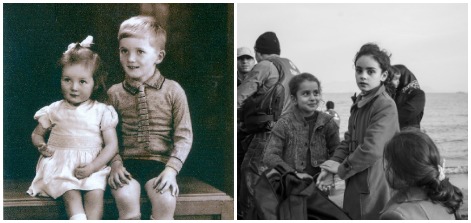
Are today's refugees really any different?
When I read a headline recently about the outrage of a 'picturesque' village to which 70 'child migrants' were to be sent, I was reminded of another time in our history when places in the countryside were obliged to welcome strangers into their midst.
Back in 1940 when she was six years old, my mother, Gwenda, and her older brother, Doug, were among the hundreds of thousands of children who left their inner-city homes and were evacuated to the countryside to escape the German bombs.
Gwenda's main memory of her journey from Newcastle to the Lake District centres round the banana she was given to eat by her mother – the last she was to see for several years. A teacher ordered the children to sit on their bags, and consequently, when Gwenda came to unpack later, she found squashed banana over all her belongings.
On arrival in the pretty village of Bampton they were lined up in the church hall while the villagers came to choose who they wanted. Yes, it does seem unbelievable that that was how the evacuees were billeted to their families! You might imagine that Gwenda and Doug – clean, nicely dressed children - would have been snapped up first (they would surely be the refugees that no one would protest about today!). But actually, that was not the case. Gwenda was the youngest child there as she was tagging along with Doug and his class of nine-year-olds - their mother had insisted that the pair should not be separated. Consequently, the locals were expecting older children, and someone of Gwenda's size probably didn't look very useful in this farming community.
Were these home-grown children that our rural communities welcomed back then really so different from the oft-maligned refugee children today?
Gwenda and Doug were the only children left when the wife of the village headmaster arrived. As the mother of two sons, she had to be persuaded to take a girl. However, she relented, and so the children went home with her. They would spend three happy years living in the schoolhouse and Gwenda would keep in touch with the couple she called 'Aunty' and 'Uncle' for the rest of their lives.
The following year, in more desperate circumstances, Bampton opened its doors to another influx of children, this time from the shipbuilding town of Barrow-in-Furness.
Undoubtedly thousands of lives were saved by this evacuation of the nation's children, and indeed, Gwenda and Doug's own street in Newcastle was bombed.
Britain also welcomed refugees from Europe, including thousands of Jewish children who might otherwise have perished.
Were these home-grown children that our rural communities welcomed back then really so different from the oft-maligned refugee children today? I would go so far as to say that the inner-city children who turned up in Bampton were often just as alien to their rural hosts as the foreign newcomers seem to be to the 'picturesque' village dwellers. But equally, both could teach something to the other.
Those harking back to 'when Britain was great' perhaps forget that it was also characterised by our opening our doors to those in need.
When the War Is Over by Barbara Fox, the story of Gwenda’s wartime evacuation, is published by Sphere and is available from Amazon.
By Barbara Fox
Twitter: @Gransnet
I think with the comment about expats you have cornered the market on that.
I would entirely ignore that if I were you jess  or else she'll have a platform for more veiled racism and hate
Welshwife the nightmare scenario is that all the hard working, tax paying, healthy young Poles and Spaniards go home
Not a cat in hell's chance!
*and we get back a lot of sun baked ex-pats, very disgruntled that their lifestyle has been disrupted, and wanting their skin cancers and liver problems dealt with forthwith. (No offence intended to you lovely expat members by this use of poetic licence)
That is NOT 'poetic licence' its a vile and racist stereotype of a large group of older British people.
Disgraceful.
Welshwife the nightmare scenario is that all the hard working, tax paying, healthy young Poles and Spaniards go home and we get back a lot of sun baked ex-pats, very disgruntled that their lifestyle has been disrupted, and wanting their skin cancers and liver problems dealt with forthwith. (No offence intended to you lovely expat members by this use of poetic licence  )
)
DJ said
*There IS a big shortage of people wanting to work in the NHS.
There is already a shortage of people already working in the NHS*
DJ like so many people fails to understand the difference between not wanting to work in the NHS and not being qualified to work in the NHS.
There IS a shortage of qualified nurses and doctors (at least in some areas and for some roles)
There is NO shortage of people who want to train to work in the NHS but they cannot get onto a degree course or training job.
Jess even the drop in applicants for nursing does not mean everyone who is keen to train as a nurse will be offered a place, there imply arent enough places.
Unless the shortage of nursing applicants was so great that places have to be left unfilled then there is NO argument, in a time of financial pressure, for tax payers to be funding the training of nurses. The money saved would be far far better spent elsewhere in the NHS .
I realise some people find it hard to get their heads around this, but I have put it as simply as possible (even a presenter on the Radio who had subscribed to the myth that British people dont want to work in the NHS had to be corrected by a nurse caller).
Its a wicked misrepresentation of British people but one loved by the open borders squad who realise that 'the NHS needs more immigrants' has proven quite an effective excuse for their extremist stance.
People forget that migration is two ways - not only do countries agree/need/ wish to have migrants particularly in areas where they are short of skills - but the migrants also wish to apply to go there. From what I have seen from people in the UK now or those considering going - the uncertainty, racism and also not being able to have permanent residency having contributed to the system for over twent years, is making people decide to leave UK and go somewhere else within the EU or not move to UK in the first place.
That jess is what the white paper is saying if you read between the lines. A reduction in immigration will not necessarily be desirable.
Stephen Crabbe (he who entered the Tory leadership campaign) on immigration and why Brexit is unlikely to lead to a reduction. And why it would be a bad idea.
Never thought I'd agree with him but I do.
www.theguardian.com/commentisfree/2017/feb/03/uk-honest-migrants-rights-brexit-britain
The white paper makes it clear that there will be continual free movement for the foreseeable future and certainly into and beyond 2019. This is almost certainly in recognition of the lobbying from certain businesses in the UK and the severe difficulties that they will encounter if this source of labour ceases in 2019. They are also ,ore than aware that free movement might be a factor in negotiations.
DJ another reason to think of moving north??????
Yes all those poor people who were thrown out by Idi Amin!
Yes, mcem, I am guilty of forgetting that NHS means NHSE. I'll have to remember that in future.
Meant to add that last year the Scottish government said that bursaries would be protected in Scotland.
'Those harking back to 'when Britain was great' perhaps forget that it was also characterised by our opening our doors to those in need.'
Those in need, not just those we need.
For those who think it's okay for Syrian children to go to countries around Syria, rather than to Europe.
www.globalcitizen.org/en/content/syrian-refugee-children-work-irc/
Woulod you like your grandchildren to have to work for ten hours a day?
Unrewarded not unreserved!
I think pen that we're in agreement in that prospective nurses will now have to repay loans while at the same time they're unable to get that top-up supplement that weekend and holiday working would give them as they have to be available for shifts. It also means of course that their valuable contribution on wards goes unreserved in financial terms. I always thought that bursaries were there to bridge that gap.
2231 Nurses All jobs in this occupation code
From the 2017 lists, just in case anyone wants to argue.
That means even more shortages now. I've seen lots of interviews with nurses who are asylum seekers or refugees.
www.gov.uk/government/uploads/system/uploads/attachment_data/file/486107/Shortage_Occupation_List_-_November_2015.pdf#%5B%7B%22num%22%3A1364%2C%22gen%22%3A0%7D%2C%7B%22name%22%3A%22XYZ%22%7D%2C47%2C585%2C0%5D
Shortage occupation lists from the government website.
This means anyone working in these occupations should be able to work in this country. As I said before, I wonder how many refugees could apply for jobs in these occupations if only they were allowed to.
Unfortunately there is so much suspicion around the subject since Brexit, we must be missing out on filling lots of vacancies.
Sorry, Jess, Mair doesn't believe that.
I may be wrong mcem but I thought , until the recent change, that nurses did not pay back any monies paid to them whilst training. That was always supposed to make nursing training attractive to some as they were not left with a debt to pay back once they had qualified. Which, in case anyone thinks I am saying otherwise, is a good thing!
While most university students - teaching or anything else - can use holidays to take on a job during holidays or weekends, nurses are obliged to be on hospital placements, ie working on wards, when not attending classes. They therefore do not have the opportunity to top up loans/grants etc that other students do.
Sad to note this week that there is a big drop in applications for nursing degrees this year, since Jeremy Hunt removed bursaries. Student nurses have to work 50% of the time while doing degree.
www.theguardian.com/education/2017/feb/02/nursing-degree-applications-slump-after-nhs-bursaries-abolished
Why do you never believe anything you read, Mair?
There IS a big shortage of people wanting to work in the NHS.
There is already a shortage of people already working in the NHS.
www.telegraph.co.uk/news/2017/02/03/nhs-out-of-hours-services-have-run-without-single-doctor-1-10/
The new STPs are planning for cuts in GPs, not increasing the number of doctors.
www.telegraph.co.uk/news/2017/01/31/warning-cuts-family-doctors-nhs-overhaul/
Cutting the number of immigrants who want to work in the NHS is only going to exaccerbate the problems we have now.
It would be interesting to know how many refugees waiting for asylum are actually medically trained.
I wonder if there are any figures for that.
That is an interesting perspective Mair and not one i have come across.
It certainly is not the case in education where there has been a decline in British applicants to train as teachers. Hence the various incentives by successive governments to induce people to go into teaching and the large recruitment campaigns overseas.
This discussion thread has reached a 1000 message limit, and so cannot accept new messages.
Start a new discussion
Get our top conversations, latest advice, fantastic competitions, and more, straight to your inbox. Sign up to our daily newsletter here.
