


How do you suggest we do that at the moment, as you say nobody is suggesting we send them all home?
A prblem with logic again, Mair.
Unwanted immigration by whom?
Oh, yes, you, of course, even though, in your words you are not suggesting sending them all home.
Only 3% of the world's immigrants are in this country.
Food security? We haven't had that for decades.
Like I said, we import 90% of our fruit.
Gransnet forums
Blogs
The wrong kind of refugee?
In recent years, the world has witnessed a refugee crisis that has forced more than a million men, women and children to flee the brutal violence in their own countries. Yet despite the life-threatening situations they face, these refugees (including children) have often been met with a degree of suspicion and fear in the nations they have escaped to.
Author Barbara Fox, whose own mother was evacuated from inner-city Newcastle as a child, wonders what the difference between Britain's long-ago children and today's refugees is?
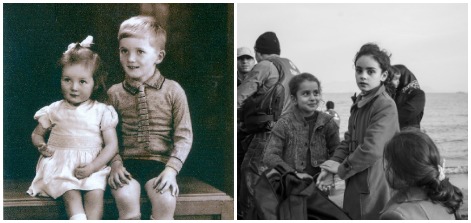
Are today's refugees really any different?
When I read a headline recently about the outrage of a 'picturesque' village to which 70 'child migrants' were to be sent, I was reminded of another time in our history when places in the countryside were obliged to welcome strangers into their midst.
Back in 1940 when she was six years old, my mother, Gwenda, and her older brother, Doug, were among the hundreds of thousands of children who left their inner-city homes and were evacuated to the countryside to escape the German bombs.
Gwenda's main memory of her journey from Newcastle to the Lake District centres round the banana she was given to eat by her mother – the last she was to see for several years. A teacher ordered the children to sit on their bags, and consequently, when Gwenda came to unpack later, she found squashed banana over all her belongings.
On arrival in the pretty village of Bampton they were lined up in the church hall while the villagers came to choose who they wanted. Yes, it does seem unbelievable that that was how the evacuees were billeted to their families! You might imagine that Gwenda and Doug – clean, nicely dressed children - would have been snapped up first (they would surely be the refugees that no one would protest about today!). But actually, that was not the case. Gwenda was the youngest child there as she was tagging along with Doug and his class of nine-year-olds - their mother had insisted that the pair should not be separated. Consequently, the locals were expecting older children, and someone of Gwenda's size probably didn't look very useful in this farming community.
Were these home-grown children that our rural communities welcomed back then really so different from the oft-maligned refugee children today?
Gwenda and Doug were the only children left when the wife of the village headmaster arrived. As the mother of two sons, she had to be persuaded to take a girl. However, she relented, and so the children went home with her. They would spend three happy years living in the schoolhouse and Gwenda would keep in touch with the couple she called 'Aunty' and 'Uncle' for the rest of their lives.
The following year, in more desperate circumstances, Bampton opened its doors to another influx of children, this time from the shipbuilding town of Barrow-in-Furness.
Undoubtedly thousands of lives were saved by this evacuation of the nation's children, and indeed, Gwenda and Doug's own street in Newcastle was bombed.
Britain also welcomed refugees from Europe, including thousands of Jewish children who might otherwise have perished.
Were these home-grown children that our rural communities welcomed back then really so different from the oft-maligned refugee children today? I would go so far as to say that the inner-city children who turned up in Bampton were often just as alien to their rural hosts as the foreign newcomers seem to be to the 'picturesque' village dwellers. But equally, both could teach something to the other.
Those harking back to 'when Britain was great' perhaps forget that it was also characterised by our opening our doors to those in need.
When the War Is Over by Barbara Fox, the story of Gwenda’s wartime evacuation, is published by Sphere and is available from Amazon.
By Barbara Fox
Twitter: @Gransnet
Penstemon
Always a pleasure to respond to reasonable posts not abusive rants!
Yes I do agree that there are interim issues. This could be relieved , if not completely solved, by employing suitably skilled foreigners on short term contracts and visas. I have explained this before, many professional BRits work in Dubai, Singapore, Australia and other places on fixed term contracts, indeed even many of those in EU countries are not employed in permanent secure jobs.
Of course BRitain would be a less attractive destination if permanent settlement was not an option but not so unattractive that we couldnt attract enough IMO. For a European or non EU doctor a spell working in a British hospital would greatly enhance their CV.
It also has the huge advantage of pinning them into the hard to fill job which they originally applied to do.
Food security? We haven't had that for decades
We havent but it has been getting worse since the 80s.
Are you by any chance suggesting that we send all refugees/asylum seekers home? You want to keep the hard workers, but refugees/asylum seekers aren't allowed to work in the UK until their claims have been sorted, which often takes over two years.
Flipping heck, Mair, that comes straight of an old Empire manual.
Who shall we keep, and who shall we not?
Who will work hardest for our country?
Not a shred of humanity in it.
Youre a very forgetful poster DJ, I have said several times nobody is suggesting sendding those who are legal and settled here home.
Illegals are another story of course though not germane to this thread.
You want to knopw how to reduce the population?
Bring total gross immigration down to 'tens of thousands'. Allow emigration to continue freely, result, negative population growth (using ONS figures).
We would have more food security if we stayed in the EU, particularly when you consider how much of our food comes from the EU - and how much of the rest is picked by EU immigrant labour.
Mair, even normal Brexiteers have realised that it's impossible to bring down immigration to tens of thousands.
Negative population growth like that will not reduce the population by enough to cope with food shortages like we are experiencing at the moment.
Again, your post does not mention refugees or asylum seekers, which is what the thread is about.
I suppose there are people who take the Sun seriously...
Though I don't think we'll ever be self sufficient in cheap winter salad produce. 
Mair, even normal Brexiteers...
You do not speak for 'normal Brexiters' DJ whatever you mean by that.
If the will is there it can be done.
“Impossibilitarians are defeated before the battle even begins".
The intention is to take the student numbers out of the immigration figures that will make a huge difference.
Bout bloody time whitewave. The fact that May was the minister in charge of trying to reduce immigration for so many years, failing to meet the target she had presumably agreed to, without getting the student numbers out of the mix, does not fill me with admiration for her ability.
Not popular with university vice chancellors, to say the least. She dies not seem to grasp that that foreign students are "an export" not "immigration".
Neither does she grasp that hanging onto the brightest ones, particularly in science and technology, is essential for the future of the economy.
They have also helped to keep Master's degree courses viable over the last few years.
As this thread is about refugees, not immigration, can I just make it clear that I feel the UK has not accepted as many refugees as I feel we should and could have done.
Thanks for bringing us back to the point Pentstemmon - I agree absolutely.
Disgraceful food dragging, particularly when it came to the kids in France with families here. Bit if a flurry when the "jungle" closed and there was a lot of pressure, and then dead stop again. These are young people who are legally allowed to come here under the Dublin agreement and the Dubs amendment.
Again, Mair, you do not mention refugees or asylum seekers.
Why not?
Friend works in border force and the stories I hear are ridiculous. Of course tighter controls need to be in place. And yes! there are the wrong kind of refugees/asylum seekers in a manner of speaking. Plenty of them actually. Genuine cases, of course, need to be looked at. The rest, no.
*you do not mention refugees or asylum seekers.
Why not?*
Er , it's not compulsory in every post DJ!
stillaliveandkicking
Good to see some common sense among all the virtue signalling.
80% of migrants entering Germany have NO documents. Most are not Syrians, the largest group being Pakistani and three quarters are young men under thirty five.
According to a BAMF study (Asylerstantragstelle
und Berufstätigkeit) only 18 percent of asylum applicants hold a university degree, 20 percent have attended a high school, approximately one-third a secondary school and 22 percent a primary school. Seven percent of migrants have no formal education at all. The majority had previously been agricultural laborers or self employed.
Undoubtedly once given rights of settlement many of the uneducated will head for Britains less regulated job market unless we get out of the EU quickly!
Mair, I've looked back over the last 150 posts, many of which you have written, and you have not mentioned asylum seekers or refugees once until this last post.
Only 18% of asylum seekers hold a degree. Why only? That seems quite a lot to me.
What's the difference between a high school and a secondary school?
How can one third attend a secondary school, yet only 22% attend a primary school? That does not make sense to me.
Can you give a link?
www.bamf.de/SharedDocs/Anlagen/EN/Publikationen/Kurzanalysen/kurzanalyse3_sozial-komponenten.pdf?__blob=publicationFile
Here you go.
I assume by high school they mean like a French lycee, and secondary only to age 15.
Precedes the 2016 Syrian migrant crisis.
What are you talking about Jess? It was March 2016 over a million migrants had already crossed into Europe.
The days offering of anti immigrant anti refugee anti asylum twaddle rhetoric now begins. Bordering on obsession.
Publication may have been March 2016, but the stats quoted all seem to be 2015.
Thanks, Mair.
The figures were for asylum seekers in 2015. It says so. Jess is right.
It also explains why asylum seekers want to come to the UK. A third of them have some knowledge of English, but only 2% know some German.
Whitewave, at least Mair is talking about asylum seekers now.
This discussion thread has reached a 1000 message limit, and so cannot accept new messages.
Start a new discussion
