Gransnet forums

Chat

UK State Pension - Is it really enough?

(112 Posts)
Cossy Mon 13-Jul-26 09:27:31

I’ve been thinking about our UK state pension.

Forget the funding of it for a moment.

So currently UK minimum wage is £12.71 (I believe) which equates to approx £24,000 (before tax) annually.

I believe current single person SP works out at approximately £12,500 annually.

So, bearing in mind that I am assuming minimum wage is calculated based on what our government believes is the minimum amount of money the average person requires to live, isn’t setting the SP at the current rate just a tad insulting?

I understand that most pensioners might have repaid their mortgages but many have rent, but we still have many of the same costs as prior to retirement. Given that there are still some who don’t have massive private pensions yet don’t qualify to any other financial help.

Do we think the SP should actually be set to mirror minimum wage?

(Ignoring the fact that the country cannot afford this, nor according to some even maintain it at the current rate)

Graphite Tue 14-Jul-26 13:02:49

I was struck by how relatively few additional households successfully claimed Pension Credit as a result of the withdrawal of universal Winter Fuel Payment in 2024.

We were lead to believe, based on DWP statistics, that over 800,000 household were eligible but not claiming. Martin Lewis was shouting about it on national TV but …

Our Pension Credit campaign has seen over 56,000 households awarded Pension Credit in one year (29 July 2024 – 27 July 2025) when compared to the previous year.

The average award was: £114.99 p.w. for a couple and £78.23 p.w. for a single pensioner.

www.gov.uk/government/news/fresh-drive-to-boost-pension-credit-take-up-as-new-figures-reveal-large-regional-gaps-in-those-receiving-benefit-worth-around-4300-a-year

So we are talking roughly £6,000 a year extra income for a couple and £4,000 for a single pensioner.

That 800,000+ was a number extrapolated from an annual survey conducted on behalf of the DWP.

Either there is something wrong with the survey data and methods or hundreds of thousands of households are still not claiming what they are entitled to.

Norah Tue 14-Jul-26 12:41:30

Graphite That people need to claim all these extras just to live at a very minimum standard is both a faff and administratively expensive - Pension Credit, Housing Benefit, Council Tax Discount plus the data sharing that has to go on to get Warm Home Discount or proof of entitlement to get free eye and dental care or a TV Licence.

The notion that we “paid in” for a State Pension is ridiculous when millions of people receive Category B, C and D pensions that they did not pay NIC for, plus the other systems to credit periods of not working e.g. Home Responsibilities Protection and NIC credits.

By and large we have had and continue to have decent safety nets. Why not make that net a higher universal one to save all the administrative overload and cost?

I agree.

Administrative costs are undoubtedly high, people are reticent to claim -- higher universal safety nets (and minimum wage) may help.

Graphite Tue 14-Jul-26 10:59:15

It’s much easier with two incomes. I’ve already posted links to government numbers which show that, even after housing costs, couples have income which is on average £328 per week more per week than single people. £17,000 per annum more than a single person. That’s a lot of money and more than the £15,000 that Cossy is suggesting as a universal basic income.

Many on just a State Pension will end up with that amount anyway when all the benefits they can claim are added in. That sum equates to expenditure that Retirement Living Standards say is required for a minimum lifestyle after tax is taken into account.

That people need to claim all these extras just to live at a very minimum standard is both a faff and administratively expensive - Pension Credit, Housing Benefit, Council Tax Discount plus the data sharing that has to go on to get Warm Home Discount or proof of entitlement to get free eye and dental care or a TV Licence.

The notion that we “paid in” for a State Pension is ridiculous when millions of people receive Category B, C and D pensions that they did not pay NIC for, plus the other systems to credit periods of not working e.g. Home Responsibilities Protection and NIC credits.

By and large we have had and continue to have decent safety nets. Why not make that net a higher universal one to save all the administrative overload and cost?

Usedtobeblonde Tue 14-Jul-26 10:32:58

I thought Vivaldi was doing well until she mentioned a husband.
What a difference that makes.

TheatreLover Tue 14-Jul-26 09:51:20

Padstow13

valdali

I'm fine on £10, 600 per year my occupational pension.
I sell a few things on Ebay & have savings I could use till I get my state pension in 18 months time at 67.
DH works & pays our council tax & most utilities, but I buy 95%
of food & household items, pay half tradesmen's bills, pay for our holidays, run a car, pay all the vets bills.
We're in an "expensive" area. I thought I would be dipping in to my savings, but so far I seem to have enough for what I want.

I can't see the logic in the state paying people the same p.a. whether they're top earners & single, or unemployed with 2 children & additional costs associated with disability, Cossy? Is this what you meant? I might be missing something....

"I'm fine......." Jaysus, then thank your lucky stars.

Why do foodbanks still exist (and multiply) and why do very many, including pensioners, thank THEIR lucky stars for them?

Is it the difference between those living in a relationship, sharing costs, and those who live on their own?

Obviously, singletons pay 100% for their food, household items, tradesman's bills, utilities, holidays etc (and singletons pay the same charge for a hotel room that a couple sharing pay).

Erica23 Tue 14-Jul-26 07:44:24

Plevey08

Why did you not get any of your ex husbands pension? Sounds like you were the one at home with disabled child and your now suffering financially.
A friend of mine aged sixty divorced many years ago, has been to a solicitor and been awarded a substantial sum from her ex’s pension pot. Maybe it’s not too late.

Padstow13 Tue 14-Jul-26 02:22:14

valdali

I'm fine on £10, 600 per year my occupational pension.
I sell a few things on Ebay & have savings I could use till I get my state pension in 18 months time at 67.
DH works & pays our council tax & most utilities, but I buy 95%
of food & household items, pay half tradesmen's bills, pay for our holidays, run a car, pay all the vets bills.
We're in an "expensive" area. I thought I would be dipping in to my savings, but so far I seem to have enough for what I want.

I can't see the logic in the state paying people the same p.a. whether they're top earners & single, or unemployed with 2 children & additional costs associated with disability, Cossy? Is this what you meant? I might be missing something....

"I'm fine......." Jaysus, then thank your lucky stars.

Why do foodbanks still exist (and multiply) and why do very many, including pensioners, thank THEIR lucky stars for them?

Graphite Mon 13-Jul-26 22:12:31

J52. If you were in pension scheme which opted out of SERPS then you should receive a Guaranteed Minimum Pension (GMP) within your workplace pension equivalent to the Additional State Pension you would have received had your scheme not contracted out. It’s complicated but that’s the basic premise.

Former Pensions Minister Steve Webb explains more here:

www.lcp.com/media/1150050/why-is-money-being-deducted-from-my-state-pension.pdf

When governments plan and legislate for pensions it’s presumably done on the basis that people will lead straightforward lives and be fully employed for the requisite number of years to get the most benefit (literally) from the system.

The old system required a man to work and pay NIC for 44 years and a woman 39. Following equalisation, that’s 35 years for both. As SP age rises that hasn’t been increased. This factors in that many young people now don’t enter the workplace until 21 when once it would have been 14, 15 or 16 for most. I think that 35 years is still fairly generous as age 21 to 67 is 46 years so allow for 11 years out of the workplace.

What it isn’t factoring in complex life changes, sustained periods of unemployment, poor health and caring responsibilities of the sandwich generation caught between child care and caring for elderly parents. More often (but not always) it is women who are worst affected as Plevey describes.

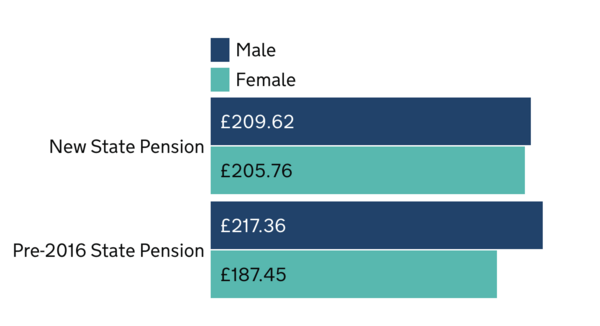
The graphic show DWP numbers from February 2025 when the New State Pension was £221.20. It shows that most people, whichever system they are on, receive less that a full pension with women lagging behind for obvious reasons. Someone with no other income would have had that topped up with Pension Credit to the then ceiling of £218.15 a week and could claim other benefits in addition which, as I said before, could bring someone’s income close to Cossy’s number of £15,000.

www.gov.uk/government/statistics/dwp-benefits-statistics-august-2025/dwp-benefits-statistics-august-2025

www.gov.uk/government/publications/benefit-and-pension-rates-2024-to-2025/benefit-and-pension-rates-2024-to-2025#pension-credit

I think pensions are always going to be messy, simply because people’s lives are messy in all sorts of ways and one size is never going to fit all. Governments can try to push the system to more reliance on workplace pensions but if fewer people are working and those who are working are opting out then the problems aren’t going to go away.

Moreover, workplace pension scheme are very vulnerable to market shocks as we saw in 2022 when they nearly failed. A Reform government is predicted to have the same effect and would let them fail as under them there would be no quantitative easing to shore them up. That’s very worrying.

Your idea is a good one, Cossy, but it isn't going to happen even if the net affect of simplification was no overall cost. I wonder if people realise how administratively expensive means testing is?

Any attempt to do what you suggest would be met by a barrage of commentators who rather enjoy stoking generational warfare and the notion that one person's pocket is being picked to pay for someone else's free ride. I expect most have little clue as to how the State Pension system has been operating and evolving over the last 100 years and the social and political factors and events which have given rise to such a range of disparities.

Cossy Mon 13-Jul-26 21:44:40

Graphite and M0nica

You’ve both raised great points.

I’m happy to say that 4 out 5 of our adult children have good private pension provision and none would ever op out, our youngest at 24 is a self employed musician so .. 🤷🏻‍♀️🤷🏻‍♀️

I don’t have the answers, but I do know I’d not like to see any pensioner living in abject poverty, irrespective of whether they’d spent their working life in paid work or not.

My MiL is a prime example, three children by the time she was 22, married and living in Southern Ireland, in what what then a very small seaside town, with little work. Long story short, developed/diagnosed with schizophrenia, moved with husband to England for work, domestic abuse, sectioned several times then electro-therapy in the 60’s completely wrecked her. So fast forward to now and she’s in a fully funded dementia home. No property to sell, very little savings, lots of small non pensionable jobs when she was well.

Thank goodness for the welfare state.

Plevey08 Mon 13-Jul-26 20:34:02

That was very informative Graphite. I am not a bitter person but we still live in a patriarchal society. I brought my 2 children up after a divorce when my children were still young.My eldest is disabled. My ex-husband was on a very good income. He got away with paying very little maintenance during their childhood. I didn't get any part of his pension. So I worked my butt off, got back into teaching and brought my kids up. He is very comfortably off now. But I'm certainly not. I'm retired but still have a mortgage. I didn't work for several years before we divorced, too difficult with a disabled child, so missed years of paying NI. I just get by. There are different circumstances for many. But I do think we should receive the minimum wage.

Deedaa Mon 13-Jul-26 20:15:27

I get by with my pension because my mortgage is paid off. I don't know how people manage if they have rent or mortgage payments to find.

J52 Mon 13-Jul-26 20:04:19

Thank you Graphite for pointing out my error. I was in an industry that opted out of SEPS, so I really wasn’t aware of the implications.

M0nica Mon 13-Jul-26 19:58:58

The simple answer is we cannot afford it in either the short or long term. We are already being held back by the huge cost of welfare benefits and with fewer and fewer children being born there will simply not be a taxpayer base sufficient to meet the cost of higher pensions.

In 1950, there were approximately 5 working-age people for every one retired person. By 2070, the Office for National Statistics (ONS) expects this fallen to about 2 workers for every pensioner.

The reason so many legal immigrants ( the vast majority) were invited or came her was because we simply did not have enough younger people, especially in the health industry, to meet the needs of the current population and had to go overseas. This goes right back to the Windrush generation who came over to feed London Transport's need for bus crews.

Now young immigrants are needed to help pay for older people's pensions.

Graphite Mon 13-Jul-26 19:46:04

No, not wrong at all, Cossy.

Retirement Living Standards publish annually what expenditure is needed for people to live a minimum, moderate of comfortable lifestyle. Important to make that distinction about their numbers. That it’s not income.

www.retirementlivingstandards.org.uk/

They say the minimum expenditure for a single person outside London is £13,900 - which again post-tax would roughly equate to your £15,000 income benchmark.

Then RLS leap to expenditure of £32,700 for a moderate lifestyle but even then, what they are describing as moderate is not excessive.

The thing they underestimate, in my opinion, is what is costs to keep one’s home in good order or what’s needed as a contingency - something which worries a lot of people at they get older and don’t have much spare cash.

For the person living on the minimum, RLS factor in only £200 and DIY. I’m reasonable fit at 70 but I don’t want to tackle those jobs any more and good luck finding a skilled tradesperson who charges less than £200 a day.

(I am not claiming they are charging too much as it equates to a gross income of less than £50,000 year when factoring in holidays, sick leave and business expenses.)

Very restrictive too in terms of any life outside the home whether pleasure or necessity. RLS say No car, free bus pass, £32 per month to cover two taxi trips, £193 per year to cover 3 rail fares. Essentially, it’s factoring in an average £10 a week to go anywhere that can’t be done on a free bus pass. Some people live somewhere with a good bus network that operates for most of the day. Many will not. And if they can’t, that leads to social isolation and the effects that can have on physical and mental health.

It’s interesting watching money advisers such as Martin Lewis telling young people that they shouldn’t turn their back on getting into workplace pension schemes as soon as they can. And yet many have and are turning their backs.

What really incenses me every time ministers start talking about the overall cost of State Pension being too expensive and unsustainable because there are too many of us, is that it should take them by surprise. It’s as if they have forgotten that we had a post-war baby boom. In the 1960s over 800,000 babies were being born a year, in some years closer to 900,000. These people have or are now reaching SP age and could easily live another 20 years.

I have to disagree with you J52 when you say back then nobody . … It’s why the graduated contribution scheme began in 1961 to be replaced by SERPS in 1978 which, as I said upthread can, in theory, add £230.54 a week to a basic state pension making a SP in excess of £20,000 a year possible for some people. Over 9000 people do receive that much and over 800,000 do receive over £300 a week so are at Cossy’s number of £15,000 a year. In effect, government did plan for people to have a pension of over £15,000, but for many people, life didn't work out that way.

That isn’t going to be possible at all now that SERPS has been abolished as a means to enhance the baseline pension although an element has been factored in hence the higher rate of the new State Pension.

J52 Mon 13-Jul-26 19:13:47

Overhauled! Sorry for typos

J52 Mon 13-Jul-26 19:12:42

Working life!

J52 Mon 13-Jul-26 19:12:18

But the state pension is a safety net, not to enable all of us who have had busy, hard-working lives to retire & work through a bucket list of destinations & experiences on.

This is an interesting point Vivaldi. Years ago at its inception the SP was seen as a ‘reward’ for a Woking life. Those who had low paid jobs, certainly could afford ( just) to live on it.
Times have changed out of all recognition and as you say it has become a safety net.
We all started our working lives at 15,16,18 or 21 depending on how far education took us. Thus paying NI for a considerable amount of years. Back then nobody, certainly government advice, suggested that a supplementary pension would be required in 2026.
The State pension situation needs to be serious overhaul and certainly clarity for those still in work

valdali Mon 13-Jul-26 18:55:01

Cossy

Thanks Graphite 14:03

Fully take onboard all your comments and info thanks

It’s interesting to hear people stating “I can manage”, “I can get by”.

I’ll be honest, at nearly 68, like many others having worked full time almost all my working life, with minimum breaks for mat leave, ranging from 6 weeks-5 months, raised four children, cared for my DM and DF and helped with care for my MiL, and cared for DH when he had his heart attack, I actually want a little bit more than to “get by” Is that so wrong??

No, of course not. & you deserve it.

But the state pension is a safety net, not to enable all of us who have had busy, hard-working lives to retire & work through a bucket list of destinations & experiences on.

Some single mums might like to do a bit more than "get by" , they might want to support their children in an expensive sport they show a flair for, make memories with their children while they are young, etc - but again, that's not what the benefits system does. It's there to keep us all out of poverty (& let's face it, it's better than the workhouse)

Cossy Mon 13-Jul-26 18:44:43

Plevey08

We are well below the minimum wage. We are 18th on the European chart out of about 20 countries. And just above Bulgaria, Estonia etc. Not good is it as, correct me if I'm wrong, the sixth wealthiest country in the world. And I'm still paying a mortgage and others are paying rent, private or otherwise.

Precisely my point!

Cossy Mon 13-Jul-26 18:44:18

watermeadow

Nobody has to live on just the state pension. If you have no other pension you get income support, which comes with lots of other extras.
I have a small work pension which, together with the state pension, gives me exactly what I’d get with income support added to my state pension. I don’t get the useful extras, which I rather resent.

Income support was phased out years ago, do you mean pension credit?

Benefits are actually much less generous than they were back in the day.

Pension Credits boost anyone with an income of less than £238 (single) £363 (couple)

I’m not sure what additional benefits can be claimed additionally other than housing benefit for those privately renting and possibly a discount on council tax.

It’s not a huge amount though.

Plevey08 Mon 13-Jul-26 18:09:30

We are well below the minimum wage. We are 18th on the European chart out of about 20 countries. And just above Bulgaria, Estonia etc. Not good is it as, correct me if I'm wrong, the sixth wealthiest country in the world. And I'm still paying a mortgage and others are paying rent, private or otherwise.

PinkCosmos Mon 13-Jul-26 16:17:56

I have a small work pension which, together with the state pension, gives me exactly what I’d get with income support added to my state pension. I don’t get the useful extras, which I rather resent.

I am in the same position. I do resent the fact that two of my friends both get pension credit and all the other benefits, making their income more than mine.

I have worked all of my life but never earned great money. I know a few people like this who are struggling whilst the ones who never worked are much better off. It doesn't feel fair.

My friends who have never worked (through choice) qualify for pension credit, rent paid etc. etc. They get more income each month than I get after working all of my life.

Not everyone has fantastic private pensions. Maybe there should be some kind of level where working all of your life should be rewarded a bit more. I have paid in way more than the qualifying years. Maybe you should get an extra amount for every extra year you pay.

I think the state pension should be exempt from tax anyway.

Generally though, I think the level at which everyone pays tax should be increased. This would take pensioners with small private pensions out of paying tax. It could also mean that people on lower incomes won't need to get 'top ups' all the time. If people have more money in their pockets, they will in turn spend more and this will help business - or am I being naïve?

.

watermeadow Mon 13-Jul-26 15:28:53

Nobody has to live on just the state pension. If you have no other pension you get income support, which comes with lots of other extras.
I have a small work pension which, together with the state pension, gives me exactly what I’d get with income support added to my state pension. I don’t get the useful extras, which I rather resent.

Doodledog Mon 13-Jul-26 15:14:57

It's not wrong at all, Cossy, which is why I twitch when people start talking about 'enough' and people being 'able to afford' things others get free.

It's not that I want to see others go without (or that I see them as 'lower forms of life' 🙄), it's that that road leads to people who do without nothing deciding what is 'enough' for others to live on, and dragging everyone down to that level. It scares me.

Cossy Mon 13-Jul-26 14:44:18

Thanks Graphite 14:03

Fully take onboard all your comments and info thanks

It’s interesting to hear people stating “I can manage”, “I can get by”.

I’ll be honest, at nearly 68, like many others having worked full time almost all my working life, with minimum breaks for mat leave, ranging from 6 weeks-5 months, raised four children, cared for my DM and DF and helped with care for my MiL, and cared for DH when he had his heart attack, I actually want a little bit more than to “get by” Is that so wrong??
