Yes, I was a bit short on my contributions. Although I had paid in 35 years, contracting out made me three years short. I paid a lump of about £2, 500 three years ago to ensure I am entitled to the full state pension in 2031.
Gransnet forums
Chat
UK State Pension - Is it really enough?
(112 Posts)I’ve been thinking about our UK state pension.
Forget the funding of it for a moment.
So currently UK minimum wage is £12.71 (I believe) which equates to approx £24,000 (before tax) annually.
I believe current single person SP works out at approximately £12,500 annually.
So, bearing in mind that I am assuming minimum wage is calculated based on what our government believes is the minimum amount of money the average person requires to live, isn’t setting the SP at the current rate just a tad insulting?
I understand that most pensioners might have repaid their mortgages but many have rent, but we still have many of the same costs as prior to retirement. Given that there are still some who don’t have massive private pensions yet don’t qualify to any other financial help.
Do we think the SP should actually be set to mirror minimum wage?
(Ignoring the fact that the country cannot afford this, nor according to some even maintain it at the current rate)
I think the question of whether a certain amount is 'enough' depends entirely on your specific circumstances. I’m 62 now, and I have no income other than the interest from my investments—yet I still feel much more fortunate than many younger people today.
Having a paid-off home changes the entire equation. It’s a bit of a false equivalency to compare a retiree to a younger person with a higher salary; even if that younger person earns double, they are often still playing catch-up. They could save every penny they earn, and they might still never achieve the same level of home equity or the stability of an investment portfolio built over a lifetime. It’s not just about current income; it’s about the foundation built over decades, which is something many younger people are struggling to replicate today."
In five years time a State Pension will seem like a lottery win, since my investment income falls a tad short of that.
I was made redundant into early retirement in my early 50s. I continued to pay into my state pension through voluntary contributions even though I was not working. I think it was about £5 a week in the late 1990s. Even then £5 was a relatively small anount. I also always paid the full stamp and never the married women;s stamp.
I can remember, when I was working in the 1960s/70s, every time a female colleague got married there would be the big debate as to whether to stay on the full stamp or save money by paying the Married womans stamp.
Dalrymple. Were you working for your husband in his business? The married woman’s stamp would not have given you a state pension anyway. It was a reduced contribution which only gave cover for industrial injuries benefit.
Presumably, when you did return to the workplace you did pay Class I NIC so built a State Pension from then on.
For people reaching SP age before 6 April 2016 there was an opportunity to gain additional State Pension by paying Class 3A Voluntary National Insurance contributions.
assets.publishing.service.gov.uk/media/5a7ef188ed915d74e33f3674/wms-state-pension-top-up.pdf
Now you can only plug a maximum six years gap in NIC by paying voluntary Class 3 contributions but until 5 April 2025 it was possible to pay voluntary Class 3 to cover missing years back to 6 April 2006.
Obviously you need the funds to pay for the back years but it was worth doing. If you live three years past SP age then you are in profit.
At current rates, every extra year you have paid NIC for gives you an additional £6.90 a week pension.
Well said Doodledog.
dalrymple23
Don't forget that there can be extenuating circumstances. I was a full-time housewife and mother. My then husband was, allegedly, paying the "married woman's stamp". Unbeknownst to me, he stopped this as (I quote) "I am paying a hefty amount into a private scheme for the both of us".
The divorce court in 1995 ensured that I received none of this (the rules have now changed). Consequently, I receive the lowest possible amount. By the time I reentered the jobs market (late forties with no skills, so on minimum wage level), I could not afford to pay for an extra pension pot. In any event, DWP advised me that the amount of payments I could make between then and retirement age, would make a negligible difference to any pension.
I agree that pension payments should be on a par with minimum wage - after all a loaf of bread costs the same for anyone. But this should have been started years ago. Private pensions taken into account and all the silly add-on benefits got rid of.
Why should private pensions be taken into account to give more to people who didn't pay anything into the system?
People on minimum wage are already fed up with earning less than is given to neighbours claiming benefits, and even people on higher wages have to pay out for rent, childcare, commuting costs and so on, so can have lower disposable incomes than if they chose to stay at home and not pay in. If, after decades of working, they find that private/occupational pensions are means-tested to give the neighbour who didn't work more, it would be a real slap in the face.
Your ex-husband treated you very badly, but if pensions were changed to allow for that sort of thing it would be a case of 'hard cases making bad law', I think. It is up to individuals to ensure that they pay their dues, and (particularly when there are dependent children) that their skills are up to date so they can support themselves if necessary. If only one half of a couple pays into the system, there is no real reason why two people should be able to take out, unless the second person was unable to work, as opposed to choosing not to.
I know that sounds hard, but it is precisely because we have fewer contributors than takers that 50s women (and those younger than they are) have to work an extra 6 or 7 years, and that pensions are so low. If we deal with that by means-testing occupational pensions, what incentive would there be for anyone to contribute? It would be fairer if there were a means by which you could appeal against the divorce settlement and get recognition from your husband for the contribution you made to your him and to your family.
Disclaimer - this does not mean that I think those who don't work are a 'lower form of life', as has been suggested. I think that everyone should be able to make choices that work for them. I also think people should consider the implications of their choices, and recognise that state pensions are intended to be contributory benefits. The system should also recognise that, IMO.
It should not be the case that not working brings higher rewards than working does - as I've said before, I think that frustration with that is responsible for a lot of people turning to more extreme politics.

Don't forget that there can be extenuating circumstances. I was a full-time housewife and mother. My then husband was, allegedly, paying the "married woman's stamp". Unbeknownst to me, he stopped this as (I quote) "I am paying a hefty amount into a private scheme for the both of us".
The divorce court in 1995 ensured that I received none of this (the rules have now changed). Consequently, I receive the lowest possible amount. By the time I reentered the jobs market (late forties with no skills, so on minimum wage level), I could not afford to pay for an extra pension pot. In any event, DWP advised me that the amount of payments I could make between then and retirement age, would make a negligible difference to any pension.
I agree that pension payments should be on a par with minimum wage - after all a loaf of bread costs the same for anyone. But this should have been started years ago. Private pensions taken into account and all the silly add-on benefits got rid of.
I agree that the SP is insulting and should be at least equivalent to the minimum wage. In practice, many people have savings and, or, private pensions so the government kind of get away with it. But I fear for younger people who maybe aren’t paying into private pension schemes and will end up with a poor retirement.
That’s what upsets me Cabbie, the almost constant criticism of people needing to claim benefits.
When I read that the average Pension Credit award since the push in 2024 was £114.99 pw for a couple and £78.23 pw for a single pensioner, I think what a difference that must make and how on earth were they managing before? That single pensioner would have been trying to managing on an income of £140 a week.
And yet unthinking people still consider almost everyone “ on benefits” is a skiver or a scrounger, whereas most of welfare spending is on pensioners, people in work on low incomes, and those who are sick or disabled. Not scroungers. Surely this is why some pensioners won’t claim Pension Credit, because they don’t want to be labelled scroungers.
And it will only get worse, as more people reach pensionable age without having worked to contribute to the funding of pensions.
What is spend on pensions and on overall welfare benefits is disclosed in annual statements published by the government.
The State Pension and other contributory benefits, e.g. maternity and bereavement benefits, are paid from a ring-fenced fund of NIC called the National Insurance Fund (NIF).
Part of the NIC collected by HMRC each year is allocated to the NHS (about £35 billion) and the rest sits in the fund. The money is invested with the Debt Management Office and interest adds to the fund.
You can see the accounting here, latest numbers for 2024/25:
assets.publishing.service.gov.uk/media/692f0e3cb3b9afff34e963bc/Great_Britain_National_Insurance_Fund_Account_-_2024_to_2025.pdf
Credit balance at start of year £86.4 billion
Income £138.3 billion
Outgoings £143.2 billon
Credit balance at end of year £79.3 billion
That credit balance has increase over the years helped by the equalisation of the state pension age and acceleration of the rise in the state pension age. In other words people receiving their state pension up to six years later than anticipated.
Jeremy Hunt depleted the fund by £10 billion by reducing NIC from 12% to 8%. Rachel Reeves has sought to increase the NHS allocation by £25 billion a year with the unpopular rise in employers NIC.
With more people than ever reaching SP age (a result of the post war baby boom) and exceeding the number of pensioners dying, we have reached a stage where NIF outgoings are exceeding NIF income and the credit balance is being eroded. It’s predicted to be exhausted by 2040 at which point Treasury will need to step in and plug the gap as is required by statute.
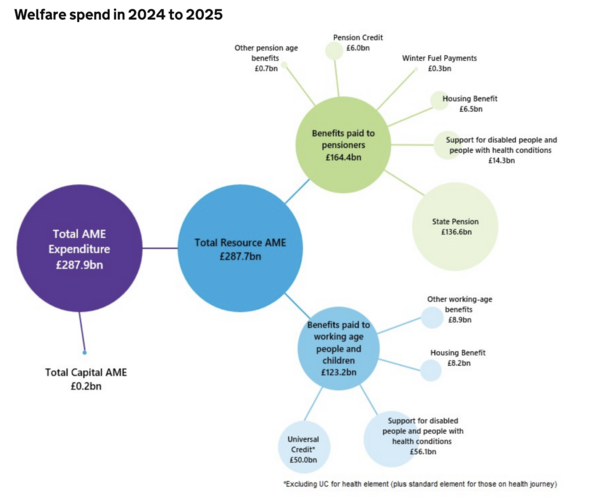
This further link, from which I have copied the graphic, shows the total welfare expenditure. AME is Annual Managed Expenditure. Pension Credit, the Winter Fuel Payment and Disability Benefits are not paid from NIC.
www.gov.uk/government/publications/dwp-annual-report-and-accounts-2024-to-2025/dwp-annual-report-and-accounts-2024-to-2025
I agree. I do think the nil rate threshold should be higher, but not that pensions should be exempt.
melp1- I think it’s only fair to point out that any private or occupational pension anyone receives had the benefit of tax relief on the contributions that were made into the scheme. Of course pensions have to be taxed - people work hard for their monthly salary and are taxed on it. Why should pensions be exempt?
My husband is always going on about the welfare bill. I keep telling him that a large part of this is pensions.
I wish when it was discussed, they would say how much of the bill goes to pensions, I think many people would be surprised. Apparently its between 42% - 47%.
Luckgirl 33 people are taxed on their income your SP is added to any other private pensions and you are taxed the same as anyone who works. So basically you saved to have a better income in retirement and then you're taxed on it.
I really don't think the UK can afford to increase SP I think they should sort out the NHS. Too much wastage and not enough doctors.
I haven't read all the posts so maybe someone has already said this - "to qualify for the new state pension, you need 35 years of National Insurance Stamps".
That is a very common problem, M0nica, especially if there are memory problems. My Mum hasn't walked for years but still insists she can! She has to be watched carefully because very occasionally she will suddenly push herself out of her wheelchair and face plant the deck. The rest of the time she can barely shift position in her chair. The mind is a very powerful thing even when failing.
I used to find that the other reason people did not/would not claim disability benefits was because to do so meant they had to admit to themselves that they were disabled.
I once made a visit to complete an Attendance Allowance form where the elderly lady had her daughter with her, who had arranged my visit. Every question I asked, the older woman would deny any problem, the daughter would disagree and explain the problem and I could see that the older woman was having difficulties walking round and doing things, but she would not admit it.
In the end I ended the visit. Both women were too distressed, one not prepared to admit her level disability and the other frustrated by her mothers unwillingness to admit to any problems.
I know of someone who lived in abject poverty unless they borrowed on the never, never which just made things worse so they would default on loans so they were always either pretending they had moved or taking out loans from dubious sources. On hearing their circumstances where there was lots of illness and disability, I suggested they might like to make a claim for benefits which they were entitled too. They were horrified as they didn't consider themselves to be social leaches. Trying to persuade them that it was their entitlement just made them angry. The mother, even when she was living on oxygen as she had COPD, would not claim for help as she died. The father has now had 3 strokes, is still in hospital with some really serious problems and will not be able to go home. I am praying that the hospital will insist he goes to a funded home with a Social Worker to make any claims because his daughters are saying they can't afford to pay for him but still won't claim "benefits".
Mollygo
ordinarygirl
I have no doubt that there are some elderly people who are not in a good financial state BUT just look at the coffee shops which are inundated by pensioners. I often listen to conversations when travelling on the bus about how pensioners have had a nice lunch in the local pub.
I’m glad you acknowledge that there are some elderly people who are not in a good financial state
I’ll make the same allowance for those younger people who are not in a good financial state.
Our town is full of eateries, cafés, restaurants, coffee shops, bubble tea shops etc. and despite the fact that there are young /younger people who are not in a good financial state these places are always full of young people-in school uniform, in hoodies, with babies in prams, in the latest fashions, with incredible eyelashes and huge lips, made up so similarly that it looks like a uniform.
Whichever group you look at there are always the haves and the have nots, but deciding that older people deserve less?
Karma will come back and bite you on the bum!
Well said!
The point you make UTBB highlights the general issue regarding State Pension. ONS says there are over 16,000 people in the UK who are over 100 years old. They will have been born even before the contributory State Pension was introduced in 1925.
Literally, we have people claiming State Pension who are age 67 to perhaps 107. That’s 40 years of overlapping generations, four decades in which life has changed enormously with regard to employment policy, state and workplace pension provision and general state support.
I think there is a very good argument for Cossy’s suggestion of a Universal Basic Income of £15,000.
You are right KCC. The push to get people to claim what they are entitled to has been going on for decades. It was why WFP was first introduced at two rates, a higher rate for people receiving Income Support in the hopes that it would encourage more people to claim it.
Were you aware that in 2011/12, under the Coalition government, the DWP ran a study where they identified people who they thought were entitled to PC, paid some extra money into their bank accounts and invited them to fill out the forms to formalise the claim? Many didn’t bother.
assets.publishing.service.gov.uk/media/5a7a1600e5274a319e777c0a/795and796summ.pdf
Over autumn and winter 2024, I was part of a volunteer group in the village helping people see if they were entitled to PC and therefore the WFP. We identified many who we thought were, helped them fill in forms etc. Weeks on, I would ask some of the people how their claim was going. Some said they had decided not to bother. It wasn’t my place to enquire why, whether there was some psychological barrier or whether they had more income than they were letting on. Fair enough. They may just have wanted to understand the gist of how it all worked and when they plugged in the real numbers realised they did not qualify.
One can only lead a horse to water …
Whatever the future of distributing/paying for State Pensions, its very worrying to think how many aren't claiming Pension Credit at the moment.
There needs to be a rethink into how to find these people and provide them with the help to claim.
What we're doing now clearly isn't working well enough.
Doodledog
I think that state pension should be enough to live on without benefits, and if people have other pensions on top they should not be penalised for having them, other than through tax, which is not a penalty so much as an obligation.
A decent level of pension should include 'extras' such as WFA - it would be much cheaper to remove the admin associated with working out who is entitled to a couple of hundred pounds a year, and just give it to everyone as part of the pension. That way, those who don't qualify for PC are not worse off than those who do.
Yes!
I think that state pension should be enough to live on without benefits, and if people have other pensions on top they should not be penalised for having them, other than through tax, which is not a penalty so much as an obligation.
A decent level of pension should include 'extras' such as WFA - it would be much cheaper to remove the admin associated with working out who is entitled to a couple of hundred pounds a year, and just give it to everyone as part of the pension. That way, those who don't qualify for PC are not worse off than those who do.
My Father was born in 1900, my Mother in 1904.
When they harried in 1933 my Mother was forced to give up work, most married women were then.
They had lived through WW and the Depression.
My F was a miner.
No Health Service no benefits in those days.
He was diagnosed with cancer in 1948 and died in 1949.
I was 11.
My M was 44 and did 3 part time jobs to keep a roof over our heads and me safe.
How was she expected to own her own house in those circumstances, she couldn’t.
She worked forever but at least she eventually got something out of the state as she lived to 101 and spent the last 7 years in a good residential home which was paid for almost entirely by SS i.e. the government.
We just topped up by about £100 a month.
Join the conversation
Registering is free, easy, and means you can join the discussion, watch threads and lots more.
Register now »Already registered? Log in with:
Gransnet »