
Gransnet forums

Health

Coca-Cola and sugar

(337 Posts)
Anya Tue 13-Oct-15 13:48:52

Has anyone been following the investigation by The Times into the full scale of Coca-Cola’s funding of scientists?

It would appear that this funding has been used to influence research, and the extent of this has come to light after the government rejected a tax on sugar sweetened drinks, despite support from Chief Medical Officer Dame Sally Davies, the British Medical Association and TV chef Jamie Oliver.

The drinks firm is said to have links to more than a dozen British scientists, including government health advisers, who counter claims that its drinks contribute to obesity

Coca-Cola is said to have provided support, sponsorship or research funding to a variety of British organizations including UKActive, the British Nutrition Foundation, the University of Hull, Homerton University Hospital, the National Obesity Forum, the British Dietetic Association, Obesity Week 2013 and the UK Association for the Study of Obesity.

Through its trade organizations, Coca-Cola representatives have met government officials and ministers more than 100 times between 2011 and 2014, according to The Times. Coca-Cola is also said to host a parliamentary dinner.

Faculty of Public Health board member Simon Capewell accused Coca-Cola of trying to mold public opinion.

“Coca-Cola is trying to manipulate not just public opinion but policy and political decisions. Its tactics echo those used by the tobacco and alcohol industries, which have also tried to influence the scientific process by funding apparently independent groups. It’s a conflict of interest that flies in the face of good practice,” he said.

New York-based nutrition researcher Marion Nestle warned scientists should not take money from Coca-Cola.

“In my opinion, no scientist should accept funding from Coca-Cola. It’s totally compromising. Period. End of discussion,” said Nestle, a professor of nutrition, food studies and public health.

Quotes taken from The Times

crun Thu 15-Oct-15 18:01:26

Wilma I'm not arguing that you can't lose weight by eating less, I'm suggesting that eat less and exercising more are not equivalent because the body has evolved to adapt to it's environment, and the two stimuli are opposites.

If you exercise more, that's a stimulus for your body to increase it's metabolic rate in order to provide the extra energy to fuel the exercise. If there's no extra food forthcoming, then your body will be forced to burn fat to make up the shortfall.

However, if you eat less, that's signalling to your body that there's an impending famine, and you will survive longer if your body can reduce it's metabolic rate as much as possible before it starts burning fat reserves. There's plenty of scope for your body to reduce your metabolism if you do no exercise, and so I think you will become less fit before you lose any weight. If you react to this by becoming less active, then you just descend into a downward spiral.

I have a record of my daily exercise and calorie intake for the last 13 years, and I think I can see this happening. During periods when I have been unable to exercise for health reasons, I have found that eating less just makes me weak, cold, and fatigued, but most of all my leg muscles get so painful I become even less active. Hence the downward spiral, and I lose no weight.

By contrast, when I have been able to return to exercising I have found that the weight falls off easily even though I'm eating hundreds of calories more. In 2008/2009 I was losing weight at 1.1kg/month on a calorie intake of 3100kcal/day, after a period when I had previously been gaining weight on 2600kcal/day.

Clearly people do lose weight by eating less, I just think that's the hardest way to go about it. People who take up exercise always comment on how much better they feel, and how the weight seemed to drop off without them even noticing. On the other hand, people who are endlessly dieting are always complaining how hard it is, and how they can't keep it up for very long. I've seen research quoted that those who do succeed in losing weight have all put it back on again within 5 years.
WilmaKnickersfit Thu 15-Oct-15 16:09:20

If you research information about losing weight, there's a wealth of evidence now that shows exercise is good for our health, but not essential for weight loss. Even at somewhere like a Slimming World class you are told whether or not you increase your activity, you will lose weight by following the plan, but you will lose weight more quickly if you do.

WilmaKnickersfit Thu 15-Oct-15 16:04:55

crunyou are making my point - the government has no appetite for seriously tackling the problem.

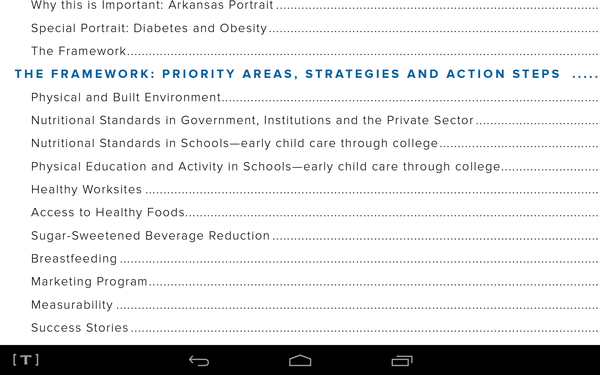
By coincidence I just read an article about Arkansas in the USA. It has just launched a 10 year plan called Healthy Active Arkansas to tackle obesity. It has the highest obesity rate in the USA. After just skimming the plan, it looks like the sort of framework we need in the UK. I have taken a screen shot of the framework outline so posters can see it covers everything mentioned here and more.

This is the link in case anyone wants to see the plan.

www.nwaonline.com/documents/2015/oct/14/healthy-active-arkansas-plan/

Mamie Thu 15-Oct-15 16:04:43

Crun, there is a wealth of evidence to support the sustained and significant weight loss of people on low-carb diets without increased exercise. You won't read much about it because it doesn't suit the food industry. Exercise to keep fit is obviously still very important.
I don't want to derail this interesting thread though.
I think your point about overweight and obese health workers is very pertinent and exemplifies the difficulty of the task.

crun Thu 15-Oct-15 15:39:54

Mamie if obesity is the point at issue, then only calories are relevant. Fat is a store for energy contained in excess food, and the calorie is a unit used for measuring the amount of energy in food.

crun Thu 15-Oct-15 15:35:15

Wilma there are loads of people who get appointed to investigate all sorts of issues, but if the conclusion isn't what the government wants to hear the report just gets stuffed down the back of the filing cabinet.

crun Thu 15-Oct-15 15:29:54

The prevalence of obesity among health workers doesn’t appear to be significantly different to the general population, so I don’t think that education is going to make any difference at all. If working with diabetic amputees doesn’t motivate people, nothing will. People know full well what they need to do, they just don’t want to do it.

Politicians with the power to address the issue are also no less overweight than the general population either, and turkeys don’t vote for xmas. There might be some action if there were enough thin voters fed up of taxes subsidising obesity, but as the number of obese patients grows the number of thin voters diminishes.

The main problem is the lack of exercise, we already eat far less than in the past. Manual workers didn’t live off 2500 calories a day, navvies were eating about 8000 calories. I don’t buy the supposed equivalence between exercising more and eating less either, they are from the point of view of energy balance, but viewed in terms of the stimuli to the body they’re complete opposites. It’s far easier to lose weight by exercising, and for good reasons I think.

WilmaKnickersfit Thu 15-Oct-15 15:23:23

I understand that some things are in place to help with the problem, but not only is it not enough, there is not a cohesive approach. It's all just a drop in the ocean, a token gesture. The obesity problem needs to be near the top of the government's agenda simply because of how many ways it impacts on every day living in this country. It's costing millions now and will only cost more the longer it goes on. And there's the nub. The government would have to take on the food industry and the food chain - and it has no intention of doing this because there's too many vested interests.

We need the government to appoint someone like Gerry Robinson to head up an initiative to put in place a strategy to tackle the obesity problem. Or even to spearhead a campaign for change.

I know local authorities are strapped for cash. I know we're supposed to be under austerity measures. But on this thread we are talking about big companies being involved in scientific research and the negative impact of the food industry on the daily lives of people in this country. At the moment this government has no appetite for change because it would be biting the hand that feeds them. All puns intended.

gillybob Thu 15-Oct-15 15:13:34

Of course not Mamie. I agree we shouldn't just focus on children either but you have to start early so it becomes a lifestyle choice. How many chubby/overweight children do you see with thin parents? Very few or none I would guess. If however we could teach the children then we could break the cycle.

Anya Thu 15-Oct-15 15:02:52

Excuse typos b****y iPad

Anya Thu 15-Oct-15 15:01:34

'Cause typos, I expect you get the drift.

Anya Thu 15-Oct-15 15:00:06

I worked with the co-ordinators of the NHSP and my own observations backed made this no surprise. BUT where I did notice an impact were the 'Cookery Clubs' in which parents participated alongside their children.

One in particular run for Dads and child(ren) on a Saturday morning was a great success and they actually published their own recipe book.

However schools have been teaching this for years. I remember being harangued by the mother of one of my Y6 pupils for 'giving her silly ideas' about eating and that her daughter would 'have her carrots and peas on a Sunday as we've always done' !!

Schools can't do this by themselves, unless they gave the interest and backing of parents it will go in one ear and out the other.

Mamie Thu 15-Oct-15 14:50:57

Interesting Anya, I hadn't seen that. I guess it is pretty naive to expect schools to be able to counter the power of advertising by the food industry, isn't it?

Mamie Thu 15-Oct-15 14:47:41

My own view is that calories are pretty irrelevant though. Yes they are all the same in calorific value, but surely nutrition and the way they are used by the body are the important bits? No good sticking to 1000 calories a day if it is all in doughnuts and fizzy lemonade, is it?
I am not sure why we are just focusing on children though, important as they are. Type 2 diabetes in adults is a pretty big problem for the health service.

Anya Thu 15-Oct-15 14:46:54

1999

Anya Thu 15-Oct-15 14:46:38

The National Healthy Schools Programme (NHSP) came into being in199.

Impact of NHSP – Healthy Eating

Pupil-level changes linked to healthy eating

• Perceived impact of NHSP on pupil level changes
Four key impacts were identified as a result of changes made by schools in terms of their approach to healthy eating and food provision. These were: the take-up of school lunches; pupil behaviour in school; an increased awareness of nutrition and healthy food choices, and increased healthy eating outside of school. The extent to which a school could have an impact on pupils was influenced by the way changes were introduced and explained to students, the availability and access that pupils had to unhealthy food outside of school, the age of pupils, and the level of parental support and engagement.
• Pupil impact – findings from the multivariate analysis of the pupil survey

Analysis found that within the two year timeframe a school’s engagement in the NHSP did not lead to any significant changes in pupil knowledge, attitudes or behaviour in relation to healthy eating either at primary or secondary level.

Looks like this Labour-funded programme had little or no impact.

gillybob Thu 15-Oct-15 14:36:09

All calories are the same Mamie as they are all the calorific value of the food/ drink we consume. I agree that some calories have little or no nutritional value though which is different. At a guess I would say that my DGC probably consume a lot more calories than some of their friends. I have never seen a 7 year old eat as much as my grandaughter does. They will all eat almost anything and have a very varied diet. My 2 DGD's are both good little cooks too.

Yes I believe that providing all children with a good, free nutritious meal at school would be an excellent idea but that will probably never happen.

Mamie Thu 15-Oct-15 14:19:32

Schools are providing education about healthy eating (I don't think the message is quite right but they are doing it). They have been doing it in some form or other for a very long time. And they teach cooking.
Quite agree about school dinners. Here in France they are cheap, delicious and compulsory unless you take your child home.
I don't think there is any money left in the LAs to provide it though.

Mamie Thu 15-Oct-15 14:14:37

Sort of Gillybob. Diet is actually much more important than exercise in weight loss (80:20 is normally quoted). The food and drink companies encourage the "calories in, calories" out message because people might think that a sugary drink is the same as as a boiled egg "all calories are the same" whereas in fact a sugary drink will increase your appetite instead of filling you up and an egg will keep you going for much longer and put good nutrients into you. All calories are not the same.

WilmaKnickersfit Thu 15-Oct-15 14:10:08

Exactly gillybob - we need to be educating the next generation now.

There's only a limited gain from campaigns aimed at parents, but every child can be taught about healthy eating. They can see what it looks like during compulsory school dinners which should be provided by the education authorities using current nutritional guidance. Contracting out school dinners to save money sends the wrong message. Local authorities should demonstrate healthy eating on a budget is achievable.

gillybob Thu 15-Oct-15 14:00:29

We should also teach children that calories in have a direct link to exercise (calories out).

gillybob Thu 15-Oct-15 13:58:59

Look at cigarettes. The people who can least afford to smoke still do so.
Look at alcohol. The people who can least afford to drink still do so.

Why would a sugar tax be any different? Why would taxing it mean that those who should have it in moderation will be quick to change their habits?

I find it incredible that any food (however good or bad it is) should need to be taxed. What is needed is a clear education from the earliest age about the benefits of eating well.

Mamie Thu 15-Oct-15 13:58:51

Interesting article here from The Canberra Times about sugar tax, obesity and nanny-states, "nannies are good for you"....
www.canberratimes.com.au/act-news/sugar-tax-inevitable-in-australias-fight-against-obesity-says-public-health-researcher-boyd-swinburn-20151013-gk7ryw.html
France already has a tax on sugary drinks btw.

Mamie Thu 15-Oct-15 13:48:37

I don't think people are saying that Gillybob. My grandchildren have treats too. Nobody is talking about banning sugar, but taxing it as we tax alcohol and tobacco. The problem is that for many children these are not rare treats; cheap, fatty, sugary processed food forms a large part of the diet. Yes it is the responsibility of parents to feed their children properly, but the reality for many families is not like that.
The tidal wave of obesity and associated diseases across the globe will overwhelm health services unless something is done quickly. It needs concerted action by governments.
I read today that by (I think) 2025, 80% of Australians will be overweight or obese. This is a global issue. Mexico has had some success with a sugar tax. Why is it so impossible to contemplate?
The cake one was a Gransnet joke!

Anya Thu 15-Oct-15 13:46:25

I don't think anyone should be denied 'a glass of....' Gilly the way a sugar tax would work in reality is that the increase in cost wouldn't really hit those who just indulged occasionally in the odd can or processed meal.

But it would hit those who 'don't feed their kids properly' far more if by this we mean they put any only cheap junk on the table, for pure convenience.
