dj posted while I was composing. In her post Richard Murphy explains just a part of how the complex system works.
Is funeral planning a conversation you've had with your family?
What's your favourite/most useful app?


Now this really be worth doing!!
Let's start with the QS.
What will be left out/watered down! Not sure how they will explain it away as it's in the manifesto. Probably say something like "Brexit and all it's complications will mean that stuff will have to be shelved"
Fox hunting - out
Triple lock - remains
Social care - out
dj posted while I was composing. In her post Richard Murphy explains just a part of how the complex system works.
as it is something that people think they understand.
They don't 'think' they understand, they 'understand' it too bl**dy well. It's a lovely simple concept that makes absolute sense to anyone who has managed a household budget. It has the direct appeal of a slogan like 'Take back control'.
It is perpetuated because people never consider the logic (or lack of logic) behind it. If the nation's 'money' is a fixed amount (as per the 'household budget' model) then an ever growing population would mean that an idividual's share of it would get smaller and smaller and smaller. If our Victorian forebears got, say £1 per head per week and the population has increased since than by a multiple of 2 (it's just a bit more than 2 really) then that £1 would have to be shared by two people, giving them 50p each. That hasn't happened. Why not?
In 'face value' terms every individual in the Uk has a nominal 'share' of far more than 50p in the nations currency 'pot'. This is because 'money' is a completely abstract concept and it can be created at will by a sovereign country that has its own currency. It's 'value' is not pegged to anything; it is what people think it is worth. It's really a very fragile and complex system which just cannot be explained by the 'household budget' model. That's why there are hundreds (if not thousands) of economists world wide studying it and interpreting it.
We went through this a few weeks ago. Is it too difficult a concept for people to understand? (this is a genuine question; I'm not trying to be goady)
From Taxresearch.
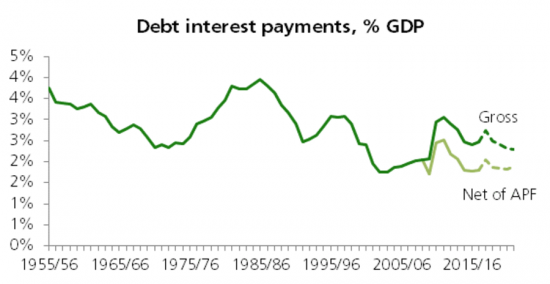
The chart comes from the House of Commons Library in June 2017: this is up to date. And what it shows is that the gross cost of UK national debt in terms of interest is about £49 billion nominally, but in reality it is at least £13 billion lower at £36 billion because of quantitative easing. The government cannot, of course, owe itself interest on its own debt that it owns itself, and so that part is not paid. If you want the clearest possible indication that QE debt only notionally exists then this is it.
So what is the reason for the obsession with the remaining £36bn or so cost? It can’t be because it is excessive in proportion to the sums owing in our recent past, because it clearly is not. What is also very obvious is that the cost of our national debt is running at exceptionally low levels. We paid a lot more interest as a proportion of GDP in past decades when the debt to GDP ratio was much lower. If you want evidence that the paranoia about the national debt is misplaced right now then this is that.
And then I have to dutifully remind you who receives this relatively modest income. Pensioners are by far the most significant recipients. Government debt underpins most UK private pension annuities because the whole thing about an annuity is that you want it to be secure, stable, reliable, boring, but to at least be income paying to some extent for the rest of your life, which you can no better estimate as to duration than can your friendly neighbourhood actuary. In our national economy this is by far the most important role gilts have to play.
Now of course we can hate paying private pensioners a return on their savings. And you can, of course, hate their desire for a safe, stable, boring place to locate their money. It is, very obviously, utterly unreasonable of them to want to lend to the government in this way with no likely net return being earned, having allowed for inflation, at present. I mean, why wouldn’t the Tories hate the Tory voting pensioners who are the biggest recipients of payments on the national debt which doesn’t actually burden the next generation but is mainly designed to benefit the last? Perhaps it’s because they think it was pensioners, like nurses, teachers and firefighters who crashed the economy in 2008 and we should now seek to wreak revenge upon them by denying them the chance they want to save in a way that technically costs us nothing.
And how do I know it costs us nothing? Because of inflation. That is running at about 2.9 per cent right now. Given that net national debt after QE is about £1.3 trillion this means inflation is writing off the national debt at a rate of £37.7 billion or so a year right now – which is slightly higher than the annual cost of interest paid, meaning the net cost to the nation of national debt each year right now is near enough precisely nothing.
But of course this net return of nothing is not only paid to pensioners. Some goes to banks which need gilts as part of their portfolio of ultra safe asset holdings. And some goes to insurance companies who need assets that behave remarkably like cash but don’t carry the risk cash does of default if a bank goes down. And some just belongs to individuals. But it makes no difference, because they are all making nothing, and what is more, some of them might even be paying some tax on the privilege of doing so.
But the Tories are apparently still deeply resentful of this non-cost which is apparently, despite being in net terms nothing at all, a massive burden on future generations who try as they might will, in the Tory imagination, never be able to save up enough to pay that net nil rate of return.
As an example of economic madness the complaints currently being made about the cost of national debt by the Tories come as close to total economic illiteracy as it is possible to get. But they remain, despite that, the supposed party of economic competence in the public imagination. To say I despair grossly misstates my sentiment on that issue. And in the meantime the country is denied the benefit of the free money that could be used to invest in the future our children need because a net cost of zero per cent is apparently too high for them to bear.
The chart comes from the House of Commons Library in June 2017: this is up to date. And what it shows is that the gross cost of UK national debt in terms of interest is about £49 billion nominally, but in reality it is at least £13 billion lower at £36 billion because of quantitative easing. The government cannot, of course, owe itself interest on its own debt that it owns itself, and so that part is not paid. If you want the clearest possible indication that QE debt only notionally exists then this is it. So what is the reason for the obsession with the remaining £36bn or so cost? It can’t be because it is excessive in proportion to the sums owing in our recent past, because it clearly is not. What is also very obvious is that the cost of our national debt is running at exceptionally low levels. We paid a lot more interest as a proportion of GDP in past decades when the debt to GDP ratio was much lower. If you want evidence that the paranoia about the national debt is misplaced right now then this is that. And then I have to dutifully remind you who receives this relatively modest income. Pensioners are by far the most significant recipients. Government debt underpins most UK private pension annuities because the whole thing about an annuity is that you want it to be secure, stable, reliable, boring, but to at least be income paying to some extent for the rest of your life, which you can no better estimate as to duration than can your friendly neighbourhood actuary. In our national economy this is by far the most important role gilts have to play. Now of course we can hate paying private pensioners a return on their savings. And you can, of course, hate their desire for a safe, stable, boring place to locate their money. It is, very obviously, utterly unreasonable of them to want to lend to the government in this way with no likely net return being earned, having allowed for inflation, at present. I mean, why wouldn’t the Tories hate the Tory voting pensioners who are the biggest recipients of payments on the national debt which doesn’t actually burden the next generation but is mainly designed to benefit the last? Perhaps it’s because they think it was pensioners, like nurses, teachers and firefighters who crashed the economy in 2008 and we should now seek to wreak revenge upon them by denying them the chance they want to save in a way that technically costs us nothing. And how do I know it costs us nothing? Because of inflation. That is running at about 2.9 per cent right now. Given that net national debt after QE is about £1.3 trillion this means inflation is writing off the national debt at a rate of £37.7 billion or so a year right now – which is slightly higher than the annual cost of interest paid, meaning the net cost to the nation of national debt each year right now is near enough precisely nothing. But of course this net return of nothing is not only paid to pensioners. Some goes to banks which need gilts as part of their portfolio of ultra safe asset holdings. And some goes to insurance companies who need assets that behave remarkably like cash but don’t carry the risk cash does of default if a bank goes down. And some just belongs to individuals. But it makes no difference, because they are all making nothing, and what is more, some of them might even be paying some tax on the privilege of doing so. But the Tories are apparently still deeply resentful of this non-cost which is apparently, despite being in net terms nothing at all, a massive burden on future generations who try as they might will, in the Tory imagination, never be able to save up enough to pay that net nil rate of return. As an example of economic madness the complaints currently being made about the cost of national debt by the Tories come as close to total economic illiteracy as it is possible to get. But they remain, despite that, the supposed party of economic competence in the public imagination. To say I despair grossly misstates my sentiment on that issue. And in the meantime the country is denied the benefit of the free money that could be used to invest in the future our children need because a net cost of zero per cent is apparently too high for them to bear.
The thing is gg a government does not run its economy like a household. That was simply a myth put about by Thatcher (more fake news) and which has stuck, as it is something that people think they understand.
I know we use it because 'they' use it but how I hate the word austerity. It covers too much and yet says nothing definable - rather like 'Brexit'.
At it's simplest when in debt you follow some basic steps. For a short period you cut back on every thing you can (austerity). You reorganise your spending so that you make savings over a longer period - our state run NHS, Firesevice, Schools, etc., have been doing this. You reorganise your debts to make sure you are paying the most expensive first (I have no idea if the government have done this but I would like to think they have) and during all this time you look for other ways of raising income.
It is this final one that the government seems to put it's head in the sand about. We must, just as we have asked those being paid by the state to take cuts, ask those who pay taxes to pay more. We all believe the deficit should be cut but we are not all contributing to this.
I agree. We are still in the EU, but acting like we are not.
It probably wouldn't have been noticed if it were not for Brexit.
This government has been highly embarressed by being censured over Hinkkey Point C.
It failed to follow correct procedure as laid down by the Aarhus committee.
The Germans say work should be halted until the UK complies
One of the reasons that pushed May into an early general election has unlike the 20 point party lead come thundering down the road as expected
The economy is tanking.
Already households are beginning to feel a huge drop in their spending power.
How will they deal with that I wonder.
I know!! How about more austerity. Sounds like a good plan
There was a head teacher I know who used to say that, GracesGran. He wanted to be the first teacher to run a school catering for all ages from nursery up to sixth form, and he used to tell us all we should be able to teach any age and any subject.
Strangely enough, nobody ever saw him teach anything.
Tegan, there should be room for both types of teachers. Middle school trained teachers usually have a subject they can teach right up to GCSE, and lots of other subjects they were trained to teach up to year 9.
Not everybody has to teach up to A level, certainly not in areas where they have sixth form colleges.
You certainly won't teach it to the level that someone who has studied that subject for years and loved it will.
My daughter and her colleagues will be at her 'leaving do' from her college on Friday. Last week it was another colleague in their department, and the week before another. As those on 'variable hours' contracts - the contract de jour in their department and throughout the college - only have to give two weeks notice it is thought that there will be two more resignations at the end of August.
The principle of the college is well known for saying that if you have trained as a teacher you can teach anything - which is patently untrue and is a great disservice to the students. The staff, as you can see, are voting with their feet.
Talking about unions, Bank of England Unite members are going on strike at the end of the month.
theconversation.com/bank-of-england-strike-threat-signals-failures-in-plan-to-dent-union-power-80484
When I was teaching English in a comprehensive, I also taught maths, history, geography, physics and RE.
However, no way could I have taught music, but everyone had music lessons.
I know my son will be one of thousands. That's why we fight for the unions in our family.
Do you, daphne?
To say you really wish people would take more notice..... We have been.
Haven't you noticed?
By the way, what do you think of the idea of Waspis doing apprenticeships?
Of course you can talk about your son being made redundant. Unfortunately, he'll be one of thousands.
Oh! If only!
They're always trying to get my daughter to teach subjects she has no knowledge of; at one time it was geography...something she didn't even do at GCSE level.Many children at my daughters comprehensive school went on to work in music/drama/art areas at pretty high levels because those departments were so good.
Sorry, daphne. How dare I talk about my son being made redundant.
Leave you to it as yuou know everything there is to know.
I really dont think that the Tory outlook has fundamentally changed from the Victorian view.
I can tell you now where it will end if the Tories get their way, Tegan.
Those who can afford private education will still get a liberal education, including art and music. Those who can't afford it will get a no frills education, including literacy and numeracy, but no thinking skills or arts. In other words, they'll get an education suitable for plebs.
That kind of thing has been going on for years dj. I really wish people would take more notice of what's been happening in schools.
I spent two years doing timetabling and cover in a big secondary school. About 10% of lessons were taken by people with no or little subject knowledge. Not surprisingly, senior management wasn't keen on the knowledge I'd acquired and did what they could to prevent whistle blowing.
Unfortunately, too many people blame teachers and, in any case, think that schools are a form of baby sitting.
That'll be interesting, Tegan.
My son was made redundant when the head of art was put in charge of music and art. She knew nothing about music, but it was thought that the kids didn't need music in the first two years, to get rid of one teacher.
Spoke to someone tonight who's married to an art teacher at a school where they're trying to stop art being part of the curriculum. So much for all this money that's supposedly being ploughed into state schools  .No art; no music..where's it all going to end?
I have a feeling I am in that club whitewave
Danish banking as well, now they are losing an ally in the UK.
'Denmark is set to decide on its participation in the EU's banking union, it said on Tuesday, which could lead to closer ties with the bloc following Copenhagen's expanding role as a financial center and Britain's decision to quit the bloc.
Danish lawmakers concluded in 2015 that it would be in the country's interests to participate in the banking union, designed to integrate the industry more closely within a single bloc-wide regulatory and supervisory framework.
But the Danes postponed making a decision then, pending clarification of certain matters.
Brexit and increased focus on Denmark as a financial center made it relevant for the country to now launch a review leading to a final decision by autumn 2019, after Britain's EU exit has been formalized, Business Minister Brian Mikkelsen said in a statement.
"We have to look at the consequences of Britain leaving the EU ... It means that we lack an important partner because the financial sector will be weakened by us not standing side by side," Mikkelsen told broadcaster TV2.
Participation in the banking union would mean closer integration for a country that has been an EU member since 1973 but holds opt-outs from EU policies on security, police and the euro.
He added that a majority in parliament and the Danish banks were positive toward Denmark joining the banking union and said a referendum would not be needed.'
From Reuters.
This discussion thread has reached a 1000 message limit, and so cannot accept new messages.
Start a new discussion
Get our top conversations, latest advice, fantastic competitions, and more, straight to your inbox. Sign up to our daily newsletter here.
