Gransnet forums

News & politics

British Social Attitudes

(9 Posts)
daphnedill Wed 28-Jun-17 18:09:14

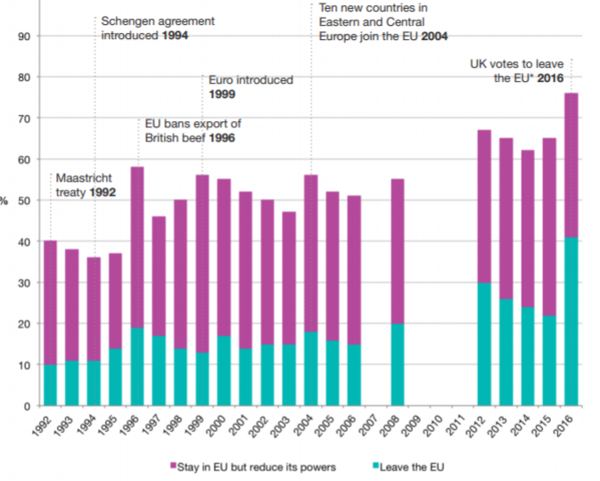
That's a bit naughty of the BBC. It's actually 41% who would leave outright, but 35% who would prefer to stay in but reduce the EU's powers. They could just as well have said that 59% want to stay, although some want to reduce its powers.

I'm a staunch Remainer. However, that doesn't mean that I don't see the EU's faults and I guess I would prefer to reduce some powers. Nevertheless, given a choice of two, I believe absolutely that Remain is the better alternative.

daphnedill Wed 28-Jun-17 17:59:11

There's a detailed analysis of referendum voting here:

bsa.natcen.ac.uk/media/39149/bsa34_brexit_final.pdf

Cherrytree59 Wed 28-Jun-17 17:50:26

Sorry can't find the 40%.On BBC on line news.

daphnedill Wed 28-Jun-17 17:44:54

Only 40% think the UK should leave the EU completely.

Cherrytree59 Wed 28-Jun-17 17:37:38

I also note that Britons hold traditionally conservative views on national security and the pulic favoured stronger state powers to fight terrorisim.

76% of people said the UK should leave the EU or that if it stays the EU powers should be reduced
This is up from 65% in 2015.

daphnedill Wed 28-Jun-17 17:10:22

I'm always cautious about correlation of social attitudes with age and education for exactly the reason you mentioned, MOnica.

Crafting Wed 28-Jun-17 16:52:17

Thanks for the link dapne. I read it all. Very interesting.

M0nica Wed 28-Jun-17 16:24:03

People are beginning to realise that you cannot get Scandinavian social policies with out Scandinavian tax systems; in other words if we want a good NHS, social support, good education and social care we must all be prepared to pay more for it, not just believe vaguely that the rich can pay for it, a bit like believing in fairies.

I think education level is far more important an indicator of social attitudes than age. It is just that in our childhoods/youth far fewer people needed further education to enter many professions than they do now and far fewer people stayed at school until 18, let alone went on to further education.

DF left school without any exam passes, went into clerical work, was called up into the army, a few years later selected for officer training, left the army, joined a bank at branch level at a senior level, without ever passing any exams. He was also a staunch Conservative!!

Education forms your political and social values far more than age.

daphnedill Wed 28-Jun-17 15:01:06

The report on the latest British Social Attitudes survey was published today. These are the key findings:

Kinder: after 7 years of government austerity, public opinion shows signs of moving back in favour of wanting more tax and spend and greater redistribution of income. We also find that attitudes to benefit recipients are starting to soften and people particularly favour prioritising spending on disabled people.

*Not soft-hearted*: the public in general continues to take a tough line on the response to threats at home and abroad. The majority want the authorities to be given strong powers to respond to terrorism and crime, and record numbers want defence spending increased.

After pensions being protected from austerity, the public are losing sympathy with the idea that this should be a priority for further spending.

The public takes a dim view of benefit fraud and tax evasion, with many thinking that exploiting “legal loopholes” is also wrong. Further, more people consider benefit fraud wrong than tax evasion. While the proportion who prioritise more spending on increasing the benefits for disabled people has risen, there is little support for more spending on benefits for the unemployed, perhaps because half of people think the unemployed could find a job if they wanted to.

*Socially liberal*: the onward march of social liberalism continues with record proportions of people being comfortable with same-sex relationships, pre-marital sex and abortion, among other issues. While younger people are still more liberal on these subjects than older people, the difference is narrowing.

Divided: the country is however clearly divided by age and education on views about the EU and immigration; young degree holders are much more positive about both than older people with no formal qualifications.

It's a very long read, but the full report is here, if anybody is interested:

bsa.natcen.ac.uk/latest-report/british-social-attitudes-34/key-findings/context.aspx

Does anybody have any comments?

Is there anything which surprises you?

Do the results have implications for future political decisions?

Anything else?