

Any one else watching Dispatches, about affordable homes?
What Theresa May has said twice about affordable homes is all lies.
Homes are being built on public land, which we owned, but the affordable ones among two hundred on one site have been dismissed altogether.
There are no homes to rent, all to buy, and not affordable for people on normal wages.
Gransnet forums
News & politics
Private wealth and public squalor
(204 Posts)We have Galbraith to thank for this theory, and I think that far from being a theory of the past it is so apt for what is happening in this country.
I am watching the BBC programme about the super rich.
Today I have also seen on a report about people resorting to living in vans and caravans because they cannot afford anywhere else to live.
Our young are struggling.
The cuts have resulted in poorer welfare system, a struggling NHS, pot holes in the roads, and so on.
Today I visited Wells and in the Cathedral precinct there were homeless people begging -shame on the church. And don’t say the homeless have always been with us.When we were growing up we had tramps who we almost knew by sight as they were so unusual.
Food banks ?
Whilst we have just been told that the super rich wealth rose from an average of 2bn to 5bn within two years of the recession. Their wealth has continued to grow to the extent that now the top 1% own more than everyone else. Marx said that wealth will always become concentrated at the top, but for many years he seemed to be wrong, I wonder if he is so wrong now?
And no I’m not envious, just demanding fairness.
Sorry, dj, you have lost me completely. What is the relevance of your response above to anything I have said in any of my posts?
So what about all the EU residents who have been in the UK for most of their working lives who are often being told that foreigners should go home, without the person saying so realising that they are talking to a foreigner?
I hope you feel equally sorry for them, Monica.
Eloethan We are both arguing on the same side of the same argument. We are both agreed that the use of tax havens by very wealthy people or organisations to avoid tax is abhorrent. We are both agreed it is a large sum of money.
I am just trying to prick some of the hype surrounding it. by pointing out that the total amount of legal overseas investment from this and most of the 195 countries in this world far exceeds the amount of tax avoidance, however large. Many of those investing in tax havens are not British and do not pay tax in the UK so not all this money relates to the UK
Misuse of language leads to the pilloring of innocent individuals and countries who are investing overseas and contributing to the wealth and welfare of their home country. Remember the paediatrician who was attacked because the mob did not know the difference between being a paediatrician and a paedophile?
The subset of those who buy property in France is probably a much smaller subset, but nowhere near the same league as those b/millionnaires who hide their untaxed money in tax havens.
Monica Many very wealthy people tend not to place their money just anywhere overseas but quite often use tax havens to assist in avoiding (or evading) tax. This has been the subject of the Panorama expose, which was based on a thorough analysis of the leaked "Paradise Papers". So, I believe when people talk about "offshore investments" or "overseas investments" they are referring to these relatively recent revelations about tax havens.
As the BBC reported in July this year when discussing the issue of tax havens:
"........... Nowadays, tax havens are controversial for two reasons: tax avoidance and tax evasion.
"..........The euphemism for a tax haven these days, of course, is "offshore" ................. ..."
And an article in The Guardian, also from July this year, stated:
"The world's super-rich have taken advantage of lax tax rules to siphon off at least $21 trillion, and possibly as much as $32trillion, from their home countries and hide it abroad – a sum larger than the entire American economy.
"James Henry, a former chief economist at consultancy McKinsey and an expert on tax havens, has conducted groundbreaking new research for the Tax Justice Network campaign group – sifting through data from the Bank for International Settlements (BIS), the International Monetary Fund (IMF) and private sector analysts to construct an alarming picture that shows capital flooding out of countries across the world and disappearing into the cracks in the financial system."
You say:
" 'tax havens' are a very small subset, in every sense, of all the places where you can make overseas investments ..."
They may well be a small subset but the size of the subset doesn't necessarily determine or reflect how much money pours into it and, bearing in mind that they are now used to launder money and avoid/evade tax, the negative effect they have on the world (and especially the developing world) is likely to be disproportionate to their size. "A sum larger than the American economy" sounds like an awful lot of money to me.
my.labourlist.org/page/m/2c9aec76/13fa0d4e/6074bdb8/34ad2d00/740216723/VEsO/
A you-tube video of homeless people/families and how they are expected to live in our country.
I feel ashamed to be British.
Tax havens are a very small subset, are they?
In that case you will not mind if we ask those who are not paying their taxes to pay them.
In fact, in order not to be mixed up in the numbers, those who pay their taxes correctly should be aligned with us to ensure that the problem doesn't continue.
If people paid instead of putting money into tax havens, we would be able to put £350 million a week into the NHS for the next 16 years.
You think that's a small amount, do you, Monica?
New homeless figures from Shelter; over 300,000 now homeless, yet May thinks putting £10 billion into help to buy will be more useful than giving it to councils to take people off the streets.
Eloethan There has been considerable confusion over descriptive phrases like 'tax haven' 'Offshore investments' and 'holding money offshore'.
Any money held overseas is an 'offshore investment'. Most are quite legally held and pay all the tax due under UK legislation. All it means is that someone has invested money in companies and assets in a country other than the UK. Hence my quotation of my very trivial investment in a overseas holiday home and associated bank accounts
'tax havens' are a very small subset, in every sense, of all the places where you can make overseas investments and I absolutely agree most people investing through these tax havens are out to avoid taxation or hide ownership.
The problem we are having is that most people seem not to be able to tell the difference between 'money invested overseas' or 'money invested offshore' and 'money invested through an over seas tax haven' and as a result many people who have quite legitimately invested in companies all over the world, repatriated their profits and paid their taxes, or who own foreign property, are quite without any justification being excoriated as tax dodgers and worse, when that is not true.
Why can't she live at Windsor and we could then build housing at the Buck house site!
There's an interesting episode of 'Analysis' on the minimum wage with Paul Johnson who's a director of the IFS. It covers the history but explains that a higher minimum wage is not necessarily a benefit. He interviews people from the Low Pay Commission and others. They explain the impact and why far better than I could.
www.bbc.co.uk/programmes/b08yngv2
My understanding is that France is not a tax haven because the whole point of a tax haven is that it has a very low or nil rate of tax and whatever happens within it is secret. Presumably if you move money from a British bank account to a French or other non-tax haven account, there will at some point be a record of the money's presence in your account and it will be liable for tax.
I really don't think having a holiday home abroad and moving a bit of money to cover expenses is in the same realm as what was seen on the programme being discussed.
I may have got it wrong but, if I understood correctly, the people using the schemes devised by firms like Appleby were able to avoid paying VAT and other taxes by representing that the assets in question were the property of a company, and not the individual and were business expenses for which they were allowed all or some tax exemption.
The new living wage has been announced today.
www.livingwage.org.uk/what-real-living-wage
£8.75 an hour for those outside London, £10.20 inside London.
A small step, but better than the government's pretend living wage, nearly 17% more in fact.
A lot of nonsense is being talked about what the purpose and use of offshore investments is. Holding money offshore simply means having bank accounts or investments in any country other than Britain and while I quite agree that some high net worth individuals are using it to avoid tax by placing it in tax havens for many the money is not in a tax haven but invested in the many countries in the world which have tax regimes not dissimilar to ours. For many the money is invested in overseas industries or running family finances where a family is scattered across many countries
Indeed, I have to come clean and confess my sins for I have money invested offshore. We have a house in France so have a French bank account, to which we regularly move money from the UK, also a savings account for anything unexpected.
Can a I expect the cold hand of the tax authorities or Guardian journalists to be hammering on my front door any time soon accusing me of money laundering and tax avoidance? I might just retreat to my offshore 'mansion' to avoid any awkward enquiries.
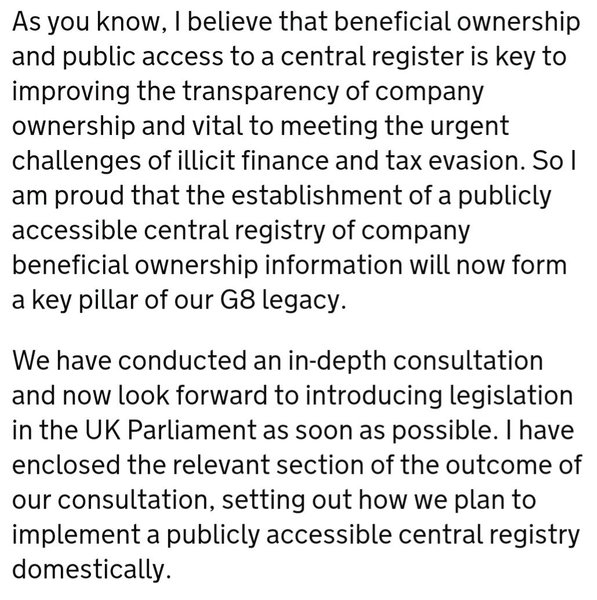
This was a Tory promise in 2014. Taking their time, aren't they?
I doubt that the "hardworking people" of this country who pay tax via PAYE or self assessment view this type of tax avoidance as helping our economy!
eazy what scheme is that then?
No we can't all invest overseas, only those with a lump sum, like the rabid socialist of my acquaintance, lived in a council house, state funded scholarship to public school, free university education leading to a well-paid job,so plenty of state support, who carefully invested his father's life savings of £60, 000 (twenty years ago) in an offshore account, freely admitting that it was to avoid paying nursing home fees when the time came. Only one small instance, I know, but there are many many people taking advantage of this scheme,(not me) and most of them would not be classed as rich. Usually paid consultancy fees, into an offshore account.
But we aren’t talking about foreign investments on which tax is paid are we?
We are talking about the wealthy shipping thei money overseas in order to avoid paying tax in the country they have chosen to live and thrive. Whose poorer members pay the full amount of tax in order to ensure the wealthy are kept secure, drive on safe roads, can call out the police when necessary, and often employ the poor at rock bottom prices, take rent from the poor whilst being subsidised by the tax payer and having a powerful say in the running of the country.
Fair? I don’t think so.
I said that ‘ we can all invest etc’ obviously meaning if we have money to invest. I do not have it, but have no objection to those who do investing their money legally.
Foreign investments do help our economy.
Tier!
Join the conversation
Registering is free, easy, and means you can join the discussion, watch threads and lots more.
Register now »Already registered? Log in with:
Gransnet »