

I didn't know this!
1954 the young Queen Elizabeth on her first trip to Australia as Queen personally signed a law in Canberra that permitted the ethnic cleansing of the Australian Capital Territory, clearing it of resident Aboriginal Peoples. When she was on Australian soil she was the Queen of Australia exercising all authority and power that she had as Queen of Australia.
nationalunitygovernment.org/content/history-repeats-ethnic-cleansing-1954-act-and-now-wa-removal-homelands
Gransnet forums
News & politics
A Terrific Victory. Excellent news from Australia
(66 Posts)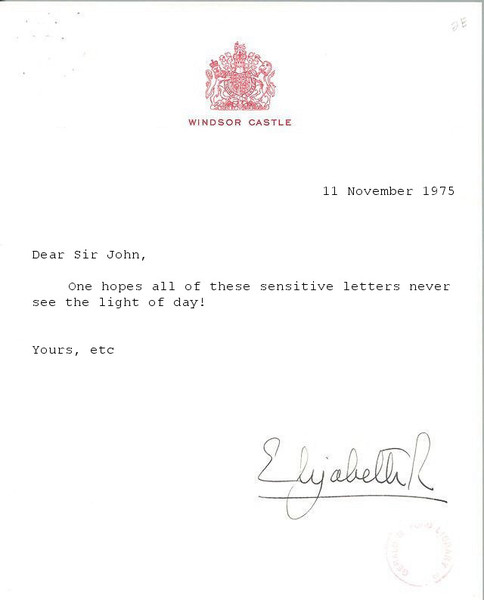
Palace letters to be released in full next week
BREAKING: First of the #PalaceLetters has been released!
www.smh.com.au/politics/federal/a-terrific-victory-palace-letters-to-be-released-in-full-next-week-20200709-p55aj5.html?fbclid=IwAR2IC8ikuFMyCmOk9ddx5AB1lIXTvZdpoMgmgsSyR5xq_Oyz3G5iDAfONt4
Oh of course
Old age moment.
Thank you Jane
Summerlove. Wouldn’t it just still be the Prime Minister?
No. The Prime Minister has to be accountable to someone other than Parliament.
A Head of State preferably an elected one.
I think it's because you Head a HeD of State to represent our country and its people's interests here and abroad.
MaizieD
I actually find it a bit weird that the Queen is the Australian Head of State. But they did opt to retain her last time they were asked.
However, I'd have no problem with them wanting to become a republic, same as I have no problem (every sympathy, actually) with Scottish independence.
I just don't fancy having a president in the UK...
Why does no monarchy = a president?
Wouldn’t it just still be the Prime Minister?
I actually find it a bit weird that the Queen is the Australian Head of State. But they did opt to retain her last time they were asked.
However, I'd have no problem with them wanting to become a republic, same as I have no problem (every sympathy, actually) with Scottish independence.
I just don't fancy having a president in the UK...
Davidhs
If that is seen as a “Terrific Victory”, life must be pretty sad for Republicans down under, perhaps that’s why there is a majority for not changing.
That's clearly not true now A poll show 62% want a Republic
theconversation.com/is-australia-ready-for-another-republic-referendum-these-consensus-models-could-work-142646
I can't see how an Elected Head of State could be cheaper than the Monarchy as Australians pay nothing towards the Monarchy, although they do pay for their Governor General, who is an Australian.
I think this link works. theconversation.com/is-australia-ready-for-another-republic-referendum-these-consensus-models-could-work-142646
A president Elected Head of State is not so expensive as the monarchy
By the way I think the palace letters news is interesting it's a part of history uncovering what was fraught to be covered up.
Davidhs
If that is seen as a “Terrific Victory”, life must be pretty sad for Republicans down under, perhaps that’s why there is a majority for not changing.
?
I guess I was a little lazy in copying from Republic but it said what I wanted to say. I am against the monarchy on principle being unelected and hereditary.
The Queen and PC was very much involved in Australian politics as the letters and correspondence show when we are led to believe that the Queen is above politics clearly not and still to this day.
OPINION POLL: 62% of Aussies want an Australian citizen as head of state.
Peter FitzSimons of the Australian Republic Movement said:
“We don’t need to stay holding Britain’s hand. It is demeaning, and unworthy of us, particularly at a time when Britain has left Europe, and we are still seen to be clinging to Britain.”
www.dailytelegraph.com.au/…/8807f7f6c42f914aece5654…
If that is seen as a “Terrific Victory”, life must be pretty sad for Republicans down under, perhaps that’s why there is a majority for not changing.
Of course, I was a bit slow on the uptake there!
It's not really anything to do with what happened nearly 50 years ago, is it! It's another stab at the monarchy and is agitated by the Republican movement in their quest for an even more expensive presidential system.
A bit disappointing for you, though, Grany that the release of the letters shows that the Queen had nothing to do with Whitlam's dismissal.
The Queen certainly does have power including the power to sign international treaties and deploy British troops abroad. It's true that most of these "royal prerogative powers" are today exercised by government, but that in itself is a serious problem. These powers have been transferred directly from the monarch to the prime minister and don't need the approval of parliament, effectively shutting out the British people from important decisions. That is fundamentally anti-democratic – and it can only happen because we have a monarchy.
The Queen and Prince Charles also have the power to veto bills that affect their private interests. Official legal advice makes clear that Queen's and Prince's Consent (as the "royal veto" is officially known) is not a mere formality. The process by which consent is obtained provides a clear opportunity for the Queen and the Prince of Wales to influence the shape and content of a bill before it reaches Parliament.
The huge waste and extravagance of the monarchy is a symptom of the main problem: the palace is totally unaccountable and is able to operate with a far greater degree of secrecy than any other part of the state. It also clearly has considerably lobbying clout within government, which explains why the government hasn't cracked down on royal spending.
However, the Sovereign Grant is just one part of the total cost of the monarchy. The royal family's security bill is picked up by the metropolitan police, for example, while the costs of royal visits are borne by local councils.
Meanwhile, income from the Duchy of Lancaster and the Duchy of Cornwall – despite belonging to the nation - goes directly to the Queen and Prince Charles respectively, depriving the treasury of tens of millions of pounds every year.
When all this hidden expenditure is included, the real cost of the monarchy to British taxpayers is likely to be around £345m annually.
Every country has a head of state, whether it is a president or a monarch. In many countries the head of state is a different person to the head of government, who is often referred to as prime minister. This is true of monarchies like Britain, Sweden and Denmark as well as republics like Ireland, Germany and Poland.
After 60 years, we're so used to the Queen as head of state that we often assume the way she carries out the role is the only way it can – or should – be done.
But because the Queen is unelected, there are important jobs she can't do – ones that an elected head of state, chosen by and answerable to the people, could.
When prime minister Boris Johnson asked the Queen to prorogue parliament (suspend it for several days) it was clear that the Queen has no independent role to play. For the first time the Queen's real job, which is to do what the PM tells her, was highlighted on prime time TV. Whatever you think about Brexit, it can't be right that the head of state is there for no reason other than do the PM's bidding.
What is a head of state for?
The phrase “ceremonial head of state” can be misleading. It suggests that the role is purely for decoration, when it is actually a crucial part of the political system.
Because an elected head of state's neutrality is prescribed by law, they can be genuinely independent of government, acting as an impartial referee of the political system and an extra check on the power of government.
If there's a risk that a new law may breach fundamental rights or principles, for example, a head of state may refer it to the Supreme Court. Or if there is widespread public opposition to a bill, the president may consult the people in a referendum. These powers are rarely used, but vitally important in a democracy.
Aside from these formal functions, a president represents their country on the world stage and takes a leading role at times of national celebration, uncertainty or tragedy. In carrying out these parts of the job, an elected head of state knows they will be held to account for their words and actions, providing a strong incentive to be unifying and inclusive.
If a president attempts to overreach their powers, there's a clear process for removing them from office - unlike a monarch. And a president is paid a straightforward annual salary, usually with a small office and one official residence; the public is not expected to fund their extended family or maintain multiple homes.
Republic calls for a constitutional head of state.
That was the system then 50 yrs ago, it has changed, the head of state now has a purely courtesy and ceremonial role with no powers to intervene. Whitlam tried to do too much too soon and was defeated by a massive margin at the election
If Australia was to have a President it would probably cost more than the present system, but it is entirely their choice.
Is it news ? I haven’t heard it discussed
Is it only 'news' if you've heard of it, Ab? Really?
It's news because it has overturned the usual conventions regarding the disclosure of historic administrative documents. I would suspect that there was a 100 year embargo on these...
I am sure she does express her views when the PM has an audience with her.
I doubt if he takes any notice of them, though. He knows that she has no power* after his unlawful prorogation of parliament.
*Perhaps the Whitlam episode taught her to be very wary of using what little power she theoretically has.
janeainsworth
Here’s a hypothetical question.
Suppose a Conservative Government in the U.K. becomes increasingly right wing and a sinister, Svengali-like figure is pulling the Prime Ministerial strings. The Army is being used for non-military purposes to enforce the Government’s far-right agenda.
What should the Monarch do?
Should she stand by and do nothing?
Or should she interfere in the democratic process?
I wonder if HM has let Boris know her thoughts on Cummings?
Sometimes I think it would be a good idea for the Head of State to step in if democracy is threatened.
I am sure she does express her views when the PM has an audience with her.
Is it news ? I haven’t heard it discussed
Maizie I suppose my thought process is that democracy is held up as something which we should respect, revere and interfering with it is an unspeakable crime.
Why? I'm not sure what is so wonderful about it. Our present democratically-elected government is bad enough, but what passes for democracy in America has resulted in the world being in the most perilous state in decades, at the whim of a narcissistic tyrant.
I think it was the Chinese Ambassador who said the other day that only 10% of the world's population lived under a democratic system & we should stop trying to impose our values & systems on everyone else.
Well he would say that, wouldn't he, but maybe there's a grain of truth in what he says.
And no, don't ask me what the answer is 
Why Goof Whitlam is relevant now is a mystery to me
It doesn't have to be 'relevant', David. It's news and it's interesting. Isn't that sufficient?
To add to your 'hypothetical, janeainsworth, would the army allow itself to be used in that way?
Plenty of coups have been initiated by the military objecting to the regime in power. It is well known that ultimately 'power' is in the hands of those who control the means of enforcement. If the army doesn't co-operate the regime is powerless to enforce its will.
So, if the army doesn't support the agenda the regime falls/fails.
I infer from your 'hypothetical' that I'm not the only person who anticipates the possibility of government by intimidation rather than by consent. 
I wonder how many others are thinking this way. Perhaps we should start a thread...
Here’s a hypothetical question.
Suppose a Conservative Government in the U.K. becomes increasingly right wing and a sinister, Svengali-like figure is pulling the Prime Ministerial strings. The Army is being used for non-military purposes to enforce the Government’s far-right agenda.
What should the Monarch do?
Should she stand by and do nothing?
Or should she interfere in the democratic process?
Join the conversation
Registering is free, easy, and means you can join the discussion, watch threads and lots more.
Register now »Already registered? Log in with:
Gransnet »