
To continue the Civil War theme, if Parliamentarians are spinning in their graves, Charles 1 must be laughing his head off...
Gransnet forums
News & politics
Johnson wanting to overrule the judiciary !
(58 Posts)Thought this must be a hoax but apparently not. Scares me that this could even be a possibility let alone becoming enshrined in law.
I so hope Parliament will treat this with total disdain. What next ? Makes me think we are going the way of the US - please no !!
and people just don't care, and if they start to take notice then Johnson and the press will distract them with something else, probably the birth of the next Johnson baby. Twitter is alive with people writing about this, intelligent articulate people who are desperately trying to warn everyone.
About government and parliament
A government with too much power.
A parliamentary system should put parliament at the centre, accountable only to the voters. In the UK parliament is weak in the face of government power, and that's largely because of the Crown and the monarchy.
The Crown gives the government huge powers to take decisions without parliament or to control parliamentary business, whether that's deciding when parliament will be running or having the power to ensure proposed laws they disagree with have little chance of getting passed.
The monarchy also denies us an independent, effective head of state. That means there is little check on the use of royal powers and no-one to arbitrate during political crises. It's like having a football match with no referee.
Parliament is weak in the face of government, largely there to do what it's told. But in terms of the power of make laws, change our constitution and determine our rights, parliament is all powerful.
In the UK parliament is sovereign, which means it's the highest power in the land. No court can overturn a decision made by parliament, no treaty can override laws passed by parliament. A court could rule that a law conflicts with a treaty, or with another law, but a judge can't override or scrap that law.
That's not how a democracy should work. Parliament is there to work for us, not to rule over us. And given the control government has over parliament, the current constitution ends up concentrating huge amounts of power in the hands of the Prime Minister and government ministers.
In terms of domestic law the British government is one of the most powerful in the democratic world.
A real parliamentary democracy
The answer to this is simple enough. There's no need to throw the whole constitution out the window. We just need to make every part of it more democratic and re-balance power between people, parliament and government.
Nezumi65
I have been following this story for a while - there are sane Tory MPs who think this is a step too far. Whether enough of them are prepared to put their necks on the line to do the right thing remains to be seen (I doubt it).
I wonder when the tory sheep MPs will wake up to the fact that the Executive is working to do them out of a job. Pass a bill putting the Executive above the law and bingo, MPs aren't needed any more... The law is whatever the Executive says it is... Judges have to comply or lose their jobs...
Exactly, that was my point.
And a step in the bypassing of discussion by those "elected representatives" who are supposed to be sovereign.
Proroguing meant that by the time they reconvened, the deadline for Brexit would be past and further discussion would be too late. It may have been a tactic in another battle, but it was a clincher in the Brexit one.
Dickens
"You know all those documentaries you've watched about a dictator's path to power?
You know there's always the bit where you think: "Why didn't people do something? They could have stopped him while there was still time"?
That's the bit we're at."
- George Monbiot (1 Dec 21)
... not my most favourite writer / columnist, but I believe he has a point...
That's precisely what I have thought when watching documentaries about Germany's build-up to the Holocaust. Never have I come up with a plausible answer. 
Sorry, but prorogue was simply a tactic in that instance surely.
Time to get all your ducks in a row and ensure no buggers against you when you reconvene. Or have I missed the point ?
I have been following this story for a while - there are sane Tory MPs who think this is a step too far. Whether enough of them are prepared to put their necks on the line to do the right thing remains to be seen (I doubt it).
or even 
trisher
There was another thread about how the Tories would replace Boris. This just shows why they won't. Only an unscrupulous meglamaniac would want this to go down as their legacy in government. Anyone with a smidgen of belief in parliamentary democracy would hesitate to do this.
We'll have to sharpen those pitchforks, trisher [grin
There was another thread about how the Tories would replace Boris. This just shows why they won't. Only an unscrupulous meglamaniac would want this to go down as their legacy in government. Anyone with a smidgen of belief in parliamentary democracy would hesitate to do this.
"You know all those documentaries you've watched about a dictator's path to power?
You know there's always the bit where you think: "Why didn't people do something? They could have stopped him while there was still time"?
That's the bit we're at."
- George Monbiot (1 Dec 21)
... not my most favourite writer / columnist, but I believe he has a point...
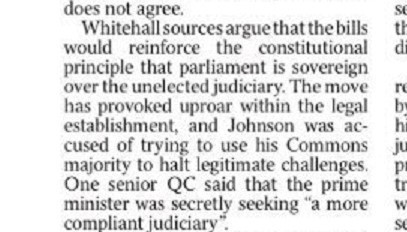
A pertinent paragraph.
'Government' seem to have got their understanding of themselves a bit muddled here. It is Parliament that is sovereign, not the Executive (the government). 'Parliament' is the sum total of the House of Commons and the House of Lords. And being 'sovereign' does not mean being above the Rule of Law.
With a big majority and MPs who seem to be oblivious to the fact that the Executive is bent on overturning Parliamentary Sovereignty and the Rule of Law this proposal could well become law and the Executive would reign supreme.
We fought a bloody civil war in the 17th C to establish the supremacy of Parliament and prevent dictatorship by the Crown (which the Executive in parliament represents). Every Parliamentarian from then onwards must be turning in their graves in utter horror and disbelief at this proposal.
I will forebear to make comparisons with Nazi Germany...
A correction - he wanted to prorogue Parliament, not dissolve it. There is a difference.
Thanks Elegran, that's very helpful. Much appreciated.
My protesting days were over after the council tax debacle to be honest but this I will happily fight. This is not Democracy in any way, shape or form, as flawed as it is .I have no wish to see the return of Autocracy in this country - banners at the ready !!
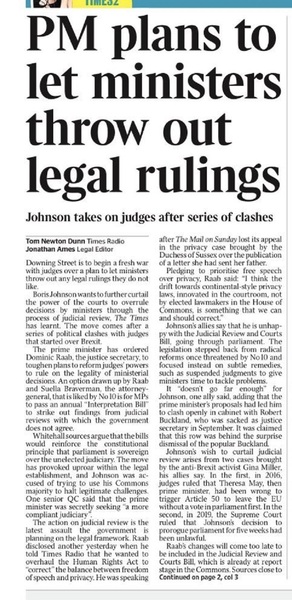
The Times
The Guardian article was published on Tue 1 Dec 2020. It includes the prediction that "Many have assumed the poll will be in May but it could be as late as December" The poll must be imminent for it to have hit the fan now. Perhaps he hopes to push it through before the Christmas recess? A typical ploy.
Germanshepherdsmum Try the guardian instead.
www.theguardian.com/politics/2020/dec/01/boris-johnson-publishes-plans-to-take-power-back-from-courts-and-mps
"Boris Johnson will scrap the need for parliamentary approval to call elections, and ban the courts from questioning the dissolution of parliament under legislation that hands powers back to the prime minister."
This was predicted when Johnson was humiliated by the Scottish law lords' verdict on his plans to dissolve Parliament early so as to get Brexit passed.
Dictatorship, here we come! If this is alowed through, the next legislation will be easier. Will it be to give a Prime Minister the power to vote himself into the job for life?
For evilt to flourish, it is necessary only that good men should do nothing - and the price of freedom is eternal vigilance. Two old truisms which should not be forgotten by a complacent electorate, or by complacent elected representatives who could find themselves mere rubber-stampers if they don't uphold the freedoms which greater men and women than them have fought for.
The link only works if you subscribe so I remain in total ignorance (not unusual for me).
Link
www.independent.co.uk/news/uk/politics/boris-johnson-reforms-judicial-review-b1970290.html
If we had a Head of State who acts in the interests of the people instead of only being able to do what the PM asks her this would not be allowed to happen. Just saying
The Independant, The Times. Seems to be under the radar at the moment with so much else at the forefront of concern but the very idea any government could interfere in this way leaves me speechless.
Join the conversation
Registering is free, easy, and means you can join the discussion, watch threads and lots more.
Register now »Already registered? Log in with:
Gransnet »