Gransnet forums

News & politics

Who is influencing this government? -and who is funding that influence?

(65 Posts)
varian Tue 27-Sept-22 09:49:46

What goes on at 55 Tufton Street?

www.bbc.com/news/uk-politics-63039558

growstuff Thu 29-Sept-22 14:39:12

DaisyAnne There isn't a country in the world (with the possible exception of North Korea) which doesn't have some form of market economy. The crucial factor is the interaction between the state and the economy, with some states opting to exercise greater control.

growstuff Thu 29-Sept-22 14:36:10

Katie59

I’m not agreeing or disagreeing, just throwing ideas around.

We have full employment in this area everyone is desperate for staff since EU workers left, the only jobless are unemployable, for whatever reason can’t or won’t hold down a job. All the migrants found accommodation somewhere and if more come the same will happen, many were not low paid and rented houses at the market rate, others lived in service accommodation

Nationally, we have nothing like "full employment".

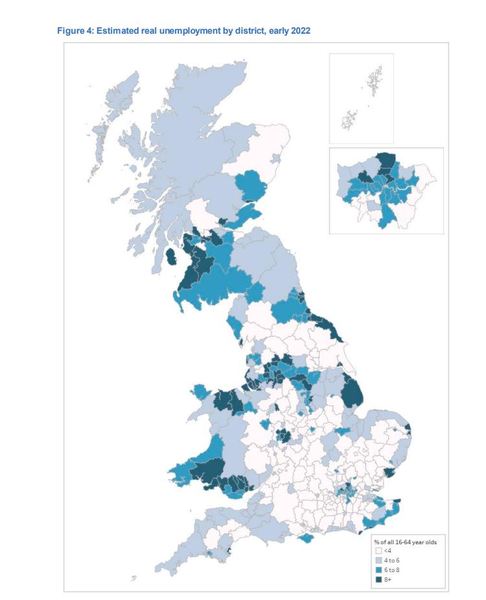
I live in an area with very low unemployment (1.9%), but that's not typical - neither is your area Katie59.

The attached shows the differences in various areas. It's from the report I linked to earlier.

I looked up some more details of my area. The latest income figures I could find were for 2016, but back then approximately 15% of the working population had household incomes over £100,000 - I would guess it's higher now. That's much higher than the national average and is an indication of the divided nation we have become.

Property prices are high and public transport is poor. Most of the high earners work in the City (London) or in Cambridge (biotech). There is low paid work available, but people quite simply can't afford to live here and can't even commute to the area unless they have their own transport because we have so few buses. Those who can afford to live here will no doubt benefit from the recent tax cuts.

It would benefit the area as a whole, if jobs were available elsewhere because we wouldn't have so much pressure on infrastructure. There are other areas like mine, just as there are those where there is little well-paid work and new jobs could be created. An example would be the North East, which has a history of engineering and could become a hub for renewable technology - if there were a will to invest.


Grantanow Thu 29-Sept-22 13:57:07

I won't be voting Tory next time!

Whitewavemark2 Thu 29-Sept-22 10:56:31

Tbh listening to her replies on the different radio stations - she is clueless.

Truss it has become obvious has sold her soul to the Tufton Street free marketeers in order to become PM, without having a clear understanding of laissez faire economics on speed as the major economic event last Friday indicated they intend to pursue.

Whitewavemark2 Thu 29-Sept-22 10:37:12

Listening to her replies, Truss clearly doesn’t understand how the price cap works.

DaisyAnne Thu 29-Sept-22 10:35:06

growstuff

Spreading the wealth/employment opportunities would also benefit the areas with "full employment" because it would relieve the pressure on the labour and housing markets.

Very true.

I would see the LP as the party more likely to do this than the ERG. I do get the idea of a "market economy", but that seems to ignore the influence of governments.

All governments influence what jobs are or aren't created. The middle ground parties seem to have little influence, although the Greens seem to have affected LP policy.

MaizieD Thu 29-Sept-22 10:32:25

Katie59

I’m not agreeing or disagreeing, just throwing ideas around.

We have full employment in this area everyone is desperate for staff since EU workers left, the only jobless are unemployable, for whatever reason can’t or won’t hold down a job. All the migrants found accommodation somewhere and if more come the same will happen, many were not low paid and rented houses at the market rate, others lived in service accommodation

But, as growstuff points out. It's not always financially feasible (or practical) for people to move to other areas for work .

When Norman Tebbit's father (or was it his grandfather) got on his bike to find work in the '30s he wasn't going to be going far outside his home area, and moving from place to place was actually easier than now, more housing available and people had less to move!

When I did a study of community in my area of the Durham coalfield I found that people frequently moved for better jobs, but it was easy for them, houses usually went with the miners' jobs and they could load all their possessions on a small cart to move them a few miles... This was happening at least until the mid 20thC.

Whitewavemark2 Thu 29-Sept-22 10:32:18

So at last Tufton Street has a fully on board team of believers in Truss and Kwarteng.

The issue I think is that neither of them appear to understand exactly what would happen judging by Truss’s replies on local radio this morning.

I suspect that her replies to the interviewers had her party holding their heads in disbelief, and it doesn’t bode well for QT if she ever turns up.

Katie59 Thu 29-Sept-22 10:22:21

I’m not agreeing or disagreeing, just throwing ideas around.

We have full employment in this area everyone is desperate for staff since EU workers left, the only jobless are unemployable, for whatever reason can’t or won’t hold down a job. All the migrants found accommodation somewhere and if more come the same will happen, many were not low paid and rented houses at the market rate, others lived in service accommodation

growstuff Thu 29-Sept-22 10:14:02

Spreading the wealth/employment opportunities would also benefit the areas with "full employment" because it would relieve the pressure on the labour and housing markets.

DaisyAnne Thu 29-Sept-22 09:59:30

growstuff

Full employment is a myth. There are many areas of the country where unemployment is high (14% in Blackpool). Most of these areas are former industrial towns. The problem is that people can't just move for work because accommodation costs in high employment areas are much higher.

There is only "full employment" in the better-off parts of the country, as Growstuffs post implies. Those on incapacity benefits, are not counted in the unemployment figures. In places where there are labour shortages and help is available, some people claiming incapacity benefit can find suitable employment. No one offers such help in areas poor in work availability because the need doesn't exist. The people are not making fraudulent claims; it's just employers find it worth their while to offer help in better-off, low unemployment areas.

Sheffield Hallam University has been surveying this phenomenon every five years. The most recent report is their sixth. By adding in the hidden unemployed – people who are on incapacity benefits but who would be working in a truly full employment economy – the researchers come up with an unemployment total of 2.34 million – a million higher than the government’s preferred yardstick for joblessness. (Guardian, May 2022)

The answer is not to attack those who claim incapacity benefits but to ensure growth in those areas and spread the wealth, or at least an ability to survive with dignity, over the country.

growstuff Thu 29-Sept-22 09:37:24

Sorry! This is the link:

shura.shu.ac.uk/30252/1/real-level-of-unemployment-2022.pdf

growstuff Thu 29-Sept-22 09:35:30

This is a direct link:

www.shu.ac.uk/centre-regional-economic-social-research/publications/the-real-level-of-unemployment-2022

growstuff Thu 29-Sept-22 09:34:43

The real level of unemployment 2022: the myth of full employment across Britain

shura.shu.ac.uk/30252/

The above is an interesting read about (un)employment in the UK.

We are now officially in recession and unemployment is likely to increase. Unfortunately, the areas which already have the highest unemployment are likely to be hit hardest, thus exacerbating the issue of regional inequality. That's why government intervention is needed to encourage the creation of well-paid, secure jobs in certain areas.

MaizieD Thu 29-Sept-22 09:30:41

growstuff

Full employment is a myth. There are many areas of the country where unemployment is high (14% in Blackpool). Most of these areas are former industrial towns. The problem is that people can't just move for work because accommodation costs in high employment areas are much higher.

Without wanting to sound like a PPB (just learnt that acronym and need to show it off) but Labour's plan for investing in green energy and insulation would bring jobs to the regions, as would most public spending. Teachers, nurses, builders etc...

MaizieD Thu 29-Sept-22 09:25:46

I'm not altogether sure if you are agreeing or disagreeing with my suggestion, Katie59.

But we surely don't have to wait for mass unemployment and destitution before attempting to rescue the economy?

I think our full employment is spurious. The criteria used for determining 'in employment' is, let me remind everyone, is that someone should be in paid employment for 1 hr per week.

fullfact.org/economy/employment-since-2010-definition/

growstuff Thu 29-Sept-22 09:13:08

Full employment is a myth. There are many areas of the country where unemployment is high (14% in Blackpool). Most of these areas are former industrial towns. The problem is that people can't just move for work because accommodation costs in high employment areas are much higher.

Katie59 Thu 29-Sept-22 08:58:51

In both cases it was a response to mass unemployment and destitution of large numbers of people, money was poured into improving infrastructure, manufacturing and armaments. Conscription was used to mobilize the labour to do the work. Ultimately that led to nationalism and WW2

We don’t have that situation now, we have full employment, although we need some infrastructure improvement, notably energy, otherwise we should be consuming less not more, traveling less too.

Any large scale infrastructure plan is going to mean a lot of migrant labour or redeploying large numbers of the UK workforce. I might even approve of such a plan if I knew what it was.

growstuff Thu 29-Sept-22 00:15:23

In Schacht's case, initiatives had a definite goal (war). I suspect that's what Katie meant. The measures Schacht took were fine and halted Germany's hyperinflation. He resigned when he opposed expenditure on rearmament. In many ways, he was a man ahead of his time.

MaizieD Thu 29-Sept-22 00:02:32

growstuff

I'm sure Katie59 can respond herself, but I think she was referring to Hjalmar Schacht's initiatives, when he was Finance Minister, not the previous hyper-inflation.

Sorry, assumed it was Weimar because it generally is.

Schacht's initiative seems to have been very successful, based on a money substitute which was redeemable for currency, and illustrates the point I was making about state investment rescuing the economy.

So why would neither initiative (Roosevelt's or Schacht's 'not go down well'?

growstuff Wed 28-Sept-22 23:20:33

I'm sure Katie59 can respond herself, but I think she was referring to Hjalmar Schacht's initiatives, when he was Finance Minister, not the previous hyper-inflation.

MaizieD Wed 28-Sept-22 22:41:33

I’m not sure Roosevelts methods would go down too well these days, there was of course another regeneration campaign in the 1930s in Nazi Germany

But in 1930s Germany there was minimal control over the issue of money.

You can't pour it in without taking much of it out again.

Which is why I keep pointing out that most of the 'created' money spent by the state would return to it by way of taxation. Some might be saved for awhile for future use, but as soon as it's used it is subject to taxation.

It's countries which have very poor tax regimes, or a scarcity of resources to purchase, which suffer hyperinflation.

GagaJo Wed 28-Sept-22 22:02:24

Dickens

MayBee70

It’s hard to believe it’s happening It crossed my mind tonight that this country is like an abused person who has been so badly treated for so long they don’t expect anything better. I never thought I’d be terrified of growing old in this country and I never thought I’d question whether it was right to bring children into the world.

Neil Kinnock was right...

I warn you not to be ordinary, I warn you not to be young, I warn you not to fall ill, and I warn you not to grow old.

... he knew.

Read Britannia Unchained authored by Kwasi Kwarteng, Pritti Patel, Dominic Raab - it's all there.

In the mad rush to get Brexit done, did any Tory voter who "lent" their vote stop to think about the ideology of the party they were giving it to?

The warning signs were all there - the comments (on record) made by Johnson, Rees-Mogg, etc about the working class, the contempt in which they hold us.

"I couldn't vote for Corbyn" cried the Left. Yes, how evil - he wanted a better society for the many, not the few... the bastard.

"Labour will bankrupt the country" they said. Hollow laugh from me as I watched the £ tumble after Truss' / Kwarteng's bonanza spooked the markets.

God, I'm so angry right now.

Oh exactly, exactly Dickens!

Katie59 Wed 28-Sept-22 21:49:27

Think Roosevelt's New Deal, a massive programme of state investment, which rescued the US from the effects of the 1930s Depression.

I’m not sure Roosevelts methods would go down too well these days, there was of course another regeneration campaign in the 1930s in Nazi Germany

DaisyAnne Wed 28-Sept-22 17:01:07

MaizieD

DaisyAnne

I have just been listening to Paul Johnson he points out:

If Labour wins the next election, they are likely to inherit a lot more economic problems than Blair did in 1997. Committing to big tax cuts when public finances will be in a poor state and they will want to increase public spending is risky for them too.

He also said that logically, this government should freeze all state spending for five years while any upturn (assuming there is one) fed through, unfreezing areas and putting money into them as we became better off. He didn't sound as if he thought this was a good idea, just the other side of hiking up the income of the rich. Sadly, because we are all aware they want to get rid of the NHS, etc., it may have been/be, what they are planning to do.

Cutting or freezing state spending is the very last thing we should be doing. Johnson is still working on the 'household budget' theory of national finances.

Osborne tried it and just created a depression/recession that it took a number of painful years to get out of. And left the country weakened by poverty and deprivation.

The economy needs money putting into it. I can't see businesses or overseas investors doing it (apart from asset stripping disaster capitalists). If no-one else will do it the government needs to do it. It doesn't matter what the source of the money is; only investment will save us. State money is as good as anyone else's and, as all state enterprise is supplied by private business providing goods and services, and we have the resources available to purchase, it cannot do anything but revive the economy.

Think Roosevelt's New Deal, a massive programme of state investment, which rescued the US from the effects of the 1930s Depression.

I could not agree more Maizie, but I have a horrible feeling that is or was, exactly what they were intending.