Gransnet forums

News & politics

Isn't it time we raised the cut-off age for paying NI

(183 Posts)
DaisyAnne Sun 20-Nov-22 10:31:37

From the beginning of our State Pension, it was paid from an age close to the life expectancy age.

Life expectancy is now 79.2; the median age at death is 82.3. We cannot ask people to work to that date. However, we could ask that those with a comparable income to those of working age to pay comparable NI until, say, 80.

I believe that if we do not use this source of extra income, we will see people expected to have private health insurance. Insurance that many of the poorest paid and the elderly will simply not be able to afford.

growstuff Sun 20-Nov-22 15:26:52

maddyone

People already have to work till 68 and pay NI now till they’re 68. I think they’ve paid enough during their lifetime.

No, they don't. The current age for receiving SP is 66 and will increase to 67 for those born in 1961.

Sorry, but on average they haven't paid enough. The current generation of workers is subsidising them.

Bea65 Sun 20-Nov-22 15:24:37

maddyone totally agree with you...am unable to retire now at 66..and paid over the NI contributing years..but now have to pay tax albeit reduced work hours due to SP now payable so feel am taxed again...

maddyone Sun 20-Nov-22 15:12:26

People already have to work till 68 and pay NI now till they’re 68. I think they’ve paid enough during their lifetime.

maddyone Sun 20-Nov-22 15:10:14

Casdon

The issue I have with this is that it changes the goalposts when older people have already made, and are living within their income. Most people live on their nest egg, and don’t continue to invest money once they have retired, being property rich does not mean that most can afford to live extravagant lifestyles or to pay an additional tax which they had not budgeted for.

I suppose it could be called the sour grapes tax, how dare some people be fortunate enough to have saved enough to live comfortable retirements, let’s make them pay for it - levelling down.

Yes, correct Casdon.
How very dare they?

growstuff Sun 20-Nov-22 14:34:57

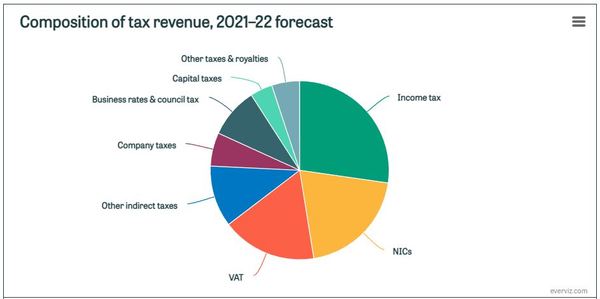
This was the Treasury forecast for tax revenue in 2021-22:

27% of the total comes from Income Tax
20% of the total is from NICs

So if a person doesn't pay NICs for whatever reason, "income tax" is effectively almost halved. I don't think that's fair.

It also shows that over half of the Treasury's income is not from income tax nor NICs. It's almost impossible to escape tax of some sort, which is why it's nonsense when people talk about "taxpayers" as a distinct group when we're all taxpayers.

DaisyAnne Sun 20-Nov-22 14:17:03

That's accountancy growstuff grin

Oreo Sun 20-Nov-22 14:05:45

Wyllow3

And yes, I think people who are well and above pensionable age who work should still pay NI, up to a higher cut off point. It goes against the grain in one way, but money has to be raised. At any age, health is utterly variable and the fortunate are still paying into a pot they will benefit from.

That seems fair to me.

Beautful Sun 20-Nov-22 14:01:11

I am far from being well off or rich ... but ... I would be willing to pay something towards the NHS if it helped to keep it for my children & future generations ... can't see why people don't unless genuinely can't afford it ... a lot of people could afford to pay but won't / wouldn't ... I also have a private medical scheme ...

growstuff Sun 20-Nov-22 13:46:06

DaisyAnne

It would help if people knew what the government uses to make its decisions and what many voters believe is a reasonable form of accounting. Posters seem not to check before they make statements of what they 'believe' happens. Why then would anyone value their opinions?

www.gov.uk/government/publications/national-insurance-fund-accounts/great-britain-national-insurance-fund-account-for-the-year-ended-31-march-2021--2

If posters insist that they "wouldn't do it this way", they tip themselves out of any argument because, currently, it is being accounted for in this way.

It's interesting how "flexible" the accounting is, including transfer of funds from and into the NIC fund to maintain an acceptable accounting balance.

growstuff Sun 20-Nov-22 13:45:00

Dinahmo

Times are changing. There are now work place pensions into which schemes employees must be automatically enroled. Obviously there are certain parameters concerning age and salary (and a few more). There are also certain options if you change jobs.

I think that they are a good idea because it gets young people into the idea of regular savings, even if their contributions are small. The employer must also contribute.

But this is about state contributions and benefits, not private pension schemes.

Dinahmo Sun 20-Nov-22 13:21:25

Times are changing. There are now work place pensions into which schemes employees must be automatically enroled. Obviously there are certain parameters concerning age and salary (and a few more). There are also certain options if you change jobs.

I think that they are a good idea because it gets young people into the idea of regular savings, even if their contributions are small. The employer must also contribute.

growstuff Sun 20-Nov-22 12:51:19

No DaisyAnne I didn't mean you. I'm with you on this one. I can see that you realise that people don't build up a "personal pot" - many people do think that.

DaisyAnne Sun 20-Nov-22 12:42:59

It would help if people knew what the government uses to make its decisions and what many voters believe is a reasonable form of accounting. Posters seem not to check before they make statements of what they 'believe' happens. Why then would anyone value their opinions?

www.gov.uk/government/publications/national-insurance-fund-accounts/great-britain-national-insurance-fund-account-for-the-year-ended-31-march-2021--2

If posters insist that they "wouldn't do it this way", they tip themselves out of any argument because, currently, it is being accounted for in this way.

sodapop Sun 20-Nov-22 12:35:40

growstuff

Casdon I agree that it would have to be introduced gradually, so people can plan, but I also agree DaisyAnne's post.

Unless everybody gets used to paying more for healthcare, we're heading for a situation where only the very basics are provided and only wealthier people can afford to top up with private insurance. I would prefer to see a system where everybody is contributing and we return to the principle where those who can afford to pay more do pay more.

Absolutely agree growstuff we need to pay more into the health care pot.

DaisyAnne Sun 20-Nov-22 12:29:46

growstuff

I agree with you Maizie that it's nothing to do with paying pensions, benefits or social care/healthcare. People don't build up an individual pension pot.

It would be fairer to amalgamate direct taxes and NI, but I don't think that will happen because people only ever read about the "headline" taxes and governments manipulate that.

I think pensioners and people such as SAHMs should be paying towards their healthcare. Maybe it's time to have a separate pension insurance because there's very little fairness about the current system. That's what happens in Germany. People pay into separate state-backed insurance schemes for unemployment, pensions and healthcare. There's a safety net for those who fall through the holes.

I don't think you meant me but just to clarify, I most certainly didn't say that people do build up a personal "pot". I'm not sure Maizie was saying that either.

DaisyAnne Sun 20-Nov-22 12:27:59

MaizieD

I carried on working until I was 3 years above the then pension age. I thought it was absurd that I stopped paying NI once I'd hit 60' I would have been happy to continue to pay it.

So, I think it reasonable that pensioners pay it if they are still employed. Otherwise, no.

It is only a tax, after all. It has nothing to do with paying our actual pensions or benefits.

It has because the government and many of the voters chose to use general accounting to keep track of it.

There are accounts that tell you what goes into the NI fund and what comes out. You may not want it to be that way but currently it is the way it is shown. How else do you keep a track on government spending?

DaisyAnne Sun 20-Nov-22 12:25:01

Wyllow3

Where would you set the base line income to start paying, DaisyAnne?

As it is a graduated tax why not just raise income tax? although in theory NI pays for the NHS, in reality its just put in the same pot.

NI is composed of two elements, the employers contribution, and the workers contribution. So it wouldn't be a 'proper' NI as there is no employers contribution for pensioners.

Raising income tax allows for the sleight of hand that says we "cannot afford" a National Health Service. I would prefer us to be paying into a (National) Health Insurance. People have weird views of National Insurance. Most know what private health insurance is and could then equate our Health Insurance with that.

I repeat, where else do the elderly get health coverage but not pay for it, usually considerably more? I can understand helping those in difficulty. However, if you earn the same income through pensions and investments as someone working, why would you not pay at least the same health insurance contribution?

If you raise National Insurance as it is now, you only raise it for the working-age population. Originally, we didn't pay for the NHS from NI; it came from general taxation. Doing so now has clouded the issue. NI should only pay working-life insurance benefits (including a pension)

Take health out and make it separate. You could do this by reducing NI by the "health" amount, reducing general individual taxation by the amount going into the NHS and paying the sum of those two into a (National) Health Insurance.

The discussion about what needs more (or less) is then clarified.

Dinahmo Sun 20-Nov-22 12:09:08

Wyllow3

And yes, I think people who are well and above pensionable age who work should still pay NI, up to a higher cut off point. It goes against the grain in one way, but money has to be raised. At any age, health is utterly variable and the fortunate are still paying into a pot they will benefit from.

Anybody who is over the pension age and is in employment does not pay NIC but their employers do, assuming that the salaries are above the exempt amount. I suspect that many retirees who continue to work are part time and their earnings will be below the primary threshold of £9880 pa (2022/23).

Assuming that pensioners who are still working earn less that the primary threshold, which is, of course below the personal allowance why should they pay NIC when someone who is younger, with the same amount of earnings, does not.

Kate1949 Sun 20-Nov-22 12:07:48

I'm with henetha. I was dragged up in the back streets of Birmingham. We had very little. When our parents died they left no house, nothing. My husband's parents were the same.
We've both worked constantly - me since age 16, my husband 15. I hated my last job where I was for many years but ploughed on as I had responsibilities. I too have earned my pension.

growstuff Sun 20-Nov-22 12:05:14

DaisyAnne

growstuff

NI isn't ring-fenced. It's just another form of tax. Yes, I do think it needs to change. The government keeps the "headline" income tax down, but increases NI. Of course, that means that Conservative core voters (pensioners) aren't affected.

I don't think NI in its current form is the way to do it, but I do think all adults (including the retired and economically inactive) should pay some form of National Health Insurance. It would need to be graduated and mean-tested for those who genuinely can't pay.

It is pretty much "ring-fenced" if you look at the accounts for it.

I agree that a separate NHI or HI would be easier to understand. With only 20% coming from NI and the rest from general taxation how on earth can we tell what we can and can't afford. I think that is why we may not get it separated sad

We're going to end up with profit-making insurance schemes anyway. I would rather the state took the initiative and ran a scheme for everybody (not just those who could afford the top ups) on a non-profit basis.

growstuff Sun 20-Nov-22 12:01:51

You're wrong Dinahmo. Many baby boomers have inherited property, which didn't happen in the past. The whole economy has been geared towards property ownership and assets rather that income. I'm not claiming all baby boomers have benefited, but many have. Just look at the OBS stats.

growstuff Sun 20-Nov-22 11:59:19

Casdon I agree that it would have to be introduced gradually, so people can plan, but I also agree DaisyAnne's post.

Unless everybody gets used to paying more for healthcare, we're heading for a situation where only the very basics are provided and only wealthier people can afford to top up with private insurance. I would prefer to see a system where everybody is contributing and we return to the principle where those who can afford to pay more do pay more.

Dinahmo Sun 20-Nov-22 11:57:57

growstuff

biglouis

Not all of us "boomers" (god how I hate that term) are sitting on million pound houses that we inherited from mummy and daddy. Some of us came from shit poor backgrounds and have worked out way up by hard work, study and determination to have a better life than out parents.

No, but many are.

I doubt that many of us baby boomers inherited large amounts of money from our parents. My DH and I certainly didn't. My own father died aged 55 and although my mother received the widows' pension and part of his employment pension it was not the full entitlement because of his age. My mother had Alzheimers and was in a nursing home for a number of years, partly funded by the proceeds from the sale of the family home. My FIL was also in a care home for a number of years, also funded in part by the proceeds from his house.

Our wealth, such as it is, came from the increase in value of our homes over the years. I suspect that, like us, many of you bought "do-uppables" and so added value to our homes. We spent as much as we could afford, often going without, in order to do this.

Back in the 60s when I started work there was not the emphasis on pensions. Large organisations, such as banks and insurance companies had some sort of pension scheme but you had to have been in employment for usually two or three years before you could join. Back then it was easy to change jobs but when you did any pension contributions were refunded.

If you were employed by the state, such as teachers, lecturers and health workers and changed jobs, it would usually be within the same sector and so you stayed within the same pension scheme.

Some of us are casualties of the Equitable collapse. Others of the decimation of pension funds, such as that of the Daily Mirror by Maxwell and the BHS by Phillip Green. Maxwell stole millions from the fund which was partially replenished by the taxpayer and the pensioners eventually received about half of their pension funds. Green also repaid some money so that the BHS workers will eventually get part of their pension.

Most of my working life has been in small businesses without a pension scheme. I chose to put as much money as possible into buying a house, knowing that home would eventually fund any care that we might need. I also chose to carry on working which I am still doing aged 75. I am lucky in that my job is not physical and also that I have several loyal clients. My problem now is that I no longer have the physical stamina to work the long hours that I used to, especially in January.

DaisyAnne Sun 20-Nov-22 11:57:51

growstuff

NI isn't ring-fenced. It's just another form of tax. Yes, I do think it needs to change. The government keeps the "headline" income tax down, but increases NI. Of course, that means that Conservative core voters (pensioners) aren't affected.

I don't think NI in its current form is the way to do it, but I do think all adults (including the retired and economically inactive) should pay some form of National Health Insurance. It would need to be graduated and mean-tested for those who genuinely can't pay.

It is pretty much "ring-fenced" if you look at the accounts for it.

I agree that a separate NHI or HI would be easier to understand. With only 20% coming from NI and the rest from general taxation how on earth can we tell what we can and can't afford. I think that is why we may not get it separated sad

growstuff Sun 20-Nov-22 11:54:16

mokryna

I believe that when companies install an automated machine to replace people because (no sickness/holiday/breaks) it is cheaper, they should be made to pay NI for the people they would have employed each year, eg supermarket’s cashier place would be a two person job (8am-10pm). It should be in all offices and factories.
It would help to plug a hole in the NI debt.

What about the extra people they employ to develop automated systems? How about people realising that the world of work is changing. How about the country investing in the kind of skills which are needed in the modern world? If a machine can do the job of humans, so be it. Maybe the labour released from doing mundane jobs could be redirected to tasks which benefit humanity.
