
I really think it is the problem DAR - the power of existing vested interests to completely scupper any meaningful changes to the social care system.
Gransnet forums
News & politics
Burnhams Tax on Cash ISAS and Death tax
(195 Posts)These are big money taxes that most of us are going to pay, Im beginning to really like his tax ideas they will provide the money that needs to be spent without borrowing.
The state will have to manage and control such vested interests- just as it did when it implemented the National Health Service via commissioning processes. It's part and parcel of the reform. Part and parcel why it's so challenging. Part and parcel why no party and no PM has ever resolved the issue.
The 2 flip sides need reforming- state commissioning of social services alongside the state regulating and ensuring service provision ie the delivery of social care services ( integrated with health services.
It complex- major reform.
If AB manages to achieve just this one thing- that will be huge.
What’s different compared with the NHS and the 1940s is that many the private/ voluntary/ charitable hospitals were in deep financial doodah and welcomed the state taking them over. The card homes in my county mostly private equity are quite happy with the current situation. What’s not to like? Fleecing self funders twice over and then benefitting from huge tax advantages because of the tactics Lizzie mentioned
There are differences I accept- but the principle of needing to reform commissioning and service provision remains the same. Just makes it more complex.
It certainly makes it more complex and the more I think about it the more depressed I get.
The idea is that a National Care Service ( Social care and nHS healthcare integrated ) will be a unified, person centred care service and that will include older adult social care.
It will need workforce upgrade, better pay, structured training and career progression for social care workers utilising Fair pay arrangements to raise standards closer to the NHS. That will attract care workers from the private sector.
It will need to tackle profiteering and the high volume of for profit providers and redirect funds into patient care. It is a fact that for profit care homes generally deliver worse quality care than non profit and council run homes even taking into account their resources. Baroness Casey and AB acknowledge this fact and the way care is currently provided, the current market commercial incentives and are opposed to this profiteering.
So even if AB seeks to change the way Social care is funded it will only have an impact if there is change to service provision as currently exists.
The market needs to be rebalanced to ensure the commissioning of services prioritises ethical models of care home ownership- ie councils, charities, co-operatives or those that are run locally in partnership with NHS commissioning groups and user groups ( those NHS commissioning networks already exist and are strong) must be king, promoted, protecting and chosen to procure service provision.
It could involve legislation to ensure *ethical providers are automatically the first selected for service provision contracts in National Care procurement. This I suggest would essential be government driven reform of the care home market.
It would have to be implemented in phases and paced, giving current commercial providers a period- say 3/4 years to convert to a non profit model or get out of the market If the latter care home accommodation will come to market- the government or ethical provider the only possible buyers as new for profit providers should be forbidden to enter the market. The current health care regulator- Care Quality Commission should only allow ethical care providers to operate as CQC compliance delivers the licence to operate legally.
There is already care home market exit and disruption, good time to capitalise on this.
I think this will only work if there is a degree of cross party working as if AB busts his socks off and skilfully gets all the ducks in a row- if an alternative party comes into government in 3 years time and unpacks all progress to date the UK will be back to square one.
No it's all doable- with a will. The UK elecorate plays a part- cross party working plays a part- but it's all doable.
This is the first time the UK has had a PM that is determined and is prioritising this complex issue. If there is not enough cross party will and co operation (would a right wing party have a problem in forcing the care home market to become ethical for the benefit of the UK? ) it will be less doable.
Lemonjam is so right about the need to move away from the profit motive in care provision.
As a retired social worker I despondently watched the change from predominantly state provided care homes to private. The council run homes had proper staff training and support and pay and conditions, and they were properly monitored. Communication was speedy and respectful between the social workers and the care homes and led to ease of individual tweaks for each resident to improve their lives.
There were a handful of private homes in existence which served the super rich and satisfied their desire to separate themselves from the hoi poloi.
Profit has no place in the provision of care and it needs to be phased out. Shareholders will have to put their money somewhere else.
When my late OH was in a nursing home, after a few months he came under the LA funding rules as his savings been sucked dry. The home manager said that when she took him on she had no idea he was going to be a "social services client" as though he had become some sort of second class citizen. In fact they received no less money as I paid the laughingly referred to "top-up" (in truth about 80% of the fee) over and above what LA paid. She did not want to have to deal with the LA and adapt the financial system to them. The nurses and carers on the ground were wonderful which was why he stayed there.
This distinction must go along with the lining of people's pockets on the back of care.
Thank you Lemonjam for your very thoughtful intelligent posts. If anything’s going to give me hope, it would be what you say. But my cynicism/ scepticism keeps getting g in the way
I am no fan of AB but I do believe in Labour / socialist principles.
I don’t mind everyone paying some kind of ring fenced, national social care contribution … but NOT to bolster the already bulging bank accounts of private equity firms.
If AB can sort out the current disgraceful mess of social care and stop it from being a cash cow for the rich … I will praise him to high heaven.
I’ll watch this space!
Luckygirl13- I was also previously involved in Strategic Change for Older People ( SCOP) but from the NHS side- ie assessing and discharging elderly care patients out of NHS elderly care community hospitals that did not meet the new NHS CHC eligibility criteria into the newly growing private sector care homes that saw the market opportunity following the Health and Social Care Act changes. Plus overseeing workforce change alongside.
All NHS care staff in elderly care services had to interview for far fewer jobs and many faced redundancy. Some went before that stage. We had previously made sure all our health care support staff were NVQ trained level 2 or 3 so the local private sector inherited the majority and the staff lost their NHS pay scales and high quality training access to date. Private Nursing and Care Homes benefited hugely from recruiting these displaced care support staff and well qualified NHS trained Registered Nurses who of course also lost access to their NHS pension provision and nHS pay scales etc etc.
The change in reverse needs to be planned and structured.
The private, for private market began and surged at that stage of legislation change. Now the government needs to do the opposite to control the social care market that has profiteered shamefully. Not to bring such residents/patients back into NHS accommodation but to shape, legislate and convert the market.
I have never believed that Healthcare or social care should be a free market driven for profit. There can be private and charitable sector providers but only if ethical, not share holder profit driven and are willing to deliver service within block contract NHS/SC available funding which needs review under Reform plans.
An enquiry into the general profitability of private care homes showed that high profit margins were not usual. A lot depended on the property itself, who it belonged to, availability of good staff, training and ability to maintain 100% occupancy.
I've known of several private care homes which had to close down. Went bust.
I agree Aveline- like all business following Covid and in current geopolitical circumstances- fuel costs etc etc- it has got harder for care homes in recent years as costs have risen. During covid the government funded everybody free as they turfed out elderly patients from hospitals until a designated date that stopped. Care homes had higher occupancy during that period as a result- since variable.
Hence why the market is currently somewhat disrupted- and a good time to capitalise on this. Hence also why some individual care homes have sold out out to the large companies. It would be easier to manage bed occupancy if state controlled. Profit margins no matter how high or low- could be redirected to National Care Service. The Reforms are also not about getting the service on the cheap but making it free at point of need and that it's a good and integrated service.
Just googled and don’t ask me why in euros 🤷♀️
The largest for-profit residential care home providers in the UK by revenue and scale are Barchester Healthcare and HC-One.
Barchester Healthcare Leads the sector with revenues exceeding €1.2 billion (£1 billion+). It operates over 260 care homes.
HC-One Operates over 250–275 care homes (roughly 8,000+ beds) with revenues approaching €1 billion.
Care UK Runs over 250 homes providing more than 10,000 beds, bringing in upwards of €620 million in revenue.
Bupa Care Homes Manages over 110–150 specialised residential and nursing homes across the UK.
Avery Healthcare Operates over 100 homes, reporting a turnover of £394.4 million.
Profit Margins and Financial Realities
Operating Margins (EBITDAR): Average operating margins (EBITDAR — earnings before interest, taxes, depreciation, amortisation, and rent) across the broader UK older persons' care sector hover around 17%.
Large Operators: Major commercial chains typically realise tighter or compressed operating margins between 10% to 15% due to heavy reliance on publicly-funded (local authority) fee caps and high staffing overheads.
Pre-Tax Profit Margins: Net or pre-tax profit margins for individual providers tend to be slim relative to total turnover (frequently under 2% to 4% on bottom-line pre-tax figures once debt interest, rent, and capital costs are accounted for.
Tuliptree
I really think it is the problem DAR - the power of existing vested interests to completely scupper any meaningful changes to the social care system.
A National Care Service, similar to the NHS, could simplify funding and make access more consistent, but creating one would mean taking on many of the very vested interests being referred to - the private care providers, local authority funding arrangements, workforce pay, and central government spending.
So those interests aren't separate from the solution; they're one of the biggest reasons reform has been so difficult for decades. The question asked by the OP wasnt whether a National Care Service is a good idea, but whether there's the political will and funding to make it happen. Your point, like theirs, is part of the overall issue.
Tuliptree
LizzieDrip
The big issues are going to be with the private equity companies as they’ll want the fees paid by the state to maintain their disgraceful profit levels
I agree TulipTree.
That’s my main concern with any proposed plan. It’s not right that the tax payer makes rich care home owners even richer.It’s just like housing benefit paying off landlords mortgages
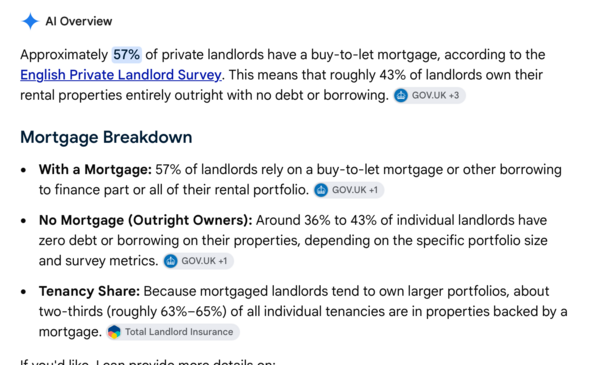
Most of us Landlords don’t have mortgages.
Primrose53
Tuliptree
LizzieDrip
The big issues are going to be with the private equity companies as they’ll want the fees paid by the state to maintain their disgraceful profit levels
I agree TulipTree.
That’s my main concern with any proposed plan. It’s not right that the tax payer makes rich care home owners even richer.It’s just like housing benefit paying off landlords mortgages
Most of us Landlords don’t have mortgages.
I'm not sure which figures you are using, but these are from Google.
There’s a difference between whether number of landlords or number of properties is counted. For example 45% of all landlords only own one property but only 21% of tenants live in properties owned by single property landlords . 79% of tenants live in properties were the landlords own 2 or more properties and in fact 49% of all tenants live in properties where the landlord has 5 or more properties. So the majority of properties ( not landlords) have or had mortgages on them and a proportion of those are being paid off by housing benefit. So state money goes into private pockets and many of the multi property landlords will be private equity companies
Yes, according to the screenshot I posted, 63-65% of tenants live in mortgaged properties, as landlords often own several, but also 57% of landlords have buy-to-let mortgages financing their portfolios. So housing benefit does pay off landlords' mortgages, even though I don't think that benefits are paid to pay mortgages for claimants. It doesn't make sense, does it?
The underlying point is public money going into private pockets. When cars homes and rented properties were ( mostly) owned by councils then it was not about profit but about only charging fees/rents that covered costs ( including hopefully decent pay for staff)
Yes, yet so many people seem to think that it's social housing that is subsidised, when in fact it is just as likely to be private landlords who get given taxpayers' money. Not all of them, maybe, but a significant number. Also employers who are making profits when their workforce doesn't earn enough to pay the rent, so need to claim benefits to cover it.
So everything should all be nationalised? How best to address this situation? I won't hold my breath.
I'm reminded of how doctors were placated at the start of the NHS - their 'mouths were stuffed with gold'.
Should the government just buy out all the care homes and rented houses?
Aveline
So everything should all be nationalised? How best to address this situation? I won't hold my breath.
Undoing privatisation is incredibly difficult and anyway politically unpalatable if only because of financial cost, let alone the opposition to it. That’s why I’m so despondent about the whole social care issue.
So everything should all be nationalised? I suppose it depends on what you mean by everything.
There are services that should not be for profit: social care, health, water, power, road maintenance etc. - basically public services. The key is in the word public ....
Politically unpalatable to whom, Tuliptree?
Join the conversation
Registering is free, easy, and means you can join the discussion, watch threads and lots more.
Register now »Already registered? Log in with:
Gransnet »