
Nonu - pleased to hear you had a wonderful time and soaked up all that lovely warmth and sunshine 
Already getting Christmas emails


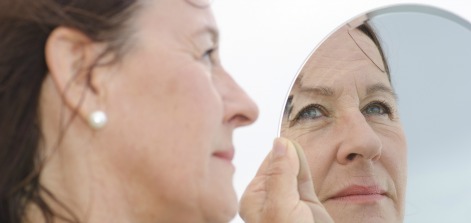
Why do our perceptions of people change as they age? Are they not the same people just because they have a few more lines on their faces? Author Nicci Gerrard discusses the invisibility of the elderly and that strange moment when she looked in the mirror and didn't recognise the older lady looking back at her.
Nicci Gerrard
Not so long ago, I was charging along a narrow aisle of a large department store, on an errand, late, harassed, hot, grumpy and unkempt, and I met a middle-aged woman coming running towards me. I noticed that she looked a bit like a demented crow; she had a gaunt face and lines around her eyes and on her face was an anxious expression. I think her shirt was wrongly buttoned. She was obviously in a hurry. I put up a hand in apology and she put her hand up as well – and I realised that she was me. I was looking at myself in a mirror. I was that demented crow.
So this was how I looked to strangers when I was running through a department store on an errand: not slim and poised and purposeful but scrawny, worried and slightly unhinged. It was a grim and hilarious revelation. We think the world sees us more or less the way we see ourselves, but in fact there’s a radical mismatch. The older we get, the more the gap between our own sense of our self and the world’s widens. How many of us look in the mirror and think: but that’s not me, not the real me, the one I carry round inside myself.
My gallant and fabulous mother is in her eighties. She is registered blind, has had multiple strokes and cancer; she has been an invalid for decades because of botched medical treatment for a bad back; she has arthritic hands and swollen ankles. But she thinks of herself as young and has the spirit of someone in her twenties (or maybe younger), someone endlessly ardent and hopeful, setting out on life’s journey. When strangers meet her, they look past of her complicated, resilient, stubborn character and what they see is her age and her frailty. They admire her because she is old. They no longer see the person that she is, so brimful of ambition and desire.
The older we get, the more the gap between our own sense of our self and the world's widens. How many of us look in the mirror and think: but that's not me, not the real me, the one I carry round inside myself.
My beloved father has always been a mild-mannered, courteous, private person, very stoical and very sweet-tempered, but also a practical joker and an eccentric inventor of devices to make my mother’s life easier. He was always proud of being a doctor – but now when people meet him, they bend down to him and call him dear and ask how ‘we’ are doing, as if even the correct pronoun has been lost to him and the singular erased. Or they don’t bend down at all – they talk to me and my siblings, or his carer. The nurses and doctors I have loved in hospital – where he has spent much time recently – have been the ones who sit by his bed and call him ‘Dr Gerrard’, who see beyond his wrinkles and his white hair and his vulnerability, and are respectful and attentive.
Sometimes I catch myself saying that my mother ‘was’ beautiful, when of course she still is. Or my father ‘was’ clever and kind - as if the old become like ghosts in their own life. I hear people talking about their parents, using words like ‘naughty’ or ‘silly’, like small children. (In the same way, people will often say ‘I love children’ and ‘I love old people’, stripping them of individuality and slotting them into a simple category.)
If we are lucky, we will become old. And yet our culture denies old age; we talk of ‘them’ rather than ‘us’. In my novel, The Twilight Hour, I wanted to make what is invisible visible again. Through the central character, 94-year-old Eleanor, I intended to show a whole vivid and richly complicated life: Eleanor is old, but she contains all the selves she has ever been – the stubborn child, the independent young woman, the woman in love, the teacher, the mother, the grandmother. Eleanor stands for all of us: we all want to be recognised, to be seen as individual, human and unique. We can start by the way that we look at the world, seeing others the way we want to be seen ourselves.
*The Twilight Hour by Nicci Gerrard is published by Michael Joseph on 23rd October 2014, £7.99 paperback or £4.99 ebook*
By Nicci Gerrard
Twitter: @gransnet
Nonu - pleased to hear you had a wonderful time and soaked up all that lovely warmth and sunshine
There is an advert on Classc FM, and probably on other radio stations; a lugubrious man comes on and says in a downbeat voice x number of people over 65 die in fires each month. Check THEIR smoke alarms.
No, I accept that for some people other peoples vigilance is necessary, but most are as capable as anyone of any other age of checking their alarms, or asking someone to do it for them. But it is the whole tone of the advert. If we are 65 or over we need to be checked on constantly by other people.
I suspect anyway the high number of people over 65 dying in fires has more to do with lack of mobility, falling asleep while smoking and dangerous wiring and appliances, rather than inoperational fire alarms.
I noticed that too, and thought I might have misheard. Obviously I hadn't. What a nerve! Mine went off today. It evidently disapproved of my making toast! I didn't burn it - honestly!
Thanks for your kind words HOLLY.
annodomini have you noticed that every time this advert comes on it is immediately followed by an advert for 'Hive', a product that allows you to use your mobile phone to control your heating (why?) and I think they say that the smoke alarm advert is brought to you by Hive before they run their own advert. If that is so I will complain strongly to Hive.
Is there no way that Gnhq can change the spelling of percieve in the right hand side column?
They could change that 'reolcating' as well! 
FlicketyB, I will have to take your word for it. I try to close my ears when the ads come on, though that one was inescapable. It reminds me of the M&S assistant who asked me if I knew someone who could look up an item on the internet for me.  I don't think she would have made that mistake again!
I agree with this entirely and have had very similar experiences. Older people are becoming the majority and we should make sure our voices are heard. It is good to see that more older authors are using mature characters in impo0rtant roles, not just as support characters. This also applies to my new novel, 'A Murderous Mind' now available as an ebook, and very reasonably priced for the pensioner market!
I called in for a cup of tea last year at the Ferry & Cruise Terminal at Portsmouth and ever since have retained the memory of what I saw. Long lines of silent old people in grey and sombre clothes, many handicapped, poor souls. Hundreds of them. All similarly dressed, all old and all waiting to check-in for a cruise to somewhere or other. I thought jolly good luck to them, but it brought home to me the increasing age profile of our population. An army of oldies, and I'm one of 'em!
The advantage of a cruise is that it is much easier to go on when you are disabled. All the accommodation and facilities on board are disabled friendly and you can have a very good holiday without going ashore and on outings.
Having said that that the standard cruise holiday would be my idea of hell. I hate great crowds, I hate noise and I hate holiday camplike entertainment. The research published recently that said that the average cruise passenger consumed 168 units of alcohol a week was for me the last straw, should I be tempted. I am not teetotal but drink very little and the thought of being surrounded throughout my holiday by people who are a bit the worse for wear - Hell!
But a few years ago we went on a cruise on the Nile on a paddle steamer with only 35 cabins and in February we are travelling up the Norwegian coast to the Arctic Circle on a Hurtigruten ferry/cruise ship. I am assured by those who have travelled on them that the food is very average and the alcohol is not only not free, but eye wateringly expensive and the entertainment is the view of the coast in the cold.
I am scanning thermal clothing and outdoor warm gear catalogues and will not be packing a swimming costume.
We are not quite as invisible as all that. We are the most likely to vote so should be mindful of the power we hold over politicians, I bet G.O. won't touch our pensions or other stuff before the election at least, and perhaps some of us have long memories ( in some cases that is all we have!) and can remember what happened to the tax issue on the absolute pig's ear of a budget in 2011 (I think it was) by G.O.
Flickety
Depends on the time of year. When I fid the Norwegian Iceland Faroes trip. I was in shorts and summer dresses until Iceland. It was very warm.
I can also assure you that cunard are not holiday camp like. They have a lot of interesting guest speakers and art talks. The culture scene is very alive.
Ah, but I am going in February! And I did talk about standard cruises. The kind run by the company that owned the Costa Concordia. The ones with a cultural bias are entirely different.
 might be a bit chillier in February. I'd take your hot water bottle and muff as well.
I can't go with Hurtigruten as they can't cater for disabled people they say.
I'd love to go to see the northern lights.
That is sad. I would not have thought it could be that hard. Just lifts and even floors. We go to France a lot with Brittany Ferries. They have lifts, specialist cabins and the dining areas are all accessible. I am suddenly feeling uncertain about some of the loos.
At the end of his life my father was not in a wheelchair, but beginning to find staircases etc beyond him and we found the Brittany Ferries system excellent.
I have yet to go on a Hurtigruten ship (DH has been on them when he made business trips to Norway) but I cannot see why they cannot be disabled friendly. Surely some of the people needing to use the ferry service must be disabled.
FlicketyB I'm not too sure I would give too much credence to the 'research' you mention.
www.telegraph.co.uk/travel/cruises/cruise-news/11021248/168-units-of-alcohol-just-an-average-week-on-a-cruise-ship.html
It appears to have been carried out by a website called Bonvoyage.co.uk and after making the unbelievable statement that the average weekly consumption is 168 units a week, (the equivalent of 6 bottles of wine a day), the article goes on to say '91% of the respondents admitted having at least one alcoholic drink during their cruise.
They're having a laugh, aren't they?
At 168 units a week most passengers would be in hospital with alcohol poisoning.
Like Galen my only experience of liners is with Cunard [posh emoticon]. . We travelled from Southampton to New York on the QM2 and had the time of our lives, without increasing our alcohol consumption from our usual couple of glasses of wine a day, plus a cocktail. Our fellow guests all appeared similarly restrained.
I hope you have a lovely time too on your Norwegian cruise. If you haven't already looked, Uniqlo's heat-tech range is very good value for thermal t-shirts etc.
Well, having once dealt with an elderly relative, who in retrospect, was certainly dependent on alcohol, if not alcoholic, it amazed me to realise just how much she could put away without smelling of alcohol or seeming other than sober.
There was the generous double whisky she had with her mid-morning coffee, another with lunch, around 4.00pm, 6.00pm and before she went to bed. Even assuming her doubles were doubles and not considerable more, that is minimum of 10 units a day. In fact I suspect it was nearer 20. That is close to 140 units a week. Someone on a cruise, drinking like that but more in the evening could consume 168 a week and only appear over the odds late at night. This is the problem with alcohol, it is easy to go way over the top over 24 hours without realising it. In an evening on the tiles you drink much less, but get more drunk.
I think your calculations are a bit out there, Galen! 168 units a week is 24 units a day, the equivalent of approximately 3 bottles of wine, not 6.
I have never been on a cruise, but I'd imagine if you have a couple of large glasses with lunch and a few more every evening, it wouldn't be that hard to reach the 20-24 unit level without realising it...
Not me gov! It was 'er! JaneA
Some people don"t go on cruises, because of the exhorbitant prices of the drinks.
Strange I know, but that is how it is !!
Oh, I'm sorry Galen - so it was!
OK then, jane, I think your calculations are out, as I said in my post mistakenly addressed to Galen.
Ana The Drink aware site says 4.2 units per bottle of wine.
168 divided by 4.2 =40 (a 175 ml glass being a unit)
40 bottles of wine per week = just under 6 per day.
Flickety I'm sure some old people like your relative could consume 168 units a week.
I'm just incredulous that this could be an average consumption as stated in the article.
Registering is free, easy, and means you can join the discussion, watch threads and lots more.
Register now »Already registered? Log in with:
Gransnet »Get our top conversations, latest advice, fantastic competitions, and more, straight to your inbox. Sign up to our daily newsletter here.
