
THAT what do they call you then. 20.59?
Gransnet forums
Blogs
Join the conversation
Registering is free, easy, and means you can join the discussion, watch threads and lots more.
Register now »Already registered? Log in with:
Gransnet »

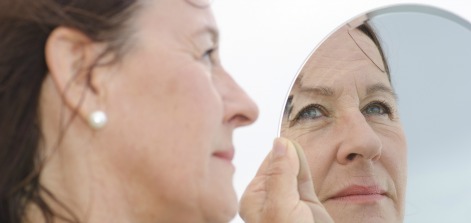
Why do our perceptions of people change as they age? Are they not the same people just because they have a few more lines on their faces? Author Nicci Gerrard discusses the invisibility of the elderly and that strange moment when she looked in the mirror and didn't recognise the older lady looking back at her.
Nicci Gerrard
Not so long ago, I was charging along a narrow aisle of a large department store, on an errand, late, harassed, hot, grumpy and unkempt, and I met a middle-aged woman coming running towards me. I noticed that she looked a bit like a demented crow; she had a gaunt face and lines around her eyes and on her face was an anxious expression. I think her shirt was wrongly buttoned. She was obviously in a hurry. I put up a hand in apology and she put her hand up as well – and I realised that she was me. I was looking at myself in a mirror. I was that demented crow.
So this was how I looked to strangers when I was running through a department store on an errand: not slim and poised and purposeful but scrawny, worried and slightly unhinged. It was a grim and hilarious revelation. We think the world sees us more or less the way we see ourselves, but in fact there’s a radical mismatch. The older we get, the more the gap between our own sense of our self and the world’s widens. How many of us look in the mirror and think: but that’s not me, not the real me, the one I carry round inside myself.
My gallant and fabulous mother is in her eighties. She is registered blind, has had multiple strokes and cancer; she has been an invalid for decades because of botched medical treatment for a bad back; she has arthritic hands and swollen ankles. But she thinks of herself as young and has the spirit of someone in her twenties (or maybe younger), someone endlessly ardent and hopeful, setting out on life’s journey. When strangers meet her, they look past of her complicated, resilient, stubborn character and what they see is her age and her frailty. They admire her because she is old. They no longer see the person that she is, so brimful of ambition and desire.
The older we get, the more the gap between our own sense of our self and the world's widens. How many of us look in the mirror and think: but that's not me, not the real me, the one I carry round inside myself.
My beloved father has always been a mild-mannered, courteous, private person, very stoical and very sweet-tempered, but also a practical joker and an eccentric inventor of devices to make my mother’s life easier. He was always proud of being a doctor – but now when people meet him, they bend down to him and call him dear and ask how ‘we’ are doing, as if even the correct pronoun has been lost to him and the singular erased. Or they don’t bend down at all – they talk to me and my siblings, or his carer. The nurses and doctors I have loved in hospital – where he has spent much time recently – have been the ones who sit by his bed and call him ‘Dr Gerrard’, who see beyond his wrinkles and his white hair and his vulnerability, and are respectful and attentive.
Sometimes I catch myself saying that my mother ‘was’ beautiful, when of course she still is. Or my father ‘was’ clever and kind - as if the old become like ghosts in their own life. I hear people talking about their parents, using words like ‘naughty’ or ‘silly’, like small children. (In the same way, people will often say ‘I love children’ and ‘I love old people’, stripping them of individuality and slotting them into a simple category.)
If we are lucky, we will become old. And yet our culture denies old age; we talk of ‘them’ rather than ‘us’. In my novel, The Twilight Hour, I wanted to make what is invisible visible again. Through the central character, 94-year-old Eleanor, I intended to show a whole vivid and richly complicated life: Eleanor is old, but she contains all the selves she has ever been – the stubborn child, the independent young woman, the woman in love, the teacher, the mother, the grandmother. Eleanor stands for all of us: we all want to be recognised, to be seen as individual, human and unique. We can start by the way that we look at the world, seeing others the way we want to be seen ourselves.
*The Twilight Hour by Nicci Gerrard is published by Michael Joseph on 23rd October 2014, £7.99 paperback or £4.99 ebook*
By Nicci Gerrard
Twitter: @gransnet
THAT what do they call you then. 20.59?
They have always called me by my first name, nonu. And their dad by his first name.
That is very NEW AGE .
My son calls his Dad by his Christian name , seems quite Pally, he has rarely called me by my Christian name !
I'm a Granny too and feel very happy to be called that. My kids call me either "Granny" if the DGC are about or by my first name - same for DH.It's either "Grandad" or the name by which he is known (his second name) We don't mind that at all. We are still their Mum and Dad. They have called us by our names from being teenagers. My elder sister thinks it's disrespectful. It's not.
"It's either" - sorry - sausage fingers.
Nah. I'm not into New Age at all, nonu. I just like my name (so why waste it?) and didn't want to be called mum.
Happy to be called a mum though, because I am one

Dont want to be a beast, but haven't you contradicted yourself
a] don"t want to be called MUM
b]Happy to be called MUM
I'm Graggy! Not Granny!
Blame dgd1
My younger daughter sometimes calls me by my christian name. I let her for a little while.
No, nonu, I have been quite clear.
I am a mum so anyone can call me a mum.
I did not want my kids to call me Mum.
"a mum" is not the same as "Mum" just as a granny is not the same as Granny.
my kids have a mum but they don't call her Mum
etc
Geddit?
I doubt it.

Sorry.
Are we in danger of over thinking all this?
Surely not.
Not reading between the lines might help!
Yes, best to stick to first person singular Ana 
And lily ponds.

I'm not sticking to any lily ponds. Might catch Ebola!
Logical thinking is not over-thinking. I think (thinking again! tut tut!) of it as reducing (or expanding if you prefer, which I do) meaning to its essence.
I think using diminutives to describe groups of people, grannies, old biddies, yummy mummies, there are hundreds of them for people of all ages and both sexes are almost always used in a dismissive, patronising or insulting way, so I do not think we should us them.
Every family has their name for different generations; Granny, Nan, Grandma, Mum, Mummy, Ma, Mother, and many others, but to me names that are acceptable, delightful,l when used as the special name for an individual can be, and often are, an expression of contempt when used to describe a group of people.
Possibly, but more often I think they are just used thoughtlessly without any attached malice. I think there is a modern tendency to take offence far too easily. If I think someone is being dismissive unfairly or contemptuously, I act on your earlier advice, flick, and "kick ass". Works a treat, I find
My youngest calls me MAMA MIA , I find it charming AND irristable[spelt right ?] probably not!! 
Registering is free, easy, and means you can join the discussion, watch threads and lots more.
Register now »Already registered? Log in with:
Gransnet »Get our top conversations, latest advice, fantastic competitions, and more, straight to your inbox. Sign up to our daily newsletter here.
