Gransnet forums

Blogs

LucyGransnet (GNHQ) Thu 17-Nov-16 10:42:52

The wrong kind of refugee?

In recent years, the world has witnessed a refugee crisis that has forced more than a million men, women and children to flee the brutal violence in their own countries. Yet despite the life-threatening situations they face, these refugees (including children) have often been met with a degree of suspicion and fear in the nations they have escaped to.

Author Barbara Fox, whose own mother was evacuated from inner-city Newcastle as a child, wonders what the difference between Britain's long-ago children and today's refugees is?

Barbara Fox

The wrong kind of refugee?

Posted on: Thu 17-Nov-16 10:42:52

(999 comments )

Lead photo

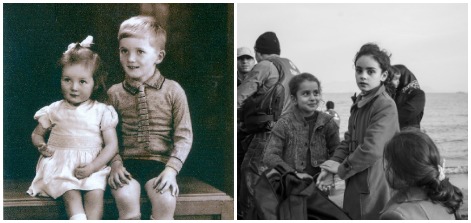
Are today's refugees really any different?

When I read a headline recently about the outrage of a 'picturesque' village to which 70 'child migrants' were to be sent, I was reminded of another time in our history when places in the countryside were obliged to welcome strangers into their midst.

Back in 1940 when she was six years old, my mother, Gwenda, and her older brother, Doug, were among the hundreds of thousands of children who left their inner-city homes and were evacuated to the countryside to escape the German bombs.

Gwenda's main memory of her journey from Newcastle to the Lake District centres round the banana she was given to eat by her mother – the last she was to see for several years. A teacher ordered the children to sit on their bags, and consequently, when Gwenda came to unpack later, she found squashed banana over all her belongings.

On arrival in the pretty village of Bampton they were lined up in the church hall while the villagers came to choose who they wanted. Yes, it does seem unbelievable that that was how the evacuees were billeted to their families! You might imagine that Gwenda and Doug – clean, nicely dressed children - would have been snapped up first (they would surely be the refugees that no one would protest about today!). But actually, that was not the case. Gwenda was the youngest child there as she was tagging along with Doug and his class of nine-year-olds - their mother had insisted that the pair should not be separated. Consequently, the locals were expecting older children, and someone of Gwenda's size probably didn't look very useful in this farming community.

Were these home-grown children that our rural communities welcomed back then really so different from the oft-maligned refugee children today?


Gwenda and Doug were the only children left when the wife of the village headmaster arrived. As the mother of two sons, she had to be persuaded to take a girl. However, she relented, and so the children went home with her. They would spend three happy years living in the schoolhouse and Gwenda would keep in touch with the couple she called 'Aunty' and 'Uncle' for the rest of their lives.

The following year, in more desperate circumstances, Bampton opened its doors to another influx of children, this time from the shipbuilding town of Barrow-in-Furness.

Undoubtedly thousands of lives were saved by this evacuation of the nation's children, and indeed, Gwenda and Doug's own street in Newcastle was bombed.

Britain also welcomed refugees from Europe, including thousands of Jewish children who might otherwise have perished.

Were these home-grown children that our rural communities welcomed back then really so different from the oft-maligned refugee children today? I would go so far as to say that the inner-city children who turned up in Bampton were often just as alien to their rural hosts as the foreign newcomers seem to be to the 'picturesque' village dwellers. But equally, both could teach something to the other.

Those harking back to 'when Britain was great' perhaps forget that it was also characterised by our opening our doors to those in need.

When the War Is Over by Barbara Fox, the story of Gwenda’s wartime evacuation, is published by Sphere and is available from Amazon.

By Barbara Fox

Twitter: @Gransnet

Mair Tue 31-Jan-17 22:19:12

Hes very well known Penst.
Not quite sure of the relevance of the mini biography to the thread?

The very highly educated Syrians you happen to know are far from typical, but almost certainly from the wealthy urban elite. Income inequality was growing before the war in Syria, with the urban elite enjoying a Western lifestyle while the majority live in, if not absolute, certainly relative poverty.

Penstemmon Wed 01-Feb-17 09:41:34

I realise you do not know my Syrian family, friends and acquaintances too or you would see your assertion to be incorrect.

Re Magdi Yacouob a very clever, able & successful Arab doctor. There are many more. Just countering the rather scaremongering view about poorly qualified foreigners. Not all doctors are great but that is not to do with their nationality. e.g. Dr Shipman?

Granny23 Wed 01-Feb-17 10:09:16

Message withdrawn at poster's request.

Granny23 Wed 01-Feb-17 10:24:45

Amid all the rancour on this (and other) threads, please watch this:

www.facebook.com/nyagphotos/videos/367779706938048/

Penstemmon Wed 01-Feb-17 10:26:38

..this is a very very interesting read

rom Heather Richardson, professor of History at Boston College:
"I don't like to talk about politics on Facebook-- political history is my job, after all, and you are my friends-- but there is an important non-partisan point to make today.
What Bannon is doing, most dramatically with last night's ban on immigration from seven predominantly Muslim countries-- is creating what is known as a "shock event."
Such an event is unexpected and confusing and throws a society into chaos. People scramble to react to the event, usually along some fault line that those responsible for the event can widen by claiming that they alone know how to restore order.
When opponents speak out, the authors of the shock event call them enemies. As society reels and tempers run high, those responsible for the shock event perform a sleight of hand to achieve their real goal, a goal they know to be hugely unpopular, but from which everyone has been distracted as they fight over the initial event. There is no longer concerted opposition to the real goal; opposition divides along the partisan lines established by the shock event.
Last night's Executive Order has all the hallmarks of a shock event. It was not reviewed by any governmental agencies or lawyers before it was released, and counterterrorism experts insist they did not ask for it. People charged with enforcing it got no instructions about how to do so. Courts immediately have declared parts of it unconstitutional, but border police in some airports are refusing to stop enforcing it.
Predictably, chaos has followed and tempers are hot.
My point today is this: unless you are the person setting it up, it is in no one's interest to play the shock event game. It is designed explicitly to divide people who might otherwise come together so they cannot stand against something its authors think they won't like.
I don't know what Bannon is up to-- although I have some guesses-- but because I know Bannon's ideas well, I am positive that there is not a single person whom I consider a friend on either side of the aisle-- and my friends range pretty widely-- who will benefit from whatever it is.
If the shock event strategy works, though, many of you will blame each other, rather than Bannon, for the fallout. And the country will have been tricked into accepting their real goal.
But because shock events destabilize a society, they can also be used positively. We do not have to respond along old fault lines. We could just as easily reorganize into a different pattern that threatens the people who sparked the event.
A successful shock event depends on speed and chaos because it requires knee-jerk reactions so that people divide along established lines. This, for example, is how Confederate leaders railroaded the initial southern states out of the Union.
If people realize they are being played, though, they can reach across old lines and reorganize to challenge the leaders who are pulling the strings. This was Lincoln's strategy when he joined together Whigs, Democrats, Free-Soilers, anti-Nebraska voters, and nativists into the new Republican Party to stand against the Slave Power.
Five years before, such a coalition would have been unimaginable. Members of those groups agreed on very little other than that they wanted all Americans to have equal economic opportunity. Once they began to work together to promote a fair economic system, though, they found much common ground. They ended up rededicating the nation to a "government of the people, by the people, and for the people."
Confederate leaders and Lincoln both knew about the political potential of a shock event. As we are in the midst of one, it seems worth noting that Lincoln seemed to have the better idea about how to use it."

Elegran Wed 01-Feb-17 10:31:01

Very good, G23 Those who insist on putting everyone into separate boxes based on one single parameter should watch this.

Mair Wed 01-Feb-17 10:52:35

Pens said
Re Magdi Yacouob a very clever, able & successful Arab doctor. There are many more
This is certainly correct

Just countering the rather scaremongering view about poorly qualified foreigners
Its not so much 'poorly qualified' they have qualifications, its the fact that initial entry levels to many universities in poorer countries are lower, especially for the rich, so they are not all guaranteed to be like Dr Yaqouob picked from among the creme de la creme of the top IQ range.

Not all universities are equal in the quality of training they offer and no Syrian and indeed no medical school in any low to medium income country is ranked in the worlds top hundred medical school

www.topuniversities.com/university-rankings/university-subject-rankings/2016/medicine#sorting=rank+region=+country=+faculty=+stars=false+search=

To make matters worse, most low to medium income countries have high corruption levels and the 'buying' of exam passes is commonplace.

"Not all doctors are great but that is not to do with their nationality. e.g. Dr Shipman?"

Red herring, he was a murderer!

You can guarantee that all British trained doctors have the knowledge and skills to do their job well. This can not be guaranteed for all foreign trained doctors. This is why the wealthy elite prefer to send their children to university in Britain or the USA.

whitewave Wed 01-Feb-17 12:18:23

I thought it would be useful to try to approach the argument regarding our medical profession, rather than by the use of divisive and hard right language but in away that uses various reports produced by our top universities and the reason for the position we find ourselves in today.

Cambridge university and Warwick university, reported amongst other things on the training in other countries, and the impact of cultural differences on ethical decision making in common practice, on our NHS.

First to look at training in other countries.

Practicalities

All countries surveyed have a code of medical ethics which follow a uniform pattern
All countries surveyed have a requirement to register with a medical regulatory body before practicing
All countries surveyed have a disciplinary procedure
All countries have structures in place to regulate and quality assure medical education.
Attention is increasing in all countries surveyed to have continual professional development.

That is the practicalities, but we know often from our own experiences that degrees vary from university to university. And it is argued that those medical degrees obtained from the developing nations do not match up to the standards of those obtained in the developed world.
These has been recognised by the BMC in the U.K. Who have set up a training scheme for 2 years to assist doctors overseas to reach the standard required by our medical profession.

However, that is not to say that recruitment from overseas, whether from a developed or developing country is straightforward.
The doctor from overseas will often experience wide differences in cultural practices, and as a result this may unless adequately trained impinged on her ability to function at 100%
E.g. The role of the family may be very different from her country of origin. Non-verbal clues may be missed because of the difference in cultural practices.
The BMI is therefore clear about the impact that cultural differences on ethical decision will make in common practice.
As a result the U.K. Is the first country to introduce a comorehensive assessment system, in order to identify any potential issues.

Now to actual numbers.

The UK has the lowest doctors per head of population of 24 of the 27 EU countries.
It costs £175k to train a doctor in the UK
How much easier to recruit a doctor trained overseas whose own country may have born the cost?
There are 267k doctors in the U.K. Of these 98k obtained their primary qualification overseas.
Germany is the top EU country who kindly trains their doctors who then come to work here.
India is the top developing country who kindly trains their doctors who then come to work in the UK.

In the past 5 years 669 doctors were struck off and of these 63% were initially trained overseas, but do not make the assumption that the majority were from developing countries.

So it could at initial look be an argument to stop recruiting from anywhere overseas and train more home grown doctors.

Now tell that to the government.

Mair Wed 01-Feb-17 15:17:38

In the past 5 years 669 doctors were struck off and of these 63% were initially trained overseas, but do not make the assumption that the majority were from developing countries

We should not make that "assumption" but we have every right to make an educated guess that they probably were 'over represented'.
I doubt it was Danish doctors being struck off!
I also suspect there would be a close correlation between the corruption index of the country and the nationality of the doctors struck off, even among those trained in Britain, people do not leave their cultural attitudes at the airport before they head to Britain.

www.transparency.org/news/feature/corruption_perceptions_index_2016

Syria scores poorly even by Middle Eastern standards.

So it could at initial look be an argument to stop recruiting from anywhere overseas and train more home grown doctors.

THAT I will entirely endorse. smile

If we are such a 'rich country' its absurd that we are failing to train doctors as other rich countries do.
WHY do you think this is WW?

Penstemmon Wed 01-Feb-17 16:01:12

Because, as a wealthy nations, we do not invest enough in, nor value education, at any level, is my answer to your question Mair.

For information: St Georges medical school (Tooting) has a branch in Cyprus and is training mostly Middle Eastern medics.

Mair Wed 01-Feb-17 17:18:27

"Because, as a wealthy nations, we do not invest enough in, nor value education, at any level, is my answer to your question Mair"

Hmmm thats circular reasoning and does not explain why.
I have my theory but would like to hear yours - remember this goes back for decades, its simply got worse recently.

Mair Wed 01-Feb-17 17:21:07

For information: St Georges medical school (Tooting) has a branch in Cyprus and is training mostly Middle Eastern medics.

Unless the Cyprus branch is making profits which are invested back in London, then a state funded Uni shouldnt be allowed to do that IMO.

Penstemmon Wed 01-Feb-17 17:23:29

Well I expect that is exactly why it is doing it Mair It has to make ends meet somehow!
Can I ask why posters often cut and paste a previous post?

JessM Wed 01-Feb-17 17:35:36

It is of course a long project "training more doctors" and both governments and probably the medical profession and universities would need to work together to make a plan. It would then take about 10 years to start to get a supply of new doctors up to registrar level (which will be the minimum level we are recruiting at I suspect) and many more years to get those extra doctors up to consultant standard. (another grade that we are recruiting at).
So this is a 20 year project if it started today. And it is unlikely to start today or tomorrow, given Jeremy Hunt seems intent on running NHS England downwards into mediocrity. Which might indeed increase the exodus of UK trained doctors to other countries.
Therefore we have to keep on recruiting doctors who are not trained here for the foreseeable future.

Mair Wed 01-Feb-17 17:37:39

Well I expect that is exactly why it is doing it Mair It has to make ends meet somehow!

Maybe, or maybe to create new opportunities for London based staff to take trips or spend an adult 'gap year' in the sun? I really dont think I am being too cynical either. hmm

Can I ask why posters often cut and paste a previous post?

I do it to clarify what I am answering, but of course I cannot speak for others. Most boards have a quote facility, but the software is rather poor here.

Mair Wed 01-Feb-17 17:50:33

Which might indeed increase the exodus of UK trained doctors to other countries

There is no "exodus* of doctors from Britain Jess.
Even most of those who go abroad do so for a few years at most. I was recently reading comment by British doctors working iN Australia, and despite the better lifestyle and hours, none wanted to remain there permanently.
Britain remains the second most sought after country in which to live and work after the USA.

Therefore we have to keep on recruiting doctors who are not trained here for the foreseeable future

Well for about twenty years (not the "foreseeable future") that is true, but remember the numbers we'd require would quickly start diminishing, and remember too that many of these posts could be filled by people on fixed term contracts (much as professional Brits take in Singapore and Dubai).
A spell as a consultant in a London hospital would greatly enhance the employability of most doctors in the world.

whitewave Wed 01-Feb-17 17:53:21

Yes jess that is the logic of the situation, but in my view it is wrong to recruit doctors from developing countries who were trained at huge expense to the detriment to their population. These folk whose medical services are usually far less comprehensive than ours cannot afford to lose expertise. We are a vastly wealthy country and have more than sufficient funds to train our own doctors. But we have chosen not to year after year after year.

Mair Wed 01-Feb-17 17:56:13

in my view it is wrong to recruit doctors from developing countries who were trained at huge expense to the detriment to their population

Agree with you again!

Mair Wed 01-Feb-17 17:57:27

We are a vastly wealthy country and have more than sufficient funds to train our own doctors. But we have chosen not to year after year after year

Why, in your opinion?

Mair Wed 01-Feb-17 18:01:55

On LBC they are about to discuss the cost of health tourism to the NHS!

rosesarered Wed 01-Feb-17 18:05:53

I did ask once if we could have a quote facility, after all other forums do and it makes life a lot easier, but the answer was no.

JessM Wed 01-Feb-17 18:20:00

Well yes Whitewave of course. But there is no quick way to solve this one. And we are at the start of a big extra need for doctors due to the demographics.

whitewave Wed 01-Feb-17 18:37:20

That mair I suspect is where our agreement begins and ends, as I am very content to think that some of my tax goes towards training doctors in the developing world. That I would also be content to see aid for hospital building and drugs in the developing world.

durhamjen Wed 01-Feb-17 19:08:42

Health Tourism on Hospital tonight, 9.00pm on BBC2.

Definitely want to see aid for hospitals in places where they have been bombed, e.g., in Yemen by Saudi Arabia using British planes and bombs.

Mair Wed 01-Feb-17 20:42:39

WW said
That mair I suspect is where our agreement begins and ends
Thats a very confrontational view.

I am very content to think that some of my tax goes towards training doctors in the developing world. That I would also be content to see aid for hospital building and drugs in the developing world

Nothing prevents you making as generous donations towards the developing world as you can afford WW, but its rather bullying to demand that others, who may be considerably less advantaged than you, should also be expected to support your pet 'good cause'.
They may prefer the money were spent on medical research, or on disabled people in this country, or education of doctors here in Britain for example.

This discussion thread has reached a 1000 message limit, and so cannot accept new messages.
Start a new discussion