

I'm with Graphite and Oreo. Such places represent a nation which prizes learning above money.
Oh, and most of them have a tempting shop/ cafe/ restaurant .
Gransnet forums
Culture/Arts
World Class Museums - why are they free to everyone?
(103 Posts)The grandchildren are on their summer break, so it’s the perfect time to visit some of our world class museums in London.
Our first visit was to the Science Museum and a week later we went to the Natural History Museum. Each time, the museum was very crowded and busy, which of course is a good thing. However, entry is free with an optional donation.
I fully support entry being free for local council tax payers, but why is it free for everyone in the world ?
Our museums are such a huge asset, but surely a reasonable entry fee should be mandatory. I know the shop and cafes benefit from extra trade, but this should be a bonus, not a lifeline.
People visiting appeared to be overwhelmingly tourists. Why do we not charge an entry fee to those who do not pay UK council tax?
There are machines where a suggested donation of £10 can be made, but I have never seen one used.
Museums elsewhere in Europe are free or only request a nominal fee. So let us share and share alike
Elegran
I believe it has been proved that good museums, art galleries and so on actually make MORE income by not charging entry fees but having a glass box for donations instead.
Do they, though? I once sat near the entrance to the National Gallery for a while (not for this purpose) and very few of the very many coming in, put anything in the voluntary donations box.
Maybe they felt like giving something later….
The Arts Council does spread the money about.
Of the £570 million 70% is used outside London.
They should be free because many people have very little to spend.
Witzend
Elegran
I believe it has been proved that good museums, art galleries and so on actually make MORE income by not charging entry fees but having a glass box for donations instead.
Do they, though? I once sat near the entrance to the National Gallery for a while (not for this purpose) and very few of the very many coming in, put anything in the voluntary donations box.
Maybe they felt like giving something later….
They probably did, in the cafe or gift shop, both of which always seem to be thronged in museums.
I was in Amsterdam this year and paid entry to every museum we visited.
Over the years, the London museums have provided enriching days out for school trips, completely free of charge, which makes a huge difference for many families.
It depends on the country, and day of the week I think, I’ve been to museums on days where there was free entry in France, and in Spain, just by coincidence - I think they must do selected days for free?
NotSpaghetti
The Arts Council does spread the money about.
Of the £570 million 70% is used outside London.
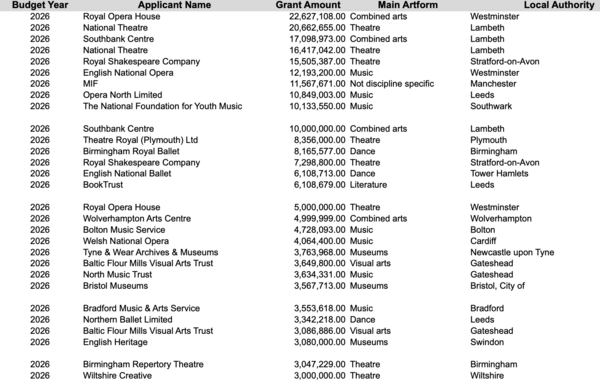
And if you want the detail then download the Arts Council spreadsheet for 2025/26 Quarter 4 here. It gives the expenditure for the year. This includes money from the DCMS listed as grants-in-aid plus lottery funding (and restricted funds which can be either).
www.artscouncil.org.uk/creative-matters/news/building-ten-year-partnership-national-trust/expenditure-data
You can sort the spreadsheet on the amount of the grants awarded in descending order.
As one might expect, the largest recipients are the big names in London: the Royal Opera House, National Theatre, the Southbank Centre, English National Opera but also the RSC in Stratford, Manchester International Festival, Opera North in Leeds, Birmingham Royal Ballet etc all receiving millions … right down to grants of under £1,000.
The big names here are mostly production companies which stage ticketed events, of course. In the context of the opening post, that would be an argument for charging overseas tourists more for tickets, wouldn't it?
Casdon
It depends on the country, and day of the week I think, I’ve been to museums on days where there was free entry in France, and in Spain, just by coincidence - I think they must do selected days for free?
Yes. I think in Paris it's the first Sunday of the month.
The Musée du Louvre is 32 euros.
I was at an exhibition of paintings yesterday at one of our smaller municipal galleries. I happened to have cash on me so I donated, but many people don’t carry cash on them these days and, surprisingly, there was no other way of donating other than the glass box. At the Botanical Gardens they have card facilities as well as a glass box.
I suppose we should encourage everyone we can to visit the wonderful treasures housed in our free museums while they can, given the current clamour to repatriate some of them to their countries of origin. Once that starts, where will it stop?
Many institutions now have contactless donation points. The Natural History Museum does, along with the Science Museum, the V&A, the National Portrait Gallery, the Tate and Royal Academy.
The NHM has reported a 64% increase in its donations since installing them so that seems to be the way forward in an increasingly cashless society.
As children in Glasgow we spent most rainy weekends at Kelvingrove ,almost everyone I knew did the same,
It was free,interesting ,educational and fun.
It still is and we often spend an hour mainly to visit the Dali though other favourite exhibits get a look and our children and grandchildren do the same.
Aim for around lunchtime for the organ recital….I,ll bet he played Dolly Parton today sometimes with a choir .Its an experience and a place much loved by native weegies and people from all over the world.
Most of us wouldn,t have seen it if it had been ticketed .
Museums should be free to use ,they are a huge benefit to the community
I think it is mean to make people pay unless it is a very small country with a poverty problem as some of the South Pacific nations are. It is a thing to be proud of showing wonderful treasures to tourists and I was proud , as a Londoner, to tell people that the wonderful art galleries and museums were free.
I used to volunteer as an independent visitor ( someone who spends time with young people in care ).
The young person I was allocated had never been to a museum or gallery, she loved me taking her, I could not have introduced her to that world if there had been charges.
Most museums charge for entry to special exhibitions, even when the museum itself is free.
The upcoming Bayeux Tapestry exhibition will have cost millions to put on, but it will also bring in £millionsin income for the museum and also bring in many extra visitors who will shop at the main museum shop as well as the exhibition special shop. They will also use the restaurants.
I think that’s fair M0nica, it costs the museums extra to put special exhibitions on, by charging it controls the number of people accessing them, as people will only pay extra if they are really interested in the subject, and the exhibitions would be overwhelmed with casual visitors otherwise.
That makes sense, considering the costs of transportation, insurance etc for special exhibitions.
Just another bit of information on the schools' front - we pay a greatly reduced price for school parties to attend an exhibition, sometimes it's just a small flat fee and teachers go free. If you are home schooling a child, then entry to exhibitions is completely free.
It is interesting to compare the free museums with the National Trust charges. I was considering taking the family to Chartwell. This would mean £102 for four adults and parking. We would obviously buy drinks and snacks, probably lunch and something in the shop. There is no reduction for pensioners, students or unemployed. It is a very expensive day out.
Thank you for your responses. I’m especially interested in the breakdown of funds allocated to each of the larger museums. Anecdotes of people not being able to afford entry backs up my proposal that there should be no charge for ‘locals’ I’m still not convinced we should be educating the world free. Many are casual observers on the tourist trail……..
Given that many of the splendid objects in our museums originated in foreign lands, and that some were surely acquired by devious methods, it seems a bit mean to charge overseas visitors for viewing what may have come from their country in the first place.
Thanks to our past as the worlds greatest empire, our wealthiest people and most powerful organisations acquired a vast assortment of the world's greatest treasures. Now residing in our museums. At least they are being protected and expertly conserved in a relatively safe and stable country.
How lucky are we, and the rest of the world, to have free access to it in so many museums .
Isn't it the least we owe?
Elusivebutterfly
It is interesting to compare the free museums with the National Trust charges. I was considering taking the family to Chartwell. This would mean £102 for four adults and parking. We would obviously buy drinks and snacks, probably lunch and something in the shop. There is no reduction for pensioners, students or unemployed. It is a very expensive day out.
If the National Trust had not bought and conserved such properties, would we be able to visit them? I doubt it.
They would either be ruins or owned by Russian oligarchs and the Chinese.
vickymeldrew
Thank you for your responses. I’m especially interested in the breakdown of funds allocated to each of the larger museums. Anecdotes of people not being able to afford entry backs up my proposal that there should be no charge for ‘locals’ I’m still not convinced we should be educating the world free. Many are casual observers on the tourist trail……..
I prefer tourists (native and foreign) to be educated.
The other sort sometimes ignorantly damage and destroy what they came to admire :-(
Well, considering it is mainly world treasures e.g taken from Greece and Egypt, I don’t think is fair to charge
Join the conversation
Registering is free, easy, and means you can join the discussion, watch threads and lots more.
Register now »Already registered? Log in with:
Gransnet »