do you still have TV licensing stamps?
What foods that you aren't allergic to don't seem to agree with your body?
Rejoice! Chancellor Healey Will Give Us Cheap Marmalade & Gherkins.
Would you rather stay your current age or swap the digits around?


The NHS is struggling and winter is setting in.
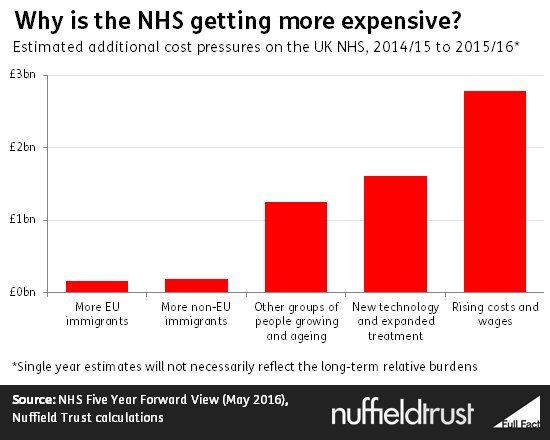
Jeremy Hunt is asking for "efficiency savings" - in other words he is making cuts when demand is rising steeply as a result of our aging population. This means that every year the NHS needs a lot more money, to just maintain their service.
Over the last 6 years Trusts have been heavily pressured by Jeremy Hunt to cut beds - "increase bed occupancy" - to become "more efficient". So there are fewer beds in the system to cope with the inevitable rise in winter admissions.
Social care budgets have been heavily cut in England so there is less of a safety net for frail people living at home - so more likely to end up in hospital.
Noro virus outbreaks in hospitals are already up on the last few years - and that tends to close whole wards.
Today I read that 7% that is one in 14 English people are waiting for non-routine operations. Suspect there aren't going to be many beds available for those on the lists. Longest waiting list for 9 years
www.theguardian.com/society/2016/dec/08/one-in-14-people-waiting-operations-demand-nhs-soars
www.bbc.co.uk/news/health-38263593
And is this a taste of things to come - flu closing school in Manchester? if there is a flu epidemic things are going to get really nasty. Best advice is, if you haven't had a flu jab yet, get one. They're about a tenner in a pharmacy near you, if you're not entitled to a free one!
www.bbc.co.uk/news/uk-england-manchester-38241513
Trouble is with averages is that they tell you very little.
Some people are lucky with their health and rarely see the GP, and never need hospital treatment.
My late MIL, bless her, must have cost a fortune. She had 2 problem pregnancies, breast cancer, lymphoma (twice), three things wrong with her heart requiring long-term medication and some time in hospital, asthma, 2 replacement knees, 2 replacement hips, arthritis requiring morphine patches etc, repeated chest infections, pancreatitis (2 weeks in hospital) and in the last couple of years vascular problems with her legs requiring several admissions, visits from district nursing team etc. I will have forgotten some things. She never smoked, didn't drink and was only slightly overweight in middle age.
She belonged to a generation that grew up in the war. Her dad was a steel worker and needed the lion's share of rationed food, she slept in an Anderson shelter from about 1940-45 and was admitted to isolation hospital as a child with rheumatic fever. While she was there she caught diphtheria and the rheumatic fever caused one of her heart problems.
You'll be impressed to know she never complained, or even grunted or groaned when trying to remain mobile.
Her generation did not have great start in life as far as health was concerned.
And this is the generation now it their mid 80s.
Yes, I know they have, Lazigirl. I misinterpreted your post.
My town lost a whole MH unit two years ago. The service hasn't been replaced.
There are good people working in psychiatric services but it sometimes feels a world away from physical health services.
Not you dd but my brother depends on community mental health services to keep him well which have been cut to barest minimum and crisis intervention.
In which universe is that?
I don't get any psychiatric treatment from the NHS.
Not to mention psychiatric services dd which the government are supposedly improving.
True!
The groups which cost most are children, the elderly and pregnant women.
I'm not sure how much I cost. I have to go to two diabetic clinics a year and pick up a paper bag of medications each month. I doubt if I could insure myself for that much if I lived in the US.
Per capita, not per patient. The assumption is that lots of people never go anywhere near the NHS. I know people who never see a GP, let alone a hospital. I make up for them!
That puts it into perspective. I just worked out that my CCG will get £1276pa per patient. That's just over £100 a month. That's one private 20 minute GP consultation a month plus a private prescription and maybe a test.
Errrmmm...so who pays for operations, hospital treatment or expensive medications?
We seem to be getting a very good deal.
No it isn't. This is.
www.england.nhs.uk/wp-content/uploads/2016/01/ccg-allocations.pdf
However, the weownit link is just as important.
For anyone who likes looking at figures.
weownit.us6.list-manage.com/track/click?u=ef1f3f5b8067610251b19fb6c&id=0c87832e0c&e=9b816f1393
Government tables for what your CCG gets now and what it will get every year up until 2020-21
By the way, the government wants to reduce the number of pharmacies, while telling us we should use them instead of going to A&E!
This is very worrying. It's probably what the government wants, though.
www.theguardian.com/society/2017/jan/14/mays-scapegoat-attempt-could-spark-mass-resignation-says-top-gp-nhs-crisis
Link to a King's Fund publication about A & E admissions:
www.kingsfund.org.uk/projects/urgent-emergency-care/urgent-and-emergency-care-mythbusters#somewhere
An extract:
Is the pressure on A&E mainly a result of people going to A&E when they should go somewhere else?
Around 13 per cent of people who attend A&E are discharged without requiring treatment, and a further 35 per cent receive guidance or advice only (HSCIC 2016). This does not mean that all these people are attending A&E unnecessarily or could be cared for elsewhere. For example, someone who leaves A&E without being admitted may well have attended appropriately because they required treatment or assessment that only A&E could provide.
Estimates vary but a survey of 3,000 people in 12 A&E units conducted for the Royal College of Emergency Medicine found that 15 per cent could have been treated in the community; again this is not to say that they all went to A&E 'inappropriately'.
Two of the claims put forward for why people go to A&E unnecessarily are examined below.
Lack of access to GP appointments
It has been suggested that more people are attending A&E because they can’t get appointments with their GP. It is difficult to pin down accurately how many people this might apply to.
However, the latest results from the GP Patient Survey show that 85 per cent of people were able to get an appointment to see or speak to someone at their GP practice, down from 88 per cent in 2011. From the latest figures, of those who couldn’t get an appointment or were offered an inconvenient appointment (11 per cent), around 4 per cent reported going to A&E instead. We know that being able to obtain timely appointments is a key concern for people accessing GP services. However, data from the GP Patient Survey suggests that while there has been a slight reduction in people’s ability to access their GP, there has not been a significant deterioration.
Confusion about the system, including about how to access to out-of-hours care
It has been suggested that removing responsibility for out-of-hours care from GPs (as part of contractual changes in 2004) led to an increase in A&E attendances. However, there is no evidence to support this.
Most people go to A&E during working hours, and these hourly patterns in attendances have remained largely unchanged in recent years. However, people are clearly uncertain about how to access out-of-hours care – results from the GP Patient Survey in July 2015 found that only around 56 per cent of people said they knew who to contact out-of-hours. While this is higher than 2014, it is actually lower than in previous years.
Access to other types of care out of hours (for example, district nursing care) is also important in keeping people out of hospital. We know that the number of district nurses employed by the NHS has decreased by about 36 per cent in the past five years.
The Parliamentary Health Select Committee, the NHS Confederation and many others have expressed concerns that the fragmented provision of urgent and emergency care makes the system confusing for the public. In response to these concerns, the NHS five year forward view commits to doing ‘far better at organising and simplifying the system, with the aim of helping patients to ‘get the right care, at the right time, in the right place’ by making more appropriate use of primary care, community mental health teams, ambulance services and community pharmacies. To support this, NHS England has been undertaking a review of urgent and emergency care, and has launched 'vanguards' in eight areas of the country to pioneer new approaches to delivering urgent and emergency care services.
--
The publication also points out that attendances are higher in Summer (so we haven't seen the worst yet), but admissions are higher in Winter. One of the factors increasing time in A & E is not being able to find beds for those who need to be admitted.
It might WW but if it's effective in reducing large percentage who don't need A&E then that's a positive. And word gets around.
It would have to be an A&E consultant I suppose to know exactly who needs treating. Anyone less qualified could put lives at risk. It is an effective filtering system for sure.
Yes Exeter - a consultant stands at the door apparently. Not sure what happened to their triage system, perhaps it needs beefing up? Seems a waste of good consultancy.
It was upsetting as he was a very good diagnostician normally WW
Re unnecessary visits to A&E I thought I heard of one hospital who had a system for sending away those who were neither an accident or an emergency, someone very qualified to decide.
Did anyone else catch that on the news (? I think)
anya that's worrying.
My daughter forwarded an information sheet on Facebook that outlined different medical problems and your first port of call. It is common sense, but it seems that there isn't a lot of that around. But maybe that's unfair on my part, maybe the difficulty getting appointments with your doctor who is herself under severe pressure, drives people in a panic or worry to A&E?
And that Jess is exactly how it should work.
In the small village where I used to live the pharmacist was always the first port of call as there was no GP practice there. I was saddened to learn he had died from a heart attack after self diagnosing indigestion and refusing his wife's suggestion he seek help.
Only for yourself DD so the pharmacist can see how bad it is - too serious and its off to the GP. Not sure they can sell thm for kids either.
That's new!
When my daughter was little, she was especially prone to eye infections, which always seemed to develop on a Friday evening (gggrrr!) I went to the pharmacist so many times for little ampoules of sterile water, who always told me to get a GP appointment as quickly as possible for antibiotic drops, which he couldn't prescribe.
How about getting this down to a mundane level again?
M DH has had this winter's guest virus for nearly 3 weeks. Bad cough and now pink eyes that are a bit sticky. He hates going to the GP and is convinced that the cough is a tiny bit better so I told him to go and ask the pharmacist about his eyes. He was given antibiotic eye drops and was surprised that these could be dispensed without a prescription. Result! No swopping viruses in the waiting room and an appointment freed up for someone else. I know that you can get hydrocortisone creams from the pharmacist as well. And thrush medication. Anyone else been using the pharmacist rather than doctors and nurses to ease the burden on services and avoid virus filled waiting rooms?
Registering is free, easy, and means you can join the discussion, watch threads and lots more.
Register now »Already registered? Log in with:
Gransnet »Get our top conversations, latest advice, fantastic competitions, and more, straight to your inbox. Sign up to our daily newsletter here.
