Another U-turn by Theresa May ....it's starting to look like the Gorgon Knot.
Arguments with son and I don't know what to do?
a personal comment on this stockpiling
Will Labour backing rejoining be the “end” or the “making” of them??
Sign up to Gransnet Daily
Our free daily newsletter full of hot threads, competitions and discounts
Subscribe
I think this is an important enough issue to have its own thread. Whilst waiting for more details ( where the devil may be) this looks like the end of any hopes for a collective 'insurance' based approach to funding social care.
It looks like the main group of losers are those who stay in their own homes ( but who have savings (not including the value of their home) of under £23000 (approx) as the value of the home will now be taken into account in assessing what they pay towards their social care costs.
So, present situation
1. Own own home, savings of less than £23000, domicillary social care free
2. Own own home, savings of more than £23000, pay own care until savings get down to £23000
Proposal
Value of home will be added to any savings and if less than £100,000, domicilary care will be free, if over £100,000, will pay for care until under £100000.
Any payment due can be deferred until after death.
If you have to go into residential care, then you are a 'winner' as you can get help once your total savings ( including value of house) fall below £100000 instead of current £25000.
I think this is correct? What I don't know yet is what the situation is if you have a partner living in the house with you? At the moment if you go into care, the value of your house is not taken into account if your partner carries on living there.
So it seems so far, that it will impact positively on the better off - apart from the loss of WFA
Another U-turn by Theresa May ....it's starting to look like the Gorgon Knot.
How much does it cost in other European countries?
Why does he UK expect free care from cradle to grave these days?
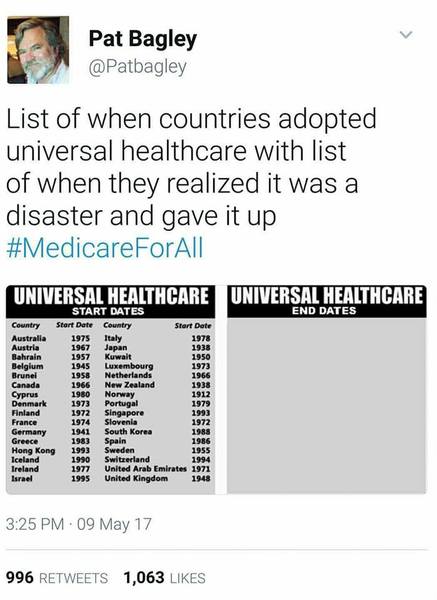
Well this was posted on FB today.
Oops not easy to read. It lists all the countries providing universal health care, the date they started .....and on the right when they abandoned the policy....it's blank!
It won't be blank if the Tories get back in.
It's easier to read when you click on it and then zoom in, Anya.
Yes, but how is it paid for?
It should be paid for by pooling our resources, if we all chipped in, through taxation, to pay for social care if would be there. We should all be willing to pay towards it, even if we never need it. If not through taxation now, then through paying more inheritance tax. We should be proud to contribute towards something that we may never need ourselves, for the good of those who will need it.
I dont think its exactly a u turn ...she has stated that the principle remains the same. She then said that there would be a cap on the total paid ...I am not sure how it would work though linked to the £100,000.
eg If the cap was , say, 500,000 then someone with 3 million is left with 2.5 million and the state paying the rest? Someone with £800,000 is left with £300,000! Is that right? And is the £100,000 idea therefore irrelevant?
Actually reading what I have just written ...yup, maybe it is a u turn!¬ I am confused!
There are many different systems of paying for social care in other countries - no one size fits all model. I think Margaret said that in Germany there is a hypothecated percentage payment. No one gets free care - we all pay for it through all the various forms of taxation - how on earth could it be free ana? Free at point of use is not the same as free.
It's just a great big, Ill thought through muddle. What the manifesto should have said is ' that the current system of funding social care is unsustainable and unfair. What is needed is a cross part consensus and we will set up a cross party committee to reach this consensus. '
Instead it's all over the place - a government that raises the level before which IHT is paid and takes money away from those unfortunate to need care. So the healthy and wealthy come out of this absolutely fine.
How much does it cost in other European countries? Why does he UK expect free care from cradle to grave these days?
Ana that is a good question. I believe (hopefully someone actually knows) that in Germany they start paying in to an insurance scheme at (again, I think) 40 to cover the cost of Care.
NICs covers our pension, contribution based Jobseeker’s Allowance, Maternity Allowance, Contribution-based Employment and Support Allowance, Bereavement benefits. In my opinion, we could have an NHSICs to cover NHS and Care after we have reached State Pension Age at possibly half the level(?) of NICs. This could be pulled backwards over time so that everyone paid it but paid less tax (currently paying for the NHS). This would give us a figure to argue about at elections if we wanted more, or less. NHS and Care.
People reaching SPA originally (only men to start with) did not always live to get it and when they did they got it for a very short time so I think it is reasonable to do something like this now but this is a purely personal opinion.
I don't think anyone wants FREE care from cradle to grave Ana nor does anyone (sane ) think it is possible. But, like any insurance we need to spread the risk so that no one is left without health care or social care. The older generation must be prepared to pay but what those of us object to is that this payment should not be an inheritance tax. Set a decent inheritance tax by all means but this does not allow for an insurance option.
E & OE
I was referring to the NHS Rigby - obviously paid for by taxes but there now seems to be some dispute about how much of those taxes should go towards care in old age. For whatever reason.
I dont think its exactly a u turn ...she has stated that the principle remains the same.
I saw that Madgran77 and she is determined that it is staying the same which must mean that the floor of £100,000 remains so the cap must be higher than that?
I actually think this sounds even worse but no doubt those who understand these thing will give us details on the news programmes in time.
So JC plays politics and Maybot doesn't-- what a joke
Heard the scaremongering from JC. I don't think so - it is all to do with the pool figures and the reaction from the population. Tell the truth!!
In France the whole burden of payment falls on the family, unless they're really poor (there's a test of income.)
eg Even the family of an elderly english person who has been living in France for many years then needs to have "care". The family is chased up for payment even if they're in the UK.
That's why elderly people here are more often than not cared for by the extended family. The mother of one of our neighbours, mid 70s, died last year aged 94 - I didn't even realise she was with them all the time.
I haven't contributed to this thread, because my view might be going against the tide. We sold our Mum's house eventually to help pay for her care. My Dad, who was already dead, knew he could have put the house in our names (he was a solicitor) but didn't do it because he thought it would be wrong. I agree with him.
So vote for an unknown cap folks.
We are being scared apparently because we are old and vulnerable. Stupid woman
£8bn where is coming from. No answer. Poor isn't she.
10bn?! Still no answer.
WFA? Clueless!
There is nothing wrong in a)choosing to care for someone if it is possible or b)choosing to pay for care if it is possible Tricia. But there is nothing wrong with insurance either.
It is the same as choosing to pay for the damage if anything happens to your house or choosing to insure it. The difficulty is it would really have to be the government who set up the insurance at this stage but I would certainly be happy to contribute even (in fact happily) if I never needed to draw on it but others did. That would, presumably, mean I had a healthier life.
It will be interesting to see the polls after that pathetic display by Maybot.
I think the problem is that we all thought we had the insurance of healthcare free at the point of use from cradle to grave. Who decided that someone with dementia did not qualify for that? Why is dementia a care problem rather than a health problem?
Registering is free, easy, and means you can join the discussion, watch threads and lots more.
Register now »Already registered? Log in with:
Gransnet »Get our top conversations, latest advice, fantastic competitions, and more, straight to your inbox. Sign up to our daily newsletter here.
