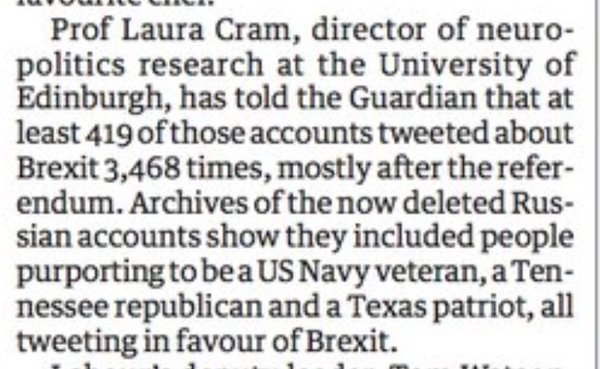
As a matter of interest, this (on the left) was posted on twitter. You have to ask yourself why Russia would go to so much trouble...
The reason I doubt the Russian tweets would have made any difference is because, apart from a few mavericks (Gove, Boris, Dyson, etc), the entire "Establishment" was (and is) pro-Remain.
I'm struggling to follow your reasoning here, Baggs.
Are you saying that people would have voted against the Establishment anyway? I think that the rejection of the Establishment, as talked about in the extract below, from a BTL comment on a Financial Times story, was exploited by Russia in their social media campaign and people were very receptive to the exploitation.
The core development that provided the spark is the implicit rejection of neoliberalism by millions of voters in Britain and America, who are using their opportunity at the ballot box to say that contemporary politics is just not working for them. They want something new but, in facilitating diverse (and perhaps concerning) outcomes such as endorsing Trump and voting to leave the EU, they do not quite know what the 'something new' should look like yet.
Critically, the presidential election and the EU referendum gave voters a platform to react against the status quo. In Britain, this was a reaction against the brand of suave, corporate politician epitomised by then-Prime Minister David Cameron, who was the default if somewhat unconvincing figurehead for the Remain campaign
The next passage deals with the effects and handling of the 2008 financial crisis and this comment follows;
There was one crucial difference that would affect ordinary people. The crisis would open the door to an unprecedented (in terms of the modern era) period of austerity which would promote savage cuts to public expenditure in order to, allegedly, balance the public purse. There were only two huge flaws with such an approach – the first being that it comprehensively did not work and the second being that it entirely failed to address broader structural deficiencies within the economy, such as the arrival and consolidation of incredibly poor wage growth (or even stagnation) alongside rising welfare dependency, house prices and job insecurity
I think you are wrong about 'the old' not using twitter. The Baby Boomers (who were the most likely 'old' people to have voted Leave, apparently the reallyold,who'd lived through WW2, were less likely to have voted Leave) seem to me to be quite enthusiastic tweeters. I 'know' plenty. And to reduce Leave voters to 'the old, and, uneducated is just simplistic. People of all ages and educational status voted Leave; it's just that the young and the better educated were more likely to have voted Remain.