Should say ‘to read ‘
Were you more emotionally attached to one parent over the other ?
Do you always alter your clocks?
A general election (democratic eh not like Hamas) is taking place in Israel on Tuesday next week.


Brexit has not yet happened, and there can be no certainty that it ever will.
www.gfmag.com/topics/blogs/uk-could-exit-brexit
Should say ‘to read ‘
This is worth remembering too:
The manifesto sets out £48.6 billion a year in day-to-day spending on a range of eye-catching policies, including more money for schools and the NHS, scrapping tuition fees, a pay rise for public sector workers and 10,000 more police officers.
It promises to pay for this with tax changes including an income tax hike for high earners, a corporation tax rise and a new Excessive Pay Levy on companies with a large number of highly-paid employees.
The party claims the full package of measures will bring in exactly the £48.6 billion they need to fund their ambitious spend.
There are some problems here…
Uncertainty: The Institute for Fiscal Studies thinks Labour’s assumptions about how much money these tax measures will really bring in are “highly uncertain”.
Higher taxes usually bring in money in the short term, but over time people tend to change their behaviour to avoid paying higher taxes: they might retire earlier, shift more of their income into pensions, or even leave the country.
Drill down into some of the specific numbers, and the sense of vagueness and uncertainty grows.
For example, Labour say they will bring in an extra £6.5bn a year by doing more to tackle tax avoidance and evasion – a suspiciously precise number for something that is notoriously hard to calculate.
Labour says they have chosen a number that lies “between the Conservatives’ and Labour’s own commitments from the 2015 manifestos”.
It’s true that the £6.5bn figure splits the difference between the anti-tax avoidance targets announced by Labour and the Tories last time.
What Labour doesn’t mention is that when the major parties came out with these figures in 2015, the IFS accused them flatly of “just making up numbers”.
Cost of nationalisation: Labour say they want to re-nationalise energy supply networks, railways, Royal Mail and water companies.
The detail of how this will be achieved and how much it will cost is not explained in today’s documents.
Cost of National Investment Bank: Last year the shadow chancellor, John McDonnell, announced a “firm pledge” for a new investment bank.
He said the government would supply £100bn of borrowed money to float the new publicly owned banks, and raise an additional £150bn from the private sector.
The bank idea is in the manifesto, but there’s no mention of that £100bn. We asked Labour about this and they told us: “The National investment bank is mainly private sector capital with some public seed capital. We are hoping to say more about this later in the campaign.”
They did not say how much government money will be ploughed into the bank, so we can’t say whether Mr McDonnell has gone back on his word.
National Transformation Fund: Labour’s plans pass their own test for “fiscal credibility”: they’ll increase spending on the everyday business of government by £48.6 billion, and they’ll take the same amount in tax.
But it’s on the long-term spending – which Labour have exempted from their Fiscal Credibility Rule – where the numbers are trickier.
The manifesto’s flagship infrastructure package is set to cost £250 billion over 10 years. This is long-term capital spending on things like new railways, energy and broadband.
The costings of this have not been published today, but Labour have confirmed to us that the fund will be paid for by government borrowing, taking advantage of low interest rates.
But hang on. Labour’s manifesto also says:
“We are committed to ensuring that the national debt is lower at the end of the next Parliament than it is today.”
How can you increase borrowing but promise to lower the national debt at the same time?
We pushed Labour on this and they told us the commitment they are making is to have debt falling “as a percentage of (trend) GDP”.
In other words, they are hoping that the economy will grow so quickly over the next five years (thanks in part to a boost from infrastructure spending) that debt as a share of the nation wealth will fall.
This is not actually stated in the manifesto, and it’s fair to say that Labour have not published any hard figures to back up this optimistic forecast for the economy.
Who bears the cost?
Businesses will bear the brunt of paying for Labour’s spending plans, with Corporation rising to 26 per cent, a hike they hope will bring in nearly £20bn a year.
The other big tax hike hits individuals with a taxable income of more £80,000 a year.
Opinions differ about how to describe these people. The Daily Mailcalled them “the middle class” today, which seems a bit of a stretch: they are the highest-income 4 per cent of taxpayers, according to the IFS.
On the other hand, there are 1.3 million of these people, and someone who earns £80,000 in a single-income household with high housing costs and several children might not feel like one of the super-rich.
The IFS says the high-income group Labour proposes to target earns more than 20 per cent of all taxable income – but pays more than 40 per cent of all income tax.
Since 2010, a string of government policy changes have already increased the income tax paid by people with the highest incomes.
Is this manifesto more radical than the last one?
Arguably, Corbyn isn’t much more radical than Miliband on tax. He’s dropped the 2015 Mansion Tax plan, but lowered the tax thresholds for top earners.
Unlike Miliband, he’s guaranteed no income tax rises for 95 per cent of people.
But Corbyn’s manifesto goes further than Ed Miliband’s on a number of key policies.
On university tuition fees, Miliband only pledged to cut them by a third. Corbyn is promising to abolish tuition fees outright and re-introduce maintenance grants for students.
Labour’s education funding pledges were not dissimilar from the Tories’ in 2015. Both promised to increase the core schools budget in line with inflation.
This time around, although Labour has not explicitly promised this, the manifesto commits to “ reversing the Conservatives’ cuts”. Presumably, this means they will boost the amount spent per pupil above inflation.
The party has repeated its commitment to reduce class sizes for five-, six- and seven-year-olds.
But Corbyn has a range of new pledges, such as free school meals for all primary school children and lifting the cap on teachers’ pay.
The new manifesto includes a 20-point plan for improving workers’ rights, including banning zero-hours contracts, raising the minimum wage, and ensuring UK workers’ are not undercut by foreign labour.
Mr Miliband also pledged to do things like raising minimum wage and banning zero-hours contracts.
But Corbyn is much clearer in his support for trade unions than Miliband, who was plagued by accusations that he was in the pocket of union leaders.
In 2015, the manifesto only mentioned trade unions once – compared to 15 times in the new one.
By Georgina Lee, Martin Williams and Patrick Worrall
Promises are easy to make. Paying for them is another matter. Clearly the LP manifesto in general made promises that the costings of the LP would make impossible to achieve, let alone sustain over any substantial
period of time.
Nothing to do with Brexit. It raises questions though about the ability of the Corbyn Labour Party to deliver on their promises to the people of the UK on domestic policy, let alone Brexit negotiations with reliable and sustainable financial management. Negotiations of the complexity of Brexit demand pragmatic approach to details. The Labour Manifesto some said where done on the back of an envelope. Sure that isn't so but you can see that point of view.
Wow that was quick ?
as fast as a robot ... for sure
?very quick Jura2
And the bulk of it b****r all to do with Brexit.
Yes, Allygran, I did notice that you make that point, but that raises the question of what on earth was the point of copying and pasting it all? I seem to remember that the Conservatives also came under a lot of criticism in that respect, but you make no mention of that, I notice!
ahhh ery quick but oh so short ;)
Jeez. Are we re-running last year's GE now?
What is the point of all this verbosity?
Or as Disraeli said about Gladstone a sophistical rhetorician, inebriated with the exuberance of his own verbosity, and gifted with an egotistical imagination that can at all times command an interminable and inconsistent series of arguments to malign an opponent and to glorify himself
Good example Monica.
Like it M0nica!
Is this still a Brexit thread?
Could be Grans-exit !
Labour will always put jobs and the economy first”
This is total rubbish, not just for Labour but for any political
party.
Staying in power is by far the most important factor.
Can we have a vote on party political broadcasts on Gransnet
Men [women] are apt to mistake the strength of their feeling for the strength of their argument. The heated mind resents the chill touch and relentless scrutiny of logic.
William E. Gladstone
Be thorough in all you do; and remember that although ignorance often may be innocent, pretension is always despicable.
William E. Gladstone
In politics, stupidity is not a handicap.
-Napoleon Bonaparte
Ah, but see where it got him in the end! And 'his' people- who died for his vanity in the 100s of 1000s- right up to 1871 (under his stupid nephew Napoleon III)...
Monica I have just visited Disraeli’s rather fine house, and by all accounts the quote by him ( of Gladstone) could equally have been applied to himself.
Actually it probably could suit a lot of politicians.
Disraeli took the definition of a 'poseur' to its ultimate length, but it is the sheer bravura of the man - and his wit that makes him so attractive.
And he married a rich widow 12 years older than him to whom he was utterly devoted for the rest of her life.What's not to like?
Just a shame he was a Conservative.
The U.K. will grant EU citizens living in the country the right to stay even if there is no Brexit deal, according to a leaked government paper seen by the Telegraph.
EU migrants will be entitled to continue living in the U.K., accessing the NHS system and claiming benefits, the paper says. And these rights will be guaranteed unilaterally by the British government, regardless of whether Brussels agrees to do the same for British citizens living in the EU27.
“Making an offer is not only important to provide certainty publicly, but will enable the UK Government to take the moral high ground. A number of other plans are also dependent on the Government’s position on this issue, relying heavily on the availability of existing labour in a ‘no deal’ scenario,” the Telegraph quotes the leaked Cabinet paper as saying. The paper also makes reference to the impact a no deal would have on the availability of labour for U.K. businesses.
www.politico.eu/article/uk-will-allow-eu-citizens-to-stay-if-no-brexit-deal-nhs-benefits/
I did wonder how they were going to square the potential situation of EU nationals working for the NHS but being unable to use it.
The U.K. will grant EU citizens living in the country the right to stay even if there is no Brexit deal, according to a leaked government paper seen by the Telegraph.
So why didn't they do this right at the start?
Or have they finally been convinced that people aren't bargaining chips?
It's a bit late to be taking the 'high moral ground' now.
Of course, we don't know the detail of this. Will it mean that they have exactly the same rights as they did pre-referendum?
"If you've forgotten all the lies told during the Brexit referendum and what the truth has turned out to be, let me remind you. The way things are going, the crew from the BBC’s Horrible Histories are going to soon have some new material to get their teeth stuck into.
As for Boris Johnson, there are so many porkpies on his plate that, well, where do you even start?"Boris Johnson’s resignation speech: what he said and what he meant
Now? Project Fear is back with a vengeance, courtesy of the Conservative Brexit Crazy Party, which lost a general election it didn’t need to hold and then sat on its hands until the last minute before producing a Chequers plan that crashed and burned within a matter of minutes.
Except that it’s Project Fear no longer. What the British government is doing to confront the subjects it is wilfully and brutally betraying... is pant-wetting. And it's now “get yourself down to Tesco to stock up on canned goods and candles” reality time. A reality that could hardly be more different from the stripy candy the Brexiteers sold during the referendum."
www.independent.co.uk/voices/brexit-food-medicine-stockpile-theresa-may-no-deal-eu-boris-johnson-david-davis-a8466161.html
Well said Varian.
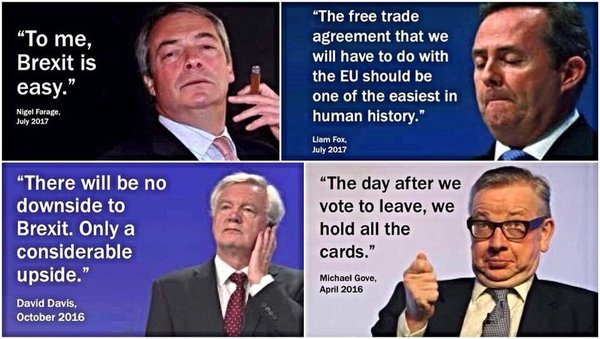
How could anyone who has seen the dire warnings issued today from the government about a no-deal brexit, ever deny that they were lied to by this bunch of charlatons?
Registering is free, easy, and means you can join the discussion, watch threads and lots more.
Register now »Already registered? Log in with:
Gransnet »Get our top conversations, latest advice, fantastic competitions, and more, straight to your inbox. Sign up to our daily newsletter here.
