
Isn't this just another breach of the general principles of the Ministerial Code? I can see in Commons procedure that:
Questions, although customarily addressed to specific ministers, are directed to the cabinet as a whole. Members may not insist upon receiving answers, nor may they insist that specific ministers respond to their questions ...
In response to a question, a minister may:
provide an answer;
defer an answer;
explain briefly why an answer cannot be provided at that time; or
say nothing.
www.ourcommons.ca/procedure/our-procedure/Questions/c_g_questions-e.html
I cannot find anything that says a minister can prevent a question from being asked. Can anyone help me out here?
Gransnet forums
News & politics
Disappointing Queen’s Speech fails those in desperate need now
(32 Posts)I thought we needed to move on from discussing the Queen to discussing the Politics of the speech. This is from a press release. The Verdict from the National Pensioners Convention which I thought would be relevant to many if not most of us.
Comment by Jan Shortt, General Secretary, National Pensioners’ Convention
In the middle of one of the worst cost-of-living crises in living memory the government had a real chance to step up and help those most affected – our oldest and poorest. But today they failed, showing little compassion for the immediate struggles of vulnerable people.
The National Pensioners’ Convention had hoped the Queen’s Speech at the State Opening of Parliament today (Tuesday, 10th May) would contain measures to provide real, and urgent financial assistance to those overwhelmed by inflationary prices, and a more than doubling of energy bills.
Instead, they outlined legislation promising longer term changes, which frankly will not help those having to choose between buying food or paying their rent or energy bills right now.
People on low and fixed incomes pay a much higher proportion of their income on essentials – there is no way they can find the extra money when costs rise so rapidly.
Spiralling energy costs, rocketing inflation and a succession of government policies which have lowered the real value of pensions and benefits, mean millions more face poverty in the coming months. It is a disaster that is only set to get worse as we approach autumn and another round of energy hikes.
But it is not just government’s lack of provision for the cost-of-living crisis. The NPC has concerns about what they have promised – they are outlined below:
*Order – we are concerned that this will prevent democratic protest by older people in circumstances where government policy undermines the dignity and respect for pensioners. It also must take account of the Bill of Rights.
*Conversion therapy – we disagree with the fact that the ban does not cover transgender and our LGBT working party will be asking for the government to meet with us to listen to our members concerns.
*Energy Security Bill – long term on sustainable energy – been ongoing for years with no progress. What about the poverty and deprivation now?
*Mental Health Bill – not before time but we need to digest whether it will address the amount of funding needed to make it work.
*Bill of Rights – we will monitor. The rights of older people have been seriously eroded in recent years and we will be looking for this to be tackled in any new legislation,
*Financial Services Bill – at last, legislation to give access to cash. However, there is still the issue of banks already closed on high streets. We need to know how the government will support communities where there are no banks and very little transport to get to the nearest one.
*Renters Bill – again long overdue, as an increasing number of older people are among those having to rent in the private sector. Along with the Social Housing Regulation Bill, we would hope to see much needed decent homes standards applied across the board.
*On-Line Harms Bill – needs to put more emphasis on the responsibilities of platform providers who make profit from their services; compensation for those scammed direct from platform providers and more funding to deal with scammers.
I'm neither endorsing this nor disagreeing. I thought it was a good structure for discussion.
You can find the original here
Thanks for the link Maizie. I think this government now feels it isn't governing, it is commanding.
Whitewavemark2
Did anyone watch Patel refusing to take questions in the QS debate?
Cooper said that she is the first Home Secretary ever not to answer questions in the QS debate.
This is a link to a clip of the incident.
I saw it last night and couldn't believe my eyes. Not only did Patel refuse to take a question from her opposite number (she didn't refuse to answer questions, she wouldn't even let Cooper ask them!) but her behaviour when she sat opposite Cooper reminded me forcibly of a defiant teenager making faces at a teacher (and I've seen plenty of them)
Is this the next step for our government to evade all accountability? Refuse to even hear any opposition questions ?
(I was going to say 'refuse to answer opposition questions', but Johnson already does that by waffling at length without once addressing the question)
twitter.com/ITVNewsPolitics/status/1524376173970698240
As I've posted, not all private landlords have properties on BTL and as the law's to be changed, and section 21 will no longer be an option for landlords, those that had planned at some point in the future to make the property they let their home, are less likely to want to have a tenant.
I'm sure many like us had thought things through before letting but couldn't have known that this change was going to happen. We've been letting out our flat for 20 years and now need to decide whether or not we want to risk having a tenant that may never leave.
Short term lets are not appropriate for anyone wishing to make the property they rent, their home.
There won't be fewer homes, unless somebody is going to bulldoze empty properties.
Did anyone watch Patel refusing to take questions in the QS debate?
Cooper said that she is the first Home Secretary ever not to answer questions in the QS debate.
Smileless2012
That's the point though growstuff. If it can take a landlord a year or more to evict a troublesome tenant, how can they evict a tenant whose not at fault?
What if they want to live in the property they own themselves?
Not all private landlords are BTL, some own the property they let. I didn't say privately let properties would disappear but there's a distinct possibility they'll be depleted.
Investing in other business ventures may be good for the economy but it wont be good for those looking for homes to rent if there are fewer available.
I disagree that the overall housing stock will be depleted. There's a possibility that it might become more affordable, if being a BTL landlord is less attractive. It also means that capital would be diverted to more productive businesses.
If a BTL landlord want to live in the property, he/she should think of that before letting. There is already provision for short term lets.
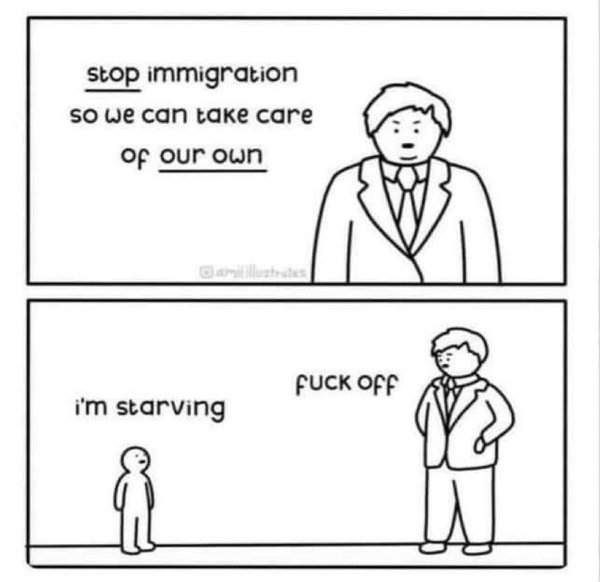
Succinct summing up of Johnson’s government
That's the point though growstuff. If it can take a landlord a year or more to evict a troublesome tenant, how can they evict a tenant whose not at fault?
What if they want to live in the property they own themselves?
Not all private landlords are BTL, some own the property they let. I didn't say privately let properties would disappear but there's a distinct possibility they'll be depleted.
Investing in other business ventures may be good for the economy but it wont be good for those looking for homes to rent if there are fewer available.
How many people can seriously afford to keep two homes for personal use only?
As you wrote, this doesn't affect people who can be evicted for justifiable reasons such as non-payment of rent, but people who have done absolutely nothing wrong.
If a landlord wants to sell the property, he/she will have to sell it with a sitting tenant. If it puts people off becoming BTL landlords, the properties won't disappear and could mean that more properties are available for people to buy or for housing co-operatives, who will be looking to the long term, to buy them.
It could also mean that people start investing in more productive businesses rather than property, which would be good for the economy.
As ever, the devil is in the detail, but if it means the country moves towards a fairer and more secure deal for tenants, it's a good thing.
It could also be one step in the direction of fewer homes available to rent from private landlords DaisyAnne. It's notoriously difficult to evict as it is even when there's unpaid rent or a tenants neglect and abuse of property, a situation where a section 21 ie 'no fault' would not be served.
Investment in property provides a place for someone to make their home and if private landlords will only be able to request a tenant leaves if they're at fault, fewer will be prepared to let.
What happens if the landlord wants the property to live in themselves?
We're nearly there, having had to gut and completely re furbish our flat and are undecided whether or not to get another tenant. If we decide not too, possibly having it as an Air B&B or keeping it for occasional use for ourselves and family, that will be one less property available for someone to make their home.
volver
Gove this morning on BBC.
I have to say I find him difficult to take seriously.
twitter.com/i/status/1524284376078594048
presumably someone had wiped the white powder off his collar before he went on air
I know Maizie but it has to be better than discussing the Royal family's perceived sartorial errors and believing that's a basis for a political view 
Just a couple more cribs from the New Statesman email (I will be buying this weeks copy  )
It is not so much that the Tories have lost their bearings under Johnson as that they never really had any, or that those bearings never all pointed in the same direction.
and
Rafael Behr captures the inherent conflict in the Guardian: by trying to level up the country or ease the cost of living without sufficiently funding either aim, Johnson, he says, is “trying to cook up egalitarian ends with libertarian means”.
Sorry not to add anything, DaisyAnne, but every time I see your thread title I think 'Did we expect anything different?'
Johnson finds detail too boring to bother with, so plans are definitely not his forte. Never mind that it is what is badly needed.
Johnson is only bothered about Johnson.
The first paragraph in the New Statesman email seems to follow that thinking Whitewave.
We are nearly three years into Boris Johnson’s tenure as prime minister and yet his government still feels like it’s searching for a plan, or perhaps merely for the appearance of one: it’s not clear how bothered Johnson is by the apparent incoherence of his government’s statements and policies.
It is like Rwanda.
It is generally thought that this is never going to happen.
Everything about the headline and nothing else.
There are a lot of intentions, but no plans to carry them out.
I agree WWM. I think that every time I look at one of the proposals in the QS, for instance. It is not so much a question of whether they intend to do these things or not but whether they are competent to do them. I see no evidence of any degree of competence. Parliament is about law, first and foremost and they seem to have little understanding of law when it comes to making it or why they should not be breaking it.
The game playing around politics is all they seem interested in and, sadly for them but happily for us, they don't seem all that competent at that, in any practical way, either.
The big issue I find is taking anything this government says seriously.
They have achieved so little.
volver
Gove this morning on BBC.
I have to say I find him difficult to take seriously.
twitter.com/i/status/1524284376078594048
Cocaine
I think anything that sounds good needs careful scrutiny, doesn't it OD
I found myself thinking there wasn't much of substance there. I wonder if the Cabinet - assuming Johnson no longer has the final say - think and election will be earlier than two years.
I recall one of Johnson' many broken election promises was to build 300,000 new homes a year and (like the 40 new hospitals) it isn't happening, nowhere near.
The Renters’ Reform Bill is a long time coming and will be yet.
The Bill was announced during the 2019 Queen’s Speech on 19 December 2019. There is still a commitment to bring a Bill forward to abolish no fault evictions in the private rented sector, but it will be preceded by a white paper which is expected in spring 2022
The Social Housing Regulation Bill includes support for tenants to buy a home of their own, which I assume means right to buy social housing so more homes will go from the public rental sector.
Gove this morning on BBC.
I have to say I find him difficult to take seriously.
twitter.com/i/status/1524284376078594048
On the Housing and Planning side, it does look as if they intend to end no-fault evictions. This would, if it happens, be one step in the direction of houses being homes rather than simply investments.
The government does seem lost however, when it comes to building more affordable homes. On "Today" this morning, Gove admitted that we need them as there is a shortage saying, "and we all know why". Other than this too long reign of Tory governments not building them, I have no idea what that means.
Again on housing, they are stoking the culture wars playing to NIMBY, mainly Tory, voters who are going (if it happens) to get a vote on their neighbour's extension plans. This could be a bit of a curate's egg of a policy but, in my view, some good may come out of it.
Join the conversation
Registering is free, easy, and means you can join the discussion, watch threads and lots more.
Register now »Already registered? Log in with:
Gransnet »