?


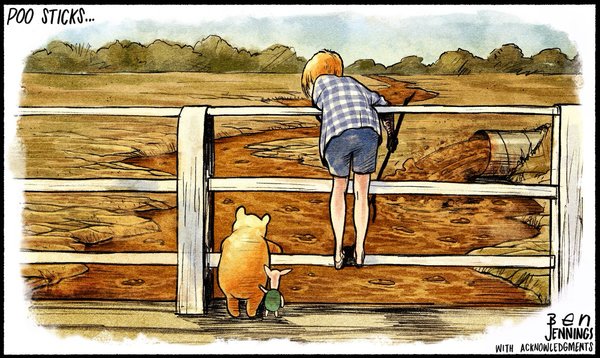
If you have made the mistake of following the Tory leadership election then you will, presuming you suspended your disbelief, now know that we are facing a bright future under Liz Truss, where growth, prosperity, light touch regulation, low tax and strong international trade will deliver us all we have ever aspired to.
In fact, more than that, the climate crisis will, under her rule, be so insignificant it can be ignored; the rule of law will no longer be required; every town, village and hamlet will be a freeport making its own regulations and laws under the benign guidance of a company given the task of doing so; and the land will flow with milk and honey.
None of this is true, of course.
This morning we have news of drought and the risk of hose pipe bans and even outright water shortages.
There is also a warning of power cust to come this winter as electricity supply will not meet demand.
Avanti has just axed two-thirds of its train services on the West Coast mainline.
Six million people are waiting for NHS treatment.
Half the UK's households do not know how they will pay their fuel bills when the average energy price increases to £4,200pa this winter. The likelihood that many will simply be unable to pay is high.
As a consequence, the rest of the economy is under severe threat of recession.
A banking crisis is possible as rents go unpaid, landlords fail to service their debts, joining those mortgage holders who will be in the same boat.
Schools and hospitals face impossible choices due to their increasing energy costs this winter.
Hardly talked about, but something I fear greatly is the risk that many care homes - which have to be warm - will simply be unable to afford to carry on trading this winter as those they p[provide for cannot pay increased bills, creating a massive care crisis.
It is actually quite hard to think of anything that is working well in the UK now, and which is not at risk of failure quite soon.
The Tory leadership election is taking place in some fantasy space created by a political party wholly out of touch with reality. The difficulty is that one of those taking part - and making the absurd promises on offer to the Tory party faithful, will be governing us soon. There is little sign that they will embrace reality then.
We are in deep, deep trouble.
Richard Murphy
10/08/22
?
Katie59
Taxation certainly isn’t needed to fund capital spending, it is usually borrowed to do that, however it certainly is needed for operating costs. Hospitals do not provide treatment without cash from taxation, nor do roads get maintained.
As for taxation being used to redistribute wealth, it hasn’t yet, all it does is enable the poor buy the basics
Where are you getting this idea that taxation funds spending from, Katie59?
Economists have shown that it isn't true.
Taxation certainly isn’t needed to fund capital spending, it is usually borrowed to do that, however it certainly is needed for operating costs. Hospitals do not provide treatment without cash from taxation, nor do roads get maintained.
As for taxation being used to redistribute wealth, it hasn’t yet, all it does is enable the poor buy the basics
I don't think anybody is suggesting that the country should be in a permanent QE situation. However, there is no good reason why it can't be used when justified eg. for long-term infrastructure initiatives or when the country is in crisis, as it is now. Ideally, it could be used for both and we shouldn't just rely on "sticking plaster" solutions.
It's a fact that the government can create/spend money without waiting to build up "savings", as a frugal household would have to do. Spending precedes taxation - that's the way the system works in an economy with a sovereign currency.
Taxation isn't used to fund spending. It's used to control the supply of money in the economy and to redistribute wealth. Of course, people with more than average wealth don't like the second aim, which is why they're so keen to perpetuate the "no magic money tree" myth.
Yes, that would be interesting to know Whitewavemark2.
Whitewavemark2
maizie it isn’t that I find it difficult to grasp, it is because I’m not convinced, and need to do a lot more reading. Brain fog at the moment though.
What do you remain unconvinced about?
Whitewavemark2
maizie it isn’t that I find it difficult to grasp, it is because I’m not convinced, and need to do a lot more reading. Brain fog at the moment though.
I would go one step further WWM. It isn't that I find the premise difficult or unconvincing. I worry that, just as those used to double entry bookkeeping latched on to the flawed, oversimplified, Mrs Thatcher's Handbag school of economics, this view may be oversimplified too.
MaizieD
Dinahmo
Maizie As usual you are spot on except for the CT rate. Currently 19% but increasing to 25% from April next for companies with a profit in excess of £250k and 19% for profits under £50k with marginal relief between the lower and upper profit figure.
I couldn't recall the CT rate offhand, so took a guess
Even at 25% the government wouldn't be getting a great deal, would it?
Yes
The EU gave us a degree of protection from outside influences while still allowing countries to run their own economies. France in particular has always protected its national interests while we’ve allowed ours to be frittered away for short term political gain.
Katie59
Private finance of public infrastructure has reduced the capital cost of any project at the cost of increased overheads during its life. So future consumers carry the debt and the operating cost in the form of increase prices, this is fine when those costs are controlled.
Relying on a imports from a potential enemy or free market supplier is foolish because having given up the ability to produce at home you then have to pay inflated prices if supply is short.
Successive governments have chosen abandon home production and rely on imports to the extent that the technology no longer exists at home, now we pay the price.
I do agree with you about PFI, Katy59. It was so unnecessary and so badly done. The private companies ran rings round the civil servants negotiating it. They were experienced, the CS's weren't.
But this is what happens when government doesn't grasp that the state can be self financing.
MacMillan warned us that Thatcher was selling off the family silver 
How right he was. But then, I'm sure she never thought in a million years that we would leave the EU.
maizie it isn’t that I find it difficult to grasp, it is because I’m not convinced, and need to do a lot more reading. Brain fog at the moment though.
Private finance of public infrastructure has reduced the capital cost of any project at the cost of increased overheads during its life. So future consumers carry the debt and the operating cost in the form of increase prices, this is fine when those costs are controlled.
Relying on a imports from a potential enemy or free market supplier is foolish because having given up the ability to produce at home you then have to pay inflated prices if supply is short.
Successive governments have chosen abandon home production and rely on imports to the extent that the technology no longer exists at home, now we pay the price.
Whitewavemark2
I’m beginning to read about MMT, and now understand why I couldn’t “fit” it into what my limited knowledge of the different economic schools told me.
It is because it sits entirely outside of the mainstream.
So now I can begin to understand it.
Governments have always issued their sovereign currency, but it was, until the early 1970s, usually given its value by either being gold or silver, or a token or note which could be redeemed for the precious metal. The currency in circulation was theoretically limited by the amount of gold and silver held in the Treasury. This was the 'gold standard'. When the gold standard applied governments genuinely had to tax and borrow to raise the revenue they needed. The language we use about our money is from the era of the gold standard.
The issuing of money without it being 'backed' by anything, is, on the other hand, a whole new ball game. It's a game that has taken government some time to cotton on to. But the QE of the past couple of decades shows that they had an inkling... QE is completely new money, issued on the strength of a 'virtual' sale of new Treasury bonds to the Bank of England and the proceeds fed into the commercial banks' reserve accounts for distribution into the economy. As the BoE belongs to the nation, QE is a 'debt' that the country 'owes itself' and will never be repaid.
There are those who argue that the fictitious bond sale should be dispensed with and the money paid straight to companies or individuals... There's no reason why this couldn't be done.
QE accounts for most of our 'debt'. The rest is people's savings and investments, as I've explained before on other threads. It is, yes, 'owed' in a sense, but does one think of an interest paying bank deposit account as a 'debt' that the bank owes?
The government isn't obliged to borrow, but it is convenient for it to continue to provide a savings and investment service, which is valued by its users because they know their principle is safe. Which cannot be said of any other investment.
This 'borrowing' means that the government doesn't have to 'create' so much money as it's popular with savers and investors and gives a constant supply of money.
Taxation is no longer needed to 'earn' money for the state coffers, but it has a number of uses, a prime use being to also control the amount of money in the economy and prevent excessive inflation. But, while there are resources available to buy (and there are plenty of things the government could be spending on; investment in green technology and in state services being some examples) inflation caused by excess money driving competition for scarce resources isn't a problem.
I think this is the most difficult bit of MMT to grasp. That taxation in one respect means that , as with 'borrowing', the government doesn't have to issue so much money, but that the amount of money returned to it via taxation doesn't limit its capacity to spend. This contradicts the story that everyone is so familiar with, that everything the state provides is paid for out of our taxes. It isn't a true story, but it suits governments that are ideologically opposed to state spending to perpetrate it.
But if we understand the true nature of how state spending isn't constrained by the tax take, then we can make more informed political choices, not influenced by the 'how is it going to be paid for?' question. because it's irrelevant.
Katie59
How could the UK nationalise utilities sold to Foreign countries and companies?
It’s not the utility companies it’s the energy producers, most of which are UK based, the government could just take the lot over.
It would have to pay a fair price in whatever form, or there would be retaliation from foreign governments.
certainly will not be easy.
this video will make some blood boil, but it is the reality
fb.watch/e-1gCl24lO/
growstuff
DaisyAnne What do you mean by a "strong" economy?
One that others outside our country believe in?
One with high economic growth?
Stability and low inflation?
Good levels of employment?
Reliable governance?
Remember, unlike some, I am not telling you this is right. These points are my current thoughts as I process the information I can glean. Equally, I am unlikely to believe anyone who tells me they know, indisputably, how our economic system could be the best for all. Although there are some "experts" I may trust more than others.
Where people aspire to different political ends, they will want a different economic reference. That does not make one right and one wrong or even one inside the mainstream and one out. It does mean we should know what we are choosing, and what economic theory a government is using when we vote.
Whitewavemark2
I’m beginning to read about MMT, and now understand why I couldn’t “fit” it into what my limited knowledge of the different economic schools told me.
It is because it sits entirely outside of the mainstream.
So now I can begin to understand it.
I don't think it does sit outside the mainstream. It's what actually happens with money and can be shown to do so. Both my children did A level economics and one of the first principles of macro-economics they get taught is that spending precedes taxation. Once it's understood that a country with a sovereign currency isn't like a household, which needs to rely on banks to borrow, it's quite easy to grasp.
I’m beginning to read about MMT, and now understand why I couldn’t “fit” it into what my limited knowledge of the different economic schools told me.
It is because it sits entirely outside of the mainstream.
So now I can begin to understand it.
DaisyAnne What do you mean by a "strong" economy?
Maizie
The flaw is that you are assuming that the government can print money at an unlimited rate. Before QE it had to be borrowed at the best rate and then paid back, that was the theory, in practice another loan was taken out to pay the first..
Currently the Hinkley Point nuclear power station is being financed by France and China, they want a payback for that which comes year by year over the life of the power station.
If printing money really was unlimited why borrow at all.
I have been reading about MMT since I first saw it flagged on here Maizie - probably by you I always thought research meant challenging the apparent flaws by looking at all the published literature. I have no background in economics, so I read, absorb and reflect - it can take some time.
It makes sense to me that the control of released currency would be to use taxation to ensure this does not exceed the capability to repay.
If I am correct, although you can "print" to grow the economy, you cannot simply print to suit your politics. We can probably agree that neither can you tax to suit your politics. Neither tax nor printing money pays the bills; a strong economy does.
If we are then saying we can print money to grow the economy and use tax to ensure it doesn't outgrow the strength of that economy, we then have to look at what does grow an economy.
Each of the extremes of politics seem to me to only provide strength to the economy in one area. I, not surprisingly, think you need economic strength in the round. I also believe you need a government that understands you cannot just maintain one part of society economically. It has to work for all to make/keep the economy strong.
Dinahmo
Maizie As usual you are spot on except for the CT rate. Currently 19% but increasing to 25% from April next for companies with a profit in excess of £250k and 19% for profits under £50k with marginal relief between the lower and upper profit figure.
I couldn't recall the CT rate offhand, so took a guess
Even at 25% the government wouldn't be getting a great deal, would it?
DaisyAnne
^I'm aware of that, of course. But there is only one main way that money enters the economy, a way that is empirically proven, and that is through it being issued by the state. This is a statement of fact. Not a theory.^
The problem, however, is that MMT argues that all government expenditure is funded by that money creation. This, to me, is over-simplified reality.
All money, either as currency or electronically, is issued against a promise to pay. What if a government believes, as I think you have said in the past, that there is a magic money tree? If they switch it on who or what will be able to keep the "promise to pay". The government obviously can do this, but only if the economy is sound and preferably growing. I'm afraid this is not the very simple ability to print money, as has been suggested. We need to know that the "promise to pay" is possible to fulfil or we will become, at worst, a pariah state. That's why Corbyn, with Corbynomics based on MMT, frightened so many people.
I really think that you should look into MMT more thoroughly, rather than depend on my interpretation.
The government can always pay, because it's the one issuing the money. This is not an objection to MMT that I have ever seen; the prime objection I've seen is the fear of inflation caused by having too much money in circulation with not enough resources for it to purchase.
But MMT isn't an endless money printing exercise; the amount of money in circulation has to be controlled.
Control is via taxation; the prime purpose of tax being to destroy excess money so as to avoid inflation. In the right circumstances, of course. Taxation wouldn't rectify our current inflation (any more than increasing interest rates will) because it is caused by supply problems and increased costs, not by too much consumer demand.
Most economists at the moment are screaming that interest rate rises (which are the only alternative tool for controlling inflation) cannot control supply side cost driven inflation. It only works for demand driven inflation because it takes money out of circulation. It's ludicrous to be doing it now when a large section of the population doesn't have enough money to even pay its living costs, let alone splash it on 'extras'.
Governments spending their way out of a recession isn't even a novel concept. It's what Roosevelt did in the 1930s with his New Deal and what Keynes promoted in the 1930's & 40's.
I'm aware of that, of course. But there is only one main way that money enters the economy, a way that is empirically proven, and that is through it being issued by the state. This is a statement of fact. Not a theory.
The problem, however, is that MMT argues that all government expenditure is funded by that money creation. This, to me, is over-simplified reality.
All money, either as currency or electronically, is issued against a promise to pay. What if a government believes, as I think you have said in the past, that there is a magic money tree? If they switch it on who or what will be able to keep the "promise to pay". The government obviously can do this, but only if the economy is sound and preferably growing. I'm afraid this is not the very simple ability to print money, as has been suggested. We need to know that the "promise to pay" is possible to fulfil or we will become, at worst, a pariah state. That's why Corbyn, with Corbynomics based on MMT, frightened so many people.
Maizie As usual you are spot on except for the CT rate. Currently 19% but increasing to 25% from April next for companies with a profit in excess of £250k and 19% for profits under £50k with marginal relief between the lower and upper profit figure.
Southern Water fined £90 million last year for pollution.
On the television tonight disgusting footage of raw sewerage being pumped into the sea all along the south coast .
Not a single beach can be used between Hastings and Pevensey a big holiday area. And there are warnings for many others.
I wonder if I can do something about my bill?
Registering is free, easy, and means you can join the discussion, watch threads and lots more.
Register now »Already registered? Log in with:
Gransnet »Get our top conversations, latest advice, fantastic competitions, and more, straight to your inbox. Sign up to our daily newsletter here.
