The Briefing Room, BBC radio 4 at 11.00 had a very interesting and informative programme on inflation. I learned a great deal, it's worth a listen.
The Government advice re emergency packs


I will not personally be affected as we paid off our mortgage years ago and don't have any debts but I am so worried about how this will affect so many families and young people who are already struggling. A divorced friend has been trying to sell her house as the children have moved out and she no longer gets maintenance. She is really struggling to pay her mortgage but despite reducing the price of her home, she still can't sell. She's been selling belongings to make ends meet. I'm sure she's representative of lots of people and they are not the people who should be targeted, it's people like me! Mortgage free, decent pension, savings, with the ability to soak up extra costs. What do others think?
The Briefing Room, BBC radio 4 at 11.00 had a very interesting and informative programme on inflation. I learned a great deal, it's worth a listen.
M0nica Casdon there have been so many articles in newspapers on line, everywhere for about 4 years aor more saying interest rates are due tp rise and cannot stay so low.
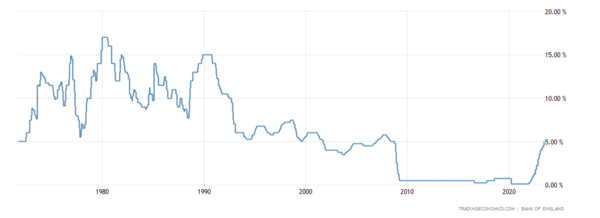
Again back in the 1970s, we had no expereience of mortgage rates going as high as they did and certainly no experience of interest rates nearly double and sometimes treble what they are now.
Agreed, for several years the news was replete with stories that interest was too low and should be soon to go up.
Certainly anyone knew for a fact interest rates fluctuate - from a 7% in 1971 to a high of 17% in 1979 to lows beginning in 2008. The rates after 1980 were, quite obviously, volatile and changing.
No excuse for ignorance. Two of our children purchased in the early 80s and two in the early 2000s - they surely grasped the concepts of rate changes.
Bank of England base rate 1979-2017
Bank rate at year end (%)*
1979--17
1980--14
1981 --14.375
1982--10
1983--9.0625
1984--9.5
1985--11.375
1986--10.875
1987--8.375
1988--12.875
1989--14.875
1990--13.875
1991--10.375
1992--6.875
1993--5.375
1994--6.125
1995--6.375
1996--5.9375
1997--7.25
1998--6.25
1999--5.5
2000--6
2001--4
2002--4
2003--3.75
2004--4.75
2005--4.5
2006--5
2007--5.5
2008--2
2009--0.5
2010--0.5
2011--0.5
2012--0.5
2013--0.5
2014--0.5
2015--0.5
2016--0.25
2017--0.5
2018--0.75
2020--0.25
2020--0.10
2021--0.25
2022--0.5
2022--0.75
Interestingly, the reason the BofE didn't put the rate up was because their modelling told them not to. Apparently, this period of very low inflation had not been experienced before. The experts got it wrong. Do listen to The Briefing Room, Norah, there are proper experts on there discussing it.
foxie48
Interestingly, the reason the BofE didn't put the rate up was because their modelling told them not to. Apparently, this period of very low inflation had not been experienced before. The experts got it wrong. Do listen to The Briefing Room, Norah, there are proper experts on there discussing it.
You’re whistling in the wind, as I was foxie48. The fact that money being taken out of individual savings accounts has hit an all time high as reported yesterday (because people can’t pay their bills any more) is also probably totally irrelevant and down to the young people of today being less financially savvy than their elders.
No one is saying young people today are less savvy than in the past. But at every level you can not opt out of making sure you stay in touch with what is going on round you in the world you live in.
What is happening now is happening, but it is not uniquely dreadful. It has happened before, several times within living memory, and it will happen again. And at times like this people draw down on their savings to meet bills. Again it is what people did in the 1970s and 1980s and at any other time when prices were going up faster than incomes.
We took a mortgage out in 2021. We fixed it for 5 years, we made length of fix, more important than lowest interest rate because we had heard the news, listened to the radio programmes like Briefing Room, seen news items and other commentary online and in newspapers and magazines, and we realised that interest rates were more likely to go up than down.
OK we do not know what will happen in 2026, but in the meanwhile we will watch what interest rates do, we will read everything we come across and we will plan ahead on the basis, that in three year's time our mortgage payment could double, or more. It is common sense, not rocket science or brain surgery.
I don't think it is easy to ride out large increases in housing though, however savvy (or 'opted in' to awareness) you are.
I've done a quick Google of costs, and found some figures for Mr and Ms Average buying an average house, with and without average childcare costs:
The average house price in the UK is £285,000 (YouGov) with huge regional variations.
With a 10% deposit (which would be difficult to save on that salary), a mortgage of £256,500 would cost £1425 per month at 4.2% (moneysavingexpert calculator) assuming that no fees have been added to cover arrangement costs, solicitor, estate agent and removals.
The median salary is £31,000 (Indeed.com) across all age ranges, and this will, of course, be lower in younger groups who are likely to have newer mortgages.
A salary of £31k would give Mr/Ms Average, assuming a pension contribution of 6% and a student loan repayment of £27 a month, a take-home of £1965.82 (thesalarycalculator.co.uk).
This would leave about £540 a month for food, transport, council tax, energy, water, phone, TV etc for a single person.
It would take a rise of only 4% on the £256,500 mortgage to take the repayments to £1980, which is more than the take-home pay before any other expenses.
Even if we assume that most houses are bought by couples with two salaries, and that both partners earn the average of £31k with the same offtakes, we are looking at a disposable household income of £2505 a month ((£1965x2=£3930, minus £1425), and childcare may well have to be paid out of that £2505. According to day nurseries.co.uk the average cost of a full time nursery place per child is £14836 pa for an under-two, and £14539 for a two year old, which comes to £2448 per month for a family with one of each. This would more than wipe out one of the salaries, and even on the 4.2% mortgage there would be little or nothing left for expenses. State help for childcare doesn't kick in until over 3, and even then will not cover full-time places.
£2448 (childcare) + £1425 (mortgage) =£3873, leaving the princely sum of £57 a month for everything else, and if the mortgage went up even a tiny bit even that would be wiped out.
I don't think that either common sense or a knowledge of brain surgery could make that work.
Doodledog
I don't think it is easy to ride out large increases in housing though, however savvy (or 'opted in' to awareness) you are.
I've done a quick Google of costs, and found some figures for Mr and Ms Average buying an average house, with and without average childcare costs:
The average house price in the UK is £285,000 (YouGov) with huge regional variations.
With a 10% deposit (which would be difficult to save on that salary), a mortgage of £256,500 would cost £1425 per month at 4.2% (moneysavingexpert calculator) assuming that no fees have been added to cover arrangement costs, solicitor, estate agent and removals.
The median salary is £31,000 (Indeed.com) across all age ranges, and this will, of course, be lower in younger groups who are likely to have newer mortgages.
A salary of £31k would give Mr/Ms Average, assuming a pension contribution of 6% and a student loan repayment of £27 a month, a take-home of £1965.82 (thesalarycalculator.co.uk).
This would leave about £540 a month for food, transport, council tax, energy, water, phone, TV etc for a single person.
It would take a rise of only 4% on the £256,500 mortgage to take the repayments to £1980, which is more than the take-home pay before any other expenses.
Even if we assume that most houses are bought by couples with two salaries, and that both partners earn the average of £31k with the same offtakes, we are looking at a disposable household income of £2505 a month ((£1965x2=£3930, minus £1425), and childcare may well have to be paid out of that £2505. According to day nurseries.co.uk the average cost of a full time nursery place per child is £14836 pa for an under-two, and £14539 for a two year old, which comes to £2448 per month for a family with one of each. This would more than wipe out one of the salaries, and even on the 4.2% mortgage there would be little or nothing left for expenses. State help for childcare doesn't kick in until over 3, and even then will not cover full-time places.
£2448 (childcare) + £1425 (mortgage) =£3873, leaving the princely sum of £57 a month for everything else, and if the mortgage went up even a tiny bit even that would be wiped out.
I don't think that either common sense or a knowledge of brain surgery could make that work.
Thank you Doodledog, that’s really helpful.
In which case Doodledog, given that nobody can have escaped the warnings that the long run of unprecedentedly low interest rates would end, why did your hypothetical couple with their two small children take out the mortgage? If they have student loans to repay one might hope they would display rather more intelligence. Any fool could work out the effect on their already tight budget of an even a small interest rate rise.
But doodledog this is not that different to the situation many of us faced in the 1970s and 80s.
No one is suggesting the current situation is easy and for some it will be catatstrophic, but that was the same then as now. Houses were repossessed, families were left homeless.
In fact it is better now because lenders do go to great lengths to help those facing difficult times, and have a range of schemes, from going interest ponly for a short perios, to extending morgages.
In the 1970s and 80s, if you couldn't make your payment, the lenders just foreclosed. DD bought her first home in 1993 and one property she wanted to buy, was a repossession. Someone over reached themselves, couldn't cope with a rise ininterest rates, so the only option was repossession.
M0nica
But doodledog this is not that different to the situation many of us faced in the 1970s and 80s.
No one is suggesting the current situation is easy and for some it will be catatstrophic, but that was the same then as now. Houses were repossessed, families were left homeless.
In fact it is better now because lenders do go to great lengths to help those facing difficult times, and have a range of schemes, from going interest ponly for a short perios, to extending morgages.
In the 1970s and 80s, if you couldn't make your payment, the lenders just foreclosed. DD bought her first home in 1993 and one property she wanted to buy, was a repossession. Someone over reached themselves, couldn't cope with a rise ininterest rates, so the only option was repossession.
Here’s the evidence. It needs the further inflation rises since 2022 factored in to make a true comparison.
www.ons.gov.uk/economy/inflationandpriceindices/articles/consumerpriceinflationhistoricalestimatesandrecenttrendsuk/1950to2022/pdf
Germanshepherdsmum
In which case Doodledog, given that nobody can have escaped the warnings that the long run of unprecedentedly low interest rates would end, why did your hypothetical couple with their two small children take out the mortgage? If they have student loans to repay one might hope they would display rather more intelligence. Any fool could work out the effect on their already tight budget of an even a small interest rate rise.
Indeed.
If both work, common currently, and have young children, and student loans, and the deposit was a "stretch" -- why purchase until all things improved for them financially? No need to rush into chaos!
I assume they bought because they needed somewhere to live, and had nobody to donate them a house?
I'm not sure about the link between student loans and intelligence, really. They are compulsory unless people have someone to donate the fees and maintenance costs of education - something else that we didn't have to consider.
We bought our first house in 1978/9. The repayments shot up immediately. Yes, we borrowed a smaller multiple of our income, but like everyone else we can't take credit for that as it wasn't our wisdom that stopped us from borrowing more - it was just the system. We weren't rushing in, either. A friend had bought an identical house (a tiny modern 'starter home' on boring estate three years earlier for half what we paid. How were we to know that three years later ours wouldn't cost twice as much again? It wasn't a case of over-reaching - there was nothing cheaper, really.
That was in the past, and I can't remember a lot of detail, but energy bills weren't huge then, and life was simpler - nobody had or needed computers or phones, or digital TV, so outgoings were lower too.
I was 22 when I married - a year after buying the house. My children are 10 years older now. Both have good jobs, but neither has a mortgage yet, as they pay hight rents and deposits are insanely high. They have done nothing wrong, any more than my generation did anything right. It is just harder for young people now, I think.
I also think that there is no virtue in suffering, and the fact that this has happened before doesn't make it easier for those going through it now. I don't think that the rates rises are 'unfair' - but I am starting to understand why some younger people resent older generations for smuggery and self-righteousness.
Monica you have said it all. I can add no more to what you have said. I agree with you, it is absolutely not worse for people with mortgages now than it was in the past. It was truly awful and many, many people lost their homes.
My mention of student loans was simply noting that they had been to university, so not unintelligent. Better options for them if they stretched themselves so much to buy would surely have been a cheaper property or continuing to rent - rents may have risen or shortly do so, but they had managed to save a deposit, money to fall back on if necessary.
M0nica
But doodledog this is not that different to the situation many of us faced in the 1970s and 80s.
No one is suggesting the current situation is easy and for some it will be catatstrophic, but that was the same then as now. Houses were repossessed, families were left homeless.
In fact it is better now because lenders do go to great lengths to help those facing difficult times, and have a range of schemes, from going interest ponly for a short perios, to extending morgages.
In the 1970s and 80s, if you couldn't make your payment, the lenders just foreclosed. DD bought her first home in 1993 and one property she wanted to buy, was a repossession. Someone over reached themselves, couldn't cope with a rise ininterest rates, so the only option was repossession.
Agreed.
Nobody said it's easy right now for people who face re-sets. But accommodations are being made by lenders. This will work out for most, my guess.
The other difference I notice is that no one felt ‘sorry’ for younger people with mortgages in the past when rates were so high. We were just expected to ‘get on with it.’ Well we were anyway, and the fact that we cut everything to the bone and could barely afford to clothe our children was just tough. It is what is, it’s nothing new.
I am not disputing that. It was awful - as I say, we were caught in the thick of it, and again in the late 80s when we moved from the tiny house to a bigger one as we wanted to start a family. We had to get a much bigger mortgage, as the sale of council houses happened when we were in the tiny house, and they were a better buy for people at that end of the market, so we made very little on the sale of ours.
We had 2 babies and fixed at something like 16% for five years, as we were afraid the rates would hit 20%. The stress was awful, and the news was full of stories of people losing their homes, as well as high unemployment.
But people need somewhere to live. They have no choice but to pay what houses cost. They need them when they need them - not everyone can wait until the market settles down (if ever). I don't think that we can question the intelligence of today's young people, or accuse them of being 'fools' for having mortgages when the alternative is paying someone else's mortgage by renting.
Indeed maddy, and no assistance from lenders as Norah says.
Doodledog
I assume they bought because they needed somewhere to live, and had nobody to donate them a house?
I'm not sure about the link between student loans and intelligence, really. They are compulsory unless people have someone to donate the fees and maintenance costs of education - something else that we didn't have to consider.
We bought our first house in 1978/9. The repayments shot up immediately. Yes, we borrowed a smaller multiple of our income, but like everyone else we can't take credit for that as it wasn't our wisdom that stopped us from borrowing more - it was just the system. We weren't rushing in, either. A friend had bought an identical house (a tiny modern 'starter home' on boring estate three years earlier for half what we paid. How were we to know that three years later ours wouldn't cost twice as much again? It wasn't a case of over-reaching - there was nothing cheaper, really.
That was in the past, and I can't remember a lot of detail, but energy bills weren't huge then, and life was simpler - nobody had or needed computers or phones, or digital TV, so outgoings were lower too.
I was 22 when I married - a year after buying the house. My children are 10 years older now. Both have good jobs, but neither has a mortgage yet, as they pay hight rents and deposits are insanely high. They have done nothing wrong, any more than my generation did anything right. It is just harder for young people now, I think.
I also think that there is no virtue in suffering, and the fact that this has happened before doesn't make it easier for those going through it now. I don't think that the rates rises are 'unfair' - but I am starting to understand why some younger people resent older generations for smuggery and self-righteousness.
Doodledog I was 22 when I married - a year after buying the house. My children are 10 years older now. Both have good jobs, but neither has a mortgage yet, as they pay hight rents and deposits are insanely high.
If I may ask. Anyone may answer.
What are insane rents, currently? Surely less than house payments? I know this is a location specific question, but I've no idea except undesirable, far from the city farm homes.
Well, obviously you could Google for something nearer to you, but the first thing that came up for me was Average monthly rents hit £2,500 in London and £1,190 for rest of UK (Renting property The Guardian. 27 Apr 2023)
Doodledog
Well, obviously you could Google for something nearer to you, but the first thing that came up for me was Average monthly rents hit £2,500 in London and £1,190 for rest of UK (Renting property The Guardian. 27 Apr 2023)
Doodledog Thank you.
I know this is a big guess.
If your mythical 2 child couple lived outside London, I'd guess they could rent, have money to spare for whatever life throw at them. Say, save for a deposit and towards payments/ build a cushion.
There is always time to wait. Or so I tell my silly brother. 
I don't find anyone smug or self righteous, by the way - just curious.
Indeed Norah. Presumably nobody made these hypothetical people take out their hypothetical mortgage.
Norah Rents vary scross the country, but basing it on where most of the population live. It is well nigh impossible to rent a property with 2 bedrooms for under £1,000 a month, and for most people the figuree will be in the £1,500-£2,000 range.
Childcare can cost £1,000 a month or more.
M0nica
Norah Rents vary scross the country, but basing it on where most of the population live. It is well nigh impossible to rent a property with 2 bedrooms for under £1,000 a month, and for most people the figuree will be in the £1,500-£2,000 range.
Childcare can cost £1,000 a month or more.
I attempted factoring childcare and rental costs in for Doodledogs mythical 2 child couple. I assume - money leftover after paying rental costs, perhaps save for a rainy day!
I'm totally ready to be proved wrong. Happens often.
Doodledog made a fantastic buying with mortgage example. Perhaps an example of rental averages (apart from London)?
Registering is free, easy, and means you can join the discussion, watch threads and lots more.
Register now »Already registered? Log in with:
Gransnet »Get our top conversations, latest advice, fantastic competitions, and more, straight to your inbox. Sign up to our daily newsletter here.
