


Nobody is perfect, Penstemmon! Perhaps you use the word because it best describes you, rather than its grammatical function. That, rather than habit, is such a nicer way of explaining it!
Gransnet forums
Pedants' corner
Is our language going to the dogs?
Is good grammar a thing of the past, something the younger generations have been chipping away at gradually with text speak and auto-correct? Author and grammar expert Caroline Taggart isn't quite ready to blame our grammar failings on the youngsters...
Caroline Taggart
Is our language going to the dogs?
Posted on: Thu 27-Oct-16 17:55:03
(125 comments )
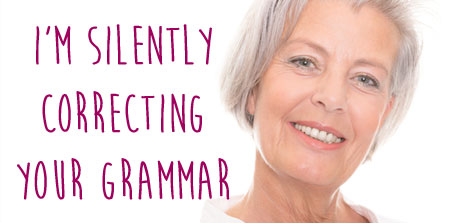
Is good grammar a thing of the past?
Whenever I do talks or radio phone-ins about grammar, usage and language generally, I'm struck by the number of people of my generation (let's say 50+, though I have to admit to 50++) who think that English is falling apart, that the young are ignorant and illiterate and that recent changes – particularly those brought about by texting and social media – are to be deplored.
I'm always slightly saddened by this, because it feels like part of the 'any change is for the worse' mentality that too often characterises advancing years. That said, I can be as guilty as anyone: years ago I had to supervise two young graduates working on a publishing project. They were bright, willing and articulate, but their spelling was atrocious and I found myself saying, 'If you kids had done Latin…' Good grief, I thought. I’m 35 and already I'm turning into my mother.
But hey. I write books about English, so of course I'm a bit of a pedant. I object to people writing should of instead of should have and using jargon such as firing on all cylinders (unless they are talking about a car) or the elephant in the room (unless there is one). I like precise language, too: when we have words that express different meanings – such as alternate and alternative, incredible and incredulous, moral and morale – losing those distinctions weakens the language.
The way we speak and write is as much a part of the way we present ourselves as the way we dress. Just as few of us would turn up for an interview or a formal dinner in torn-off jeans and a scruffy t-shirt, so we should tailor our language to the occasion.
It does matter, whatever the anti-pedantry brigade says. If ever I am on trial for my life, I hope that the jury will be disinterested rather than uninterested.
It matters. But it doesn't matter all the time. And there's the rub. In the pub with friends on a Friday night, we can get away with saying, 'Well, you know what I mean.' In a job interview or being introduced to sticklers of an older generation, we should try harder. The way we speak and write is as much a part of the way we present ourselves as the way we dress. Just as few of us would turn up for an interview or a formal dinner in torn-off jeans and a scruffy t-shirt, so we should tailor our language to the occasion. The important thing is to know the difference and be able to smarten ourselves up when it matters. IMHO.
That's an expression I find myself using more and more, as I become more dogmatic in my old age. It's short for 'in my humble opinion' and you use it – or at least I do – when the opinion you've just expressed isn't very humble at all. I like it because of a story a friend tells from the days when he was a magazine editor dealing with a particularly pompous contributor. The contributor ended a diatribe with this abbreviation, provoking the tart reply that the man had never had a HO in his L. My friend was well into his sixties at the time – don't tell me that we have nothing to learn from the young, and that there is no room for innovation in our language.
Caroline's book, Misadventures in the English Language, is published by Michael O'Mara and is available from Amazon.
By Caroline Taggart
Twitter: @citaggart
 just figured out how to do this!
Written communication in correct English with correct punctuation is important! Why? So that there is no liklihood of misunderstanding.
Yes, our language has evolved and, as far as business letters are concerned, the staid "I remain, Sir, your obedient servant" would be ridiculous now. But even in emails, if you're communicating on a business level, correct spelling and grammar is so important.
You'd be surprised how much people are judged on their written communication skills. They may be really good at what they do but if they can't spell or they use poor grammar they may be judged as being ill-schooled or slapdash.
According to Minibags, rinouchka, the expression "I'm good" in response to a query of how one is, is the same as "I'm fine". Her argument goes like this: "I'm fine" means "I'm feeling fine" and "I'm good" means "I'm feeling good". In this casual greeting context 'good' and 'fine' are synonyms.
It's not going to get any better. I work in a school office and the majority of the teachers (all with degrees) are incapable of writing their end of year reports or letters in acceptable English. Absolutely dreadful. (The Headteacher and I have to trawl through them to correct, and mainly they just don't see that what they have written is incorrect/rubbish either). If you saw some of the letters we get from applicants for jobs or from college students or Year 10 pupils asking for work experience placements you would want to scream. (Sometimes I do, but very quietly!)
I just don't get how teachers, of all people, can possibly get through their degrees with such bad grammar? We'd have been marked down for that, even in University.
I very much agree with Louizalass. Punctuation is necessary to make sense of the written word. I have recently received several business letters and had to read them several times to try and makes sense of them. Without sounding like a complete 'Old Fa*t' and understanding that language is always evolving, why are standards slipping? Why is poor grammar not given more credence in examinations?
My pet hate, nay loathe (although I suppose this is regarding pronunciation rather than grammar) is the addition of 'shh' in words, in particular that 'assume' has become (to those under 30, anyway) a-shume, or is it me?
Thank you thatbags...and minibags for the clarification. Still don't like but accept your explanation!
Oh no! I also missed an 'o' off too!
I think there are still a lot of people who can write well, entertainingly, interestingly, and with good command of grammar and diction. Common, casual usage will always be what MrBags and I would call "another animal". Always has been. It's just like everything else human: vast variation and inventiveness. I think it's fab.
That's me saying I don't think the language is going to the dogs deteriorating.
To/too
Lose/loose
These make my eye develop a tic!
My pet hate at the moment is the inappropriate use of the word 'like', as in 'I was like...' This is instead of 'I said'.
My very articulate GC have caught this habit. I can only hope that they will outgrow it. Their parents don't let them get away with it, I'm glad to say.
I've received an email today from our local police community message service headed "bomb fire night". . . .
or was it a Freudian slip?
It may well have been Monica but this is not the first mistake from this source.
Sentences ending with obviously !
I hate most of the americanisms that have crossed the pond. When did people start changing things up, instead of just changing them? Why are we good instead of fine, when asked how we are? Why oh why has the billion become 1,000 million instead of being a million million? 

Drives me mad when people who aren't American say 'do the math'.
It's mathS!! Speak properly!!
I'm a language 'geek' but daren't push it too far, so won't go into detail.
Enough to say that (as I believe) language is what differentiates between humans and other animals. So we should make the most of it, and not lose the skills which have produced so much beautiful language in the past.
It's not just 'grammar' either.
I really hate to hear 'v' instead of versus or 'vs' when used to indicate matches between teams such as England v France, West Ham v Chelsea and so on. I know it's become common use and I shouldn't mind but it still grates.
I cannot accept that poor punctuation and spelling play any role in language evolution.
For example, when reading product reviews, I find it hard to have faith in the opinion of the reviewer when they have written in such an illiterate style - and sadly, this is extremely common.
As previous posters have said, it's hard to understand how any generation can pass through the educational system and emerge years later with such poor language skills.
The Remembrance Day Service and Festival of Remembrance made me reflect on the education that I received and how it differed from education today. We were not only drilled in grammar, spelling and punctuation but also know all the words to Jerusalem, I Vow To Thee My Country and so on. My DS is not even sure of the words of the National Anthem.
Bellanonna It is kitchen but listening to certain folk especially those in the media who refer to being in the kitchen as being in the'kit ching' or not watching someone but were wat ching.
It is the ching bit that has me clim bing up the wall.Catch my drift?
I add another.I was going 'like' out today
not going out but must add like.I saw it 'like' Not just I saw it.
Sorry for the delay in responding but I had been
'like' busy in my kit ching.
Join the conversation
Registering is free, easy, and means you can join the discussion, watch threads and lots more.
Register now »Already registered? Log in with:
Gransnet »