

I’m currently watching the Vietnam documentary on Netflix. The former soldiers are in their seventies. One elderly North Vietnamese soldier just commented on his observations of the way American soldiers responded when a comrade was injured or killed “I realised, these Americans, they’re just like us”.
Gransnet forums
TV, radio, film, Arts
They Shall Not Grow Old
(37 Posts)www.independent.co.uk/arts-entertainment/films/reviews/they-shall-not-grow-old-peter-jackson-review-first-world-war-ww1-lord-of-the-rings-hobbit-a8586401.html
I know I have referred t this elsewhere, but do see it if you can. It is something very special.
We have just caught up with this amazing programme this evening. I had to keep telling myself that this was real, that they weren't actors. It really brought home the futility of war, all the young men , of both sides realising that at the end , they were all the same. Incredible work by Peter Jackson.
Amazing film, it did bring the experience to life. I read an article at the weekend where an old soldier said how hard it was after the war. Some jobs were advertised as 'No ex-servicemen wanted'. What a slap in the face after all they had gone through. To some extent WW1 , the war to end all wars, was overshadowed by WWII. I also watched a program last night with Dan Cruickshank about the war graves and how the came about. Learnt a lot from that too.
An incredible effort. All the soldiers seemed so cheerful but every now and then I spotted a young face that looked scared or weary. I imagine they relied on each other to keep spirits up as they saw their comrades fall.
What was interesting was the way they volunteered, and were made into soldiers very quickly, with odd bits of uniform. How disciplined they were to shape up into fighting units so quickly.
I also found it very sad that life at home went on as before after the war, and those who hadn't experienced it didn't really want to hear about it. They weren't aware of the horrors the men faced. The men who returned were just a body of men who had trouble finding employment.
The public didn't value them or didn't see them as returning heroes or want to know how they had fared. How strange, given the awful losses and dreadful experiences they'd had.
A wonderful piece of film making.
What a wonderful film, a real labour of love. I have a lovely studio picture of my paternal grandfather in uniform and really regret not asking him or my father about his experiences in WW1. He was a forbidding figure and I was a little frightened of him but I’m sure he must have told my father or one of his siblings about his experiences During WW1. I had a lot of conversations with my Dad about his experiences in the army before and during WW2 but we never spoke about my Grandad’s experiences in WW1 - a missed opportunity.
I watched this last night and share the admiration for Peter Jackson's work. Like others, I was struck by the weight gain and growth amongst the young volunteers, as well as by the poor state of their teeth. I have a lovely photograph of my paternal grandparents, taken just after WW1, both with unsmiling but happy faces. My father explained it was usual not to smile for photographs because their teeth were bad. They both had false teeth not long after.
My grandfathers both talked about their experience of WW1 in very similar terms to the men in the documentary. They talked of the patriotism and bravery shown by both sides, neither had a critical word for the German soldiers.
I've just watched this and it's one of the most astonishing programmes I've seen on tv for a long time. Well done to Peter Jackson for what must have been a labour of love.
I agree very much with the comments about the stoicism of the men, their acceptance, their lack of bitterness, their magnanimity towards the 'enemy'.
Regarding the shocking teeth, the film tells us that due to the plentiful food the army provided, these young men/boys in fact put on weight, about a stone, and gained an inch in height, during their training. I imagine many came from impoverished backgrounds, which would account for the teeth, and three square meals a day would have been welcome.
I was struck by the fortitude and resoluteness (is there such a word?) of the men speaking, all of them I believe, actual survivors. It was a sharp reminder of how my parents and grandparents conducted themselves: make the best of it; what can't be cured must be endured;there is always someone worse off than you, etc. etc.; phrases which seemed trite to me once but now I see how they got people through awful times.
So much respect.
We watched this programme last night, Peter Jackson has done a wonderful job, it was so moving and the men's stoicism was heartbreaking to listen to. Terrible experiences and without any counselling in the aftermath, well it wasn't a thing then. Those that returned had very little to come back to and a disinterested public, who to add insult to injury, almost shunned them.
The cause of the first world war, unlike the 2nd always seemed to me to be a bit vague, a Serb shot the Archduke Franz Ferdinand, and unleashed hell. It should have been sorted out by diplomacy. All those young lives lost for what? When the British got together with their German counterparts they realised they were just young men/boys like themselves following orders. I can't help recalling the "Frankie Goes to Hollywood" video of their song "When Two Tribes Go To War" with a mockup of Brezhnev and I think Regan slugging it out in a boxing ring. An ideal scenario imo, leaders who think a world war is a great idea should get together to knock seven bells out of each other instead!
Yes the teeth were shocking 
I think the home population were as 'shell-shocked' at the end of the war as those who fought it. Many had lost family members, and like the returning troops had seen all their hopes and plans destroyed and just wanted to block out the stress and strain they had suffered and look to the future because the past was too painful.
I think many soldiers felt like that too, which was why so few wanted to talk about their experiences in the war immediately afterwards and many not for decades.
My DGM, as well as losing her husband, brother and BiL in the war, also lost her baby son, born September 1914, died March 1915. Her brother and BiL were killed a few months later.
She was left alone, the only support of 2 small children, an elderly mother and an invalid sister, with just a small pension. She clearly destroyed all photos of those who died, as none now exist, although we have photos of her and her children and did not talk to her daughters about their father.
I think that the only way she could carry on as valiantly as she did, earning enough money to support her dependents, getting her daughters the good education that enabled them to make their own way in the world, was by putting the past behind her and only looking forward.
Vera Brittain (Shirley William's mother) talks about this at the end of 'Testament of Youth'
Thanks for that Bathsheba as you said exactly what I was going to say almost word for word.
The other thing was the way that the black and white footage ( complete with fast jerky action) segued into colour and normal speed, it was truly amazing.
Although I had read quite a bit about WW1 it was still a shock to see this.No wonder, when I once ( as a teenager) asked my Grandad, who served all through that war ‘what was it like’ he simply replied ‘it was horrible, love’.
Such a heart-rending film, but also such an eye opener - we’re all used to seeing films and dramas, and reading novels set in WW1, but the realism of this film set it apart. It was heartwarming and shocking in equal measure: seeing the men being blown to bits, or watching helplessly as their comrades sank forever into the gloopy mud, and the next minute seeing them goofing about, swapping hats with the captive enemy. They were so stoical, so accepting of the desperate situation they were in.
The saddest part for me was at the end, when they returned home and they said that no-one knew what they’d been through because no-one wanted to talk about it. They were just expected to slot back into their lives as if the intervening 4 years hadn’t happened.
It was such a good programme, no punches pulled. It's hard to comprehend the life they lived through that terrible war. There was a great sense of camaraderie with the men which must have alleviated some of the problems.
It's a shame we seemed to have learned nothing from their sacrifices.
DF had all his top teeth out while in the army, his upbringing was not particularly financially challenging.
My parents both saw army dentists during WWll my father had all his front teeth out (he had come from a very poor family) but the false teeth they gave him lasted all his life. I don't know what my mother had done, but it was so horrific she never went near a dentist again!
Maybe it was the sense of belonging and comradery M0nica ? Many of these young men wouldn't have see the next town before then.
The other thing I noticed was how many said they enjoyed being in the war. How it was a good time in their lives.
Many (if not most) of the people enlisting would have been from the poorest walks of life without the luxury of dentistry (other than maybe the string and door technique).
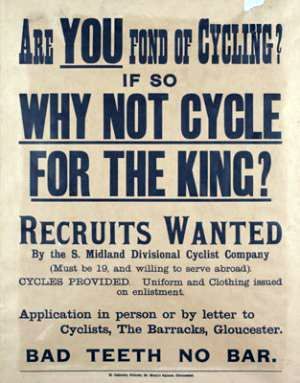
Have yet to watch this as I was out last night at an armistice party. One of the things that caught our attention was this poster from WW1 . On the bottom it says ‘Bad teeth no bar’ so I am wondering how bad teeth had to be for people to be turned down for the army given the comments above.
I found it extremely moving, the colorisation made it very contemporary, and brought home how awful conditions were at the front. In the beginning, all those young lads eager to join up had no idea what they were going in to, or how long they would have to endure such terrible conditions, no wonder they didn't want to talk about it when they returned.
The teeth were very noticeable! I don't suppose there were many dentists then, which would have cost money, so few bothered about their teeth.
Glad I watched it.
Only children and those on certain benefits don't pay for dental treatment travelsafar Many times in my life I have had to put off having dental treatment because I could not afford it. Imagine being on minimum wage and needing a check up or a filling or two? eat? heat? or dentist? Likewise prescriptions. NHS dentistry is VERY expensive.
gillybob But there are also many who can and do. There will always be the haves and have nots in life whatever happens in society, but i feel that doesn't take away from the fact that we DO have NHS dentist and are very lucky to have them especially for the younger generation who do not have to pay for their treatment.
I remember my grandad talking about young (underage) boys enlisting. He said that here on Tyneside many of the boys/men did not have a possession to their name and often shared clothes, shoes with their siblings. The prospect of having a kit of ones own was looked at as a luxury of sorts. If only they knew what awaited them.
I thought that about the teeth too.Thank god for the NHS and painfree dental work nowadays
Even now in 2018, there are still many people who cannot afford a visit to the dentist !
I noticed that too, not surprising really when you think of the rations they would be on. I suppose it is a minor point compared with all the terrible injuries, blindness, amputation that so many young men suffered but I wondered if any came home with a full set of their own teeth?
Join the conversation
Registering is free, easy, and means you can join the discussion, watch threads and lots more.
Register now »Already registered? Log in with:
Gransnet »