So…..what are we all up to on this beautiful sunny bank holiday? ☀️
Loss of sense of taste and smell
Last letters become first - March 26

 With summer holidays ahead, you may want to think about exploring the countryside - and to have an idea of what birds and nature to look out for. Peter Holden, who came in for a birdwatching webchat in May, has put together some suggestions for birds and other natural creatures to look out for at this time of year both inland and by the sea - and some tips for keeping the children occupied and happy.
I was very impressed at the wide range of questions in May – especially about garden birds. Many of our generation grew up with freedom and access to the countryside, or at least something we considered a ‘wild place’ (mine was in west London and was a disused airfield with a stream where I could catch sticklebacks and tadpoles!) Today, for a host of different reasons, many children are deprived of this wild experience; many grow up in a mostly man-made environment and entertainment tends to be digital rather than natural. Not only is a country visit relaxing and good for our health, it can also be an opportunity to introduce young children to the wonders of nature.
For further ideas of what to look out for in the country and by the sea this summer, we've started a thread.
 An unfortunate fact of life is the just as most schools break up, so many of our wild birds become more difficult to see and hear. This is no accident. Spring was protracted this year, but many birds were singing well in April, laying eggs in May and producing young in June. But by July and August many are quite worn out! Look carefully: adult birds often look ragged, and we are approaching the time that many will have to moult their old feathers and grow new ones – these new feathers will need to survive the next 12 months.
During annual moult, small birds tend to be a bit secretive: they keep in dense vegetation and don’t sing. Larger species, such as gulls and crows, moult their flight-feathers gradually and can be seen with gaps in their wings – a good thing to point out to the children! So woodland can be very disappointing in summer. The birds are still there but they seem to disappear. Moult has taken over.
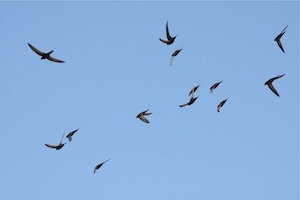
Some birds disappear for other reasons. Swifts are one of the last summer migrants to arrive from Africa in late April and are also one of the first to leave in August. They will moult in Africa. They leave in a rush: one day there are loads, the next a few and soon none at all. If you see Swifts regularly it would be good to keep a diary of their abundance and discover just when most leave – perhaps a project for grandchildren?
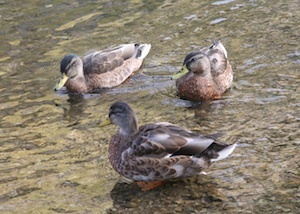 Another bird that you may come across are moulting Mallards. Drakes (males) take no part in rearing their young and you may come across a ‘boys club’ of moulting drakes. They will have lost their colourful spring plumage and the only real clue to their sex is their yellow-green bill. They are flightless for about 6 weeks as they re-grow their flight feathers. Females will be with well-grown young with their browner bills – and they too will usually be flightless.
Still, if the birds are often scarce the butterflies may not be. Sunshine and warm temperatures are needed to bring out the butterflies, but the brown and cream Speckled Woods can often be found – and in recent years this butterfly has spread northwards. Red Admirals – a striking red, black and white butterfly – may also be on the edge of woodland from June onwards. These are mainly migrants having arrived here from the near continent.
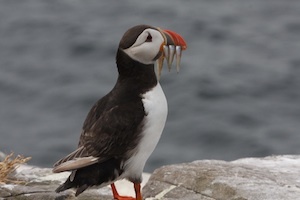
 As a child I had considerate parents who took me to places to see birds – but I never experienced the excitement of a seabird colony until I left school and had earlier holidays. Many Puffins seem to leave their nesting cliffs just when schools break up in mid July. If you are within reach of some of the special colonies such as the Farne Islands, Bempton Cliffs in Yorkshire, Skomer or Ramsey in South Wales and some of the Scottish cliffs and islands, then get there as soon as possible in July before the birds depart because they will stay out at sea – well out of sight of land - until next spring.
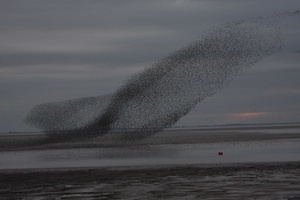
In addition to the seabird colonies, the beaches themselves can be a rewarding. Watch the effect of the changing tides on the birds feeding patterns. Most extreme are estuaries, such as The Wash, the Ribble, Morecambe Bay, Solway and the Forth. Here the incoming tides push hundreds and sometimes thousands of birds off their feeding grounds and onto the shore-line or near-by fields. These high-tide roosts often start forming during August and can be really spectacular.
 Even sandy beaches have their facination – Sanderling frequently chase minute food items along the sea edge, running like little clock-work toys as they dodge the waves. Curlews and godwits probe the wet mud with their incredibly long bills in their search for sea-food. Out at sea, but close to shore, terns plunge-dive into the shallow water in their search for fish – always fun to watch.
Rocky shores may have fewer birds but then there is the bonus of the magical world of the rockpool. Get a net and become a child again. Discover the charms of the shore crabs, the beauty of the sea anemones, the strength of the limpet and speed of the shrimps.
Pictures: Peter Holden
To keep children occupied (and educated) try the following: