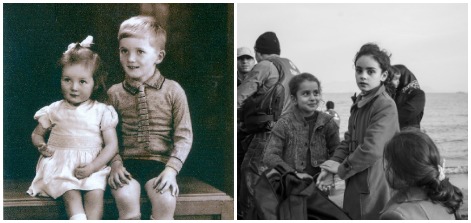
No I am not implying anything I haven't stated Jess.
Roses raised the point that we were persistently lied to (by,sad to say, mainly charity workers). They insisted that 'young children' 'some as young as eight', that seemed to be the favoured meme, although I even heard it reported 'some as young as four', were living alone with no family helping them at Calais.
The reality is, not surprisingly that most of the alleged 'unaccompanied children' are young adults.
I am very doubtful if many are even under eighteen as not many parents/guardians would let their young sons undertake such a hazardous journey alone. Those who are under eighteen are probably with an older brother or cousin (who is also claiming to be under eighteen).
They should all be subject to medical and dental examinations IO.
Since Sweden started doing this they have found a very high number who are certainly over eighteen, and this despite the fact that they always give them the benefit of the doubt if its less than certain.
Gransnet forums
Blogs
The wrong kind of refugee?
In recent years, the world has witnessed a refugee crisis that has forced more than a million men, women and children to flee the brutal violence in their own countries. Yet despite the life-threatening situations they face, these refugees (including children) have often been met with a degree of suspicion and fear in the nations they have escaped to.
Author Barbara Fox, whose own mother was evacuated from inner-city Newcastle as a child, wonders what the difference between Britain's long-ago children and today's refugees is?
Are today's refugees really any different?
When I read a headline recently about the outrage of a 'picturesque' village to which 70 'child migrants' were to be sent, I was reminded of another time in our history when places in the countryside were obliged to welcome strangers into their midst.
Back in 1940 when she was six years old, my mother, Gwenda, and her older brother, Doug, were among the hundreds of thousands of children who left their inner-city homes and were evacuated to the countryside to escape the German bombs.
Gwenda's main memory of her journey from Newcastle to the Lake District centres round the banana she was given to eat by her mother – the last she was to see for several years. A teacher ordered the children to sit on their bags, and consequently, when Gwenda came to unpack later, she found squashed banana over all her belongings.
On arrival in the pretty village of Bampton they were lined up in the church hall while the villagers came to choose who they wanted. Yes, it does seem unbelievable that that was how the evacuees were billeted to their families! You might imagine that Gwenda and Doug – clean, nicely dressed children - would have been snapped up first (they would surely be the refugees that no one would protest about today!). But actually, that was not the case. Gwenda was the youngest child there as she was tagging along with Doug and his class of nine-year-olds - their mother had insisted that the pair should not be separated. Consequently, the locals were expecting older children, and someone of Gwenda's size probably didn't look very useful in this farming community.
Were these home-grown children that our rural communities welcomed back then really so different from the oft-maligned refugee children today?
Gwenda and Doug were the only children left when the wife of the village headmaster arrived. As the mother of two sons, she had to be persuaded to take a girl. However, she relented, and so the children went home with her. They would spend three happy years living in the schoolhouse and Gwenda would keep in touch with the couple she called 'Aunty' and 'Uncle' for the rest of their lives.
The following year, in more desperate circumstances, Bampton opened its doors to another influx of children, this time from the shipbuilding town of Barrow-in-Furness.
Undoubtedly thousands of lives were saved by this evacuation of the nation's children, and indeed, Gwenda and Doug's own street in Newcastle was bombed.
Britain also welcomed refugees from Europe, including thousands of Jewish children who might otherwise have perished.
Were these home-grown children that our rural communities welcomed back then really so different from the oft-maligned refugee children today? I would go so far as to say that the inner-city children who turned up in Bampton were often just as alien to their rural hosts as the foreign newcomers seem to be to the 'picturesque' village dwellers. But equally, both could teach something to the other.
Those harking back to 'when Britain was great' perhaps forget that it was also characterised by our opening our doors to those in need.
When the War Is Over by Barbara Fox, the story of Gwenda’s wartime evacuation, is published by Sphere and is available from Amazon.
By Barbara Fox
Twitter: @Gransnet
You don't know a thing about people on here djen and yet you roll out comment after comment of a personal nature.
What happens sometimes is a tragedy, we and the French authorities try and discourage anybody from jumping illegally into lorries, but it still happens.If anybody genuinely has family here then it will be looked into and their claims checked out.Patience is needed, and meanwhile they are somewhere where they will not be allowed to starve.
At least I do have feelings. I am not heartless like some on here.
What a ludicrous thing to say, durhamjen. You're forever coming out with statements like that, by which you mean that anyone who dares to question your view must obviously be lacking in 'compassion'.
Do try to be a bit more realistic.
There are many children in France who have the legal right to be here under Dublin agreement and under Dubs amendment. Many of them have families here who are waiting for them. The UK government had a frenzy of activity dealing with for a couple of weeks but then stopped completely.
I really wish that the government would stop dragging its feet and start meeting its responsibilities under law.
I think it's a pity that some of you would rather gripe on about people who aren't entitled to be here instead of complaining about the ones who we should be welcoming and protecting.
The last child to be killed falling off a lorry was a 14 year old trying to get to family here. They were his only family left in the world
But how do you know? He may have been twenty two. He may have had parents but covered up because he knew that claiming to be orphaned would more likely win him leave to remain.
The prize that is British citizenship is huge to a Third worlder. I don't know why you wouldn't realise people will spin a yarn to win it.
Well said, Jess.
fullfact.org/immigration/asylum-seekers-uk-and-europe/
88,000 considered to be unaccompanied minors. Are they all economic migrants?
I know what people write on here and I know who writes with compassion for others and who doesn't.
Jess
Many of us are appalled at the Dubs amendment, we should not be picking up those claiming to be under eighteen because other EU countries won't.
It is unfortunately their legal right to come, but arguably it shouldnt be, and we do not have a responsibility to search for them.
The very least we should be doing is verifying their ages. It is shocking that our young girls in British schools should be exposed to the risk of being forced to consort with adult men, some as old as thirty five who pose as minors. Truly appalling.
Jess and DJ, you are both keen to admit these young men. What safeguards would you put in place to ensure adult men cannot get away with posing as younger than their age?
For those who haven't seen this picture do take a look, an extreme case, yes, but there are many similar stories, which led to Sweden imposing medical checks.
Claimed to be 14: Saad Alsaud is reported to have been the fastest 14-year-old in Sweden, dwarfing younger boys and girls in a running event
Read more: www.dailymail.co.uk/news/article-3422000/Just-old-think-migrant-children-Alarming-pictures-shed-light-growing-scandal-amid-asylum-crisis.html#ixzz4W9kchOiA
Follow us: @MailOnline on Twitter | DailyMail on Facebook
The last photo of a child in the jungle I saw was a little toddler wearing a pink anorak - she was about 4.
But not alone Welsh.
The current debate reminds me so often of the 1930s. The anti-semitic Daily Mail was campaigning hard to keep out Jewish refugees who were trying to get away from Hitler. The UK government pulled up the drawbridge and grudgingly consented to take a limited number of children only in the Kindertransport project. Those who were not the right age to be sent alone to the UK got rounded up and sent to the camps, where millions died.
So many parallels.
Rubbish you're losing the argument and you are bringing up the past. Hardly the same as the 1930s. These so called children are in a safe place the EU.
I agree with you Jess et al but I've come to the conclusion there is no point banging your head against a brick wall.
Yes,once the war, or Hitler or Nazis are brought in to the debate online this is always regarded as losing the argument.
Not the same scenario at all, as said above, the EU countries are all safe countries as is Turkey which is housing so many Syrian refugees who really need help, about 20 miles from the border with Syria.
The economic migrants who reach France are safe there.
Much better that the government is very careful who comes into this country and supports at the source the people who need it most, which is exactly what has been happening, money, vast amounts, to the camps near the Syrian borders helping all real refugees there.
Yes,once the war, or Hitler or Nazis are brought in to the debate online this is always regarded as losing the argument.
Indeed where would the globalist left be without him?
They haven't got a logical argument for their suicidal plan to inundate us with foreign nationals.
Digressing into 1930s anti Semitism only reminds us that sadly that hasn't gone away and as we all now know Jewish people today suffer racial abuse from factions within the far left as well.
Those who cannot remember the past are condemned to repeat it.
Nice soundbite but glib.
More correct would be to say that pinpointing errors that were made in the past, and avoiding them, can sometimes avert resultant bad consquences.
anya I so agree with Santayana
The situation in Europe now, is not like the situation in the 1930's.
Syrian refugees have been taken in by safe countries, particularly Greece and Turkey And Germany, and do not therefore need to 'flee' right across several countries into France.They may want to, for various reasons, but do not need to ( as opposed to Jewish refugees in the 1930's.who certainly did need to.)
Tbh I think that even if we do remember the past, we often repeat our mistakes ( both as a country, and on a personal level.)
The triumph of hope over experience...
This discussion thread has reached a 1000 message limit, and so cannot accept new messages.
Start a new discussion