Thanks JessM for your compassionate and well informed post.
Reading some of the comments here would lead many to despair about the lack of compassion that seems to run alongside a negative and dare i say it, bigoted view of the world
I had the privilege of working with two women who came to the UK in the late 1930's to escape Nazi Germany, as part of the Kinder transport. They were, of course, from wealthy, professional families, otherwise they'd have been on a train to a death camp. That was the fate that befell all their relatives left in Vienna or Nazi Germany. I accept the view of many is that any mention of the Nazi's means I've lost the argument. I don't accept that. I grew up with WW1 and WW2 as the backdrop to my life. It's only as I've reached my late 60's that I've acknowledged and realised the extent of the influence. The Daily Mail was influential in the build up to and during WW2 in advising its readers against taking in children from the Kinder transport, or offering refuge to adult members of the Jewish community. That's reminiscent of that paper's approach to refugees from Syria and frighteningly like Mr Trumps approach to refugees from various Middle Eastern Countries. They are indeed, the wrong kind of refugee.
Gransnet forums
Blogs
The wrong kind of refugee?
In recent years, the world has witnessed a refugee crisis that has forced more than a million men, women and children to flee the brutal violence in their own countries. Yet despite the life-threatening situations they face, these refugees (including children) have often been met with a degree of suspicion and fear in the nations they have escaped to.
Author Barbara Fox, whose own mother was evacuated from inner-city Newcastle as a child, wonders what the difference between Britain's long-ago children and today's refugees is?
Are today's refugees really any different?
When I read a headline recently about the outrage of a 'picturesque' village to which 70 'child migrants' were to be sent, I was reminded of another time in our history when places in the countryside were obliged to welcome strangers into their midst.
Back in 1940 when she was six years old, my mother, Gwenda, and her older brother, Doug, were among the hundreds of thousands of children who left their inner-city homes and were evacuated to the countryside to escape the German bombs.
Gwenda's main memory of her journey from Newcastle to the Lake District centres round the banana she was given to eat by her mother – the last she was to see for several years. A teacher ordered the children to sit on their bags, and consequently, when Gwenda came to unpack later, she found squashed banana over all her belongings.
On arrival in the pretty village of Bampton they were lined up in the church hall while the villagers came to choose who they wanted. Yes, it does seem unbelievable that that was how the evacuees were billeted to their families! You might imagine that Gwenda and Doug – clean, nicely dressed children - would have been snapped up first (they would surely be the refugees that no one would protest about today!). But actually, that was not the case. Gwenda was the youngest child there as she was tagging along with Doug and his class of nine-year-olds - their mother had insisted that the pair should not be separated. Consequently, the locals were expecting older children, and someone of Gwenda's size probably didn't look very useful in this farming community.
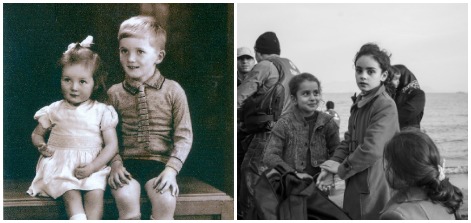
Were these home-grown children that our rural communities welcomed back then really so different from the oft-maligned refugee children today?
Gwenda and Doug were the only children left when the wife of the village headmaster arrived. As the mother of two sons, she had to be persuaded to take a girl. However, she relented, and so the children went home with her. They would spend three happy years living in the schoolhouse and Gwenda would keep in touch with the couple she called 'Aunty' and 'Uncle' for the rest of their lives.
The following year, in more desperate circumstances, Bampton opened its doors to another influx of children, this time from the shipbuilding town of Barrow-in-Furness.
Undoubtedly thousands of lives were saved by this evacuation of the nation's children, and indeed, Gwenda and Doug's own street in Newcastle was bombed.
Britain also welcomed refugees from Europe, including thousands of Jewish children who might otherwise have perished.
Were these home-grown children that our rural communities welcomed back then really so different from the oft-maligned refugee children today? I would go so far as to say that the inner-city children who turned up in Bampton were often just as alien to their rural hosts as the foreign newcomers seem to be to the 'picturesque' village dwellers. But equally, both could teach something to the other.
Those harking back to 'when Britain was great' perhaps forget that it was also characterised by our opening our doors to those in need.
When the War Is Over by Barbara Fox, the story of Gwenda’s wartime evacuation, is published by Sphere and is available from Amazon.
By Barbara Fox
Twitter: @Gransnet
With all the talk of Trump I have not heard anything about the latest peace talks.
Does anyone know if anything positive has come out of it?
iam64 never apologise for bringing up Nazi activity. It must never be forgotten and always serve as a reminder of what such ideologies can lead us to.
Good post joelsnan
I can't see any posts with 'lack of compassion' and certainly no bigoted ones, there are however some sensible ones.Perhaps it's the fact that sensible posts are not handwringing ones? As a country we are doing all we can and spending a fortune on help for the camps.
How much do we spend on the camps rose?
Anti-semitism was the reason behind not accepting all the people we could have done in the 1930's.
Consult Mr Google ww he will tell you, why ask me?
Cameron said several times that we were spending more than any other country apart from the USA......presumably that is true, but can easily be looked up if feeling sceptical.
I think about £1 billion up to last March according to the Independent.
Oh I thought that as you said a fortune that you knew.
www.independent.co.uk/voices/syrian-refugees-will-cost-ten-times-more-to-care-for-in-europe-than-in-neighboring-countries-a6928676.html
I hesitated to put the link on as it claims that the refugees cost ten times more to care for in Europe than in countries around Syria and I thought someone would be critical of me for choosing that link.
Someone may be able to find another one.
Is that the total from all countries or just us jalima?
It is now important for the UK to mobilise other donor countries to live up to our example when responding to conflict based emergencies. Pointing out the difficulties which can occur if they don’t should ensure that we win the argument when the next round of fighting breaks out in the Middle East.
Rob Williams is CEO of War Child UK
13 March 2016
No ww you didn't ( let's be honest) but yes, a fortune....ie.a lot of dosh.
Just us, whitewave
Since 2012, donor governments and aid organisations have spent around $15 billion on looking after ever increasing numbers of Syrian refugees. About 10 per cent of that has been contributed by the UK. Overall, Britain is by far the biggest European donor to Syrian refugees in the Middle East.
That was March 2016
Post whatever you think is relevant, Jalima - don't be intimidated!
Of course - isn't the USA the biggest donor? What will happen now?

It was the Independent not the Daily Mail 
Thank you for that information, I have often wondered how much is spent.
I don't have an up-to-date figure
I recommend a most illuminating little book on this subject: The Optician of Lampedusa by Emma Jane Kirby.
Buy or borrow it. Just over 100 pages.
Thank you rin it's been on my wish list for a while. I'll get it next order
Thanks Jalima- it's helpful to have that information.
MY gran and Grandad took 2 little girl evacuees of 4 and 6 to live in her Devon farm home. They came from the East End of London and their home was bombed and their mother killed, their father also killed in war. There seemed no one for them to go back to so my Grandparents kept them after war and they brought them great joy.
I think it is just common sense to say it is cheaper to rehome refugees near to their home rather than bring them to EU as travel cost will be included. Also better to find homes for them closer to their own country as culture more similar. If losing their country and home they probably won't want to lose culture too. Also easier for them to return when safe.
This discussion thread has reached a 1000 message limit, and so cannot accept new messages.
Start a new discussion