A lovely story, newnanny. Unfortunately many of the middle east countries have their own problems, their own refugee populations, and cannot absorb any more. Some countries have nearly as many refugees as indigenous people.
Gransnet forums
Blogs
The wrong kind of refugee?
In recent years, the world has witnessed a refugee crisis that has forced more than a million men, women and children to flee the brutal violence in their own countries. Yet despite the life-threatening situations they face, these refugees (including children) have often been met with a degree of suspicion and fear in the nations they have escaped to.
Author Barbara Fox, whose own mother was evacuated from inner-city Newcastle as a child, wonders what the difference between Britain's long-ago children and today's refugees is?
Are today's refugees really any different?
When I read a headline recently about the outrage of a 'picturesque' village to which 70 'child migrants' were to be sent, I was reminded of another time in our history when places in the countryside were obliged to welcome strangers into their midst.
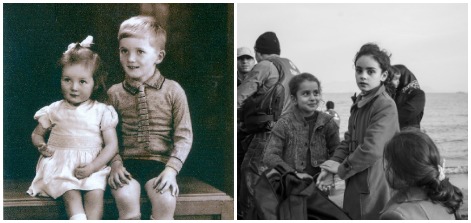
Back in 1940 when she was six years old, my mother, Gwenda, and her older brother, Doug, were among the hundreds of thousands of children who left their inner-city homes and were evacuated to the countryside to escape the German bombs.
Gwenda's main memory of her journey from Newcastle to the Lake District centres round the banana she was given to eat by her mother – the last she was to see for several years. A teacher ordered the children to sit on their bags, and consequently, when Gwenda came to unpack later, she found squashed banana over all her belongings.
On arrival in the pretty village of Bampton they were lined up in the church hall while the villagers came to choose who they wanted. Yes, it does seem unbelievable that that was how the evacuees were billeted to their families! You might imagine that Gwenda and Doug – clean, nicely dressed children - would have been snapped up first (they would surely be the refugees that no one would protest about today!). But actually, that was not the case. Gwenda was the youngest child there as she was tagging along with Doug and his class of nine-year-olds - their mother had insisted that the pair should not be separated. Consequently, the locals were expecting older children, and someone of Gwenda's size probably didn't look very useful in this farming community.
Were these home-grown children that our rural communities welcomed back then really so different from the oft-maligned refugee children today?
Gwenda and Doug were the only children left when the wife of the village headmaster arrived. As the mother of two sons, she had to be persuaded to take a girl. However, she relented, and so the children went home with her. They would spend three happy years living in the schoolhouse and Gwenda would keep in touch with the couple she called 'Aunty' and 'Uncle' for the rest of their lives.
The following year, in more desperate circumstances, Bampton opened its doors to another influx of children, this time from the shipbuilding town of Barrow-in-Furness.
Undoubtedly thousands of lives were saved by this evacuation of the nation's children, and indeed, Gwenda and Doug's own street in Newcastle was bombed.
Britain also welcomed refugees from Europe, including thousands of Jewish children who might otherwise have perished.
Were these home-grown children that our rural communities welcomed back then really so different from the oft-maligned refugee children today? I would go so far as to say that the inner-city children who turned up in Bampton were often just as alien to their rural hosts as the foreign newcomers seem to be to the 'picturesque' village dwellers. But equally, both could teach something to the other.
Those harking back to 'when Britain was great' perhaps forget that it was also characterised by our opening our doors to those in need.
When the War Is Over by Barbara Fox, the story of Gwenda’s wartime evacuation, is published by Sphere and is available from Amazon.
By Barbara Fox
Twitter: @Gransnet
Some figures for you, newnanny.
theconversation.com/syrian-refugees-in-turkey-jordan-and-lebanon-face-an-uncertain-2017-70747
Caring for refugees abroad means they are stuck in camps - some of them for years already, with no hope for their lives or the education of their kids. They are like vehicles parked and forgotten in a giant car park.
Caring for them here means helping them to progress the kids education and helping the family to take its place in society. You are not comparing like with like.
But many who are in camps don't want to go to other countries, they are hoping that they can go home again one day.
Many of them who are here or in Germany say that, too, Jalima.
It's having the choice that matters to them; as Jess says, education for their children, a decent roof over their heads, no fear of being bombed or shot at when they go out of their front door, a place in society.
It's having the choice that matters to them; as Jess says, education for their children, a decent roof over their heads, no fear of being bombed or shot at when they go out of their front door, a place in society
What a shame that we cannot even provide all that for some British citizens and foreigners already here.
I agree with you there, Mair.
However, helping those less fortunate is a sign of a caring democracy, which is what I like to think we were, and could become again.
theconversation.com/why-the-us-and-britain-are-not-democracies-71745
"Unfortunately many of the middle east countries have their own problems, their own refugee populations, and cannot absorb any more. Some countries have nearly as many refugees as indigenous people"
"Indigenous people " eh?
Strange choice of word from you DJ!
I would have thought you'd have been all of the mantras:
"We are all from Africa"
"Everyone is a migrant"
Isn't your distinction an example of the latest Newspeak of the globalist media "othering"?

You've often struck me as being intelligent, Mair. I am surprised you have to laugh at the use of the word indigenous.
Watch it Mair - durhamjen's sucking up to you...
Perfectly correct use of the word. Look it up in the dictionary if you need to.
You might need to re-settle yourself M, you're flailing around again and failing to present any coherent arguments.
Assume the nay-sayers on this thread would be happy if, like the US, we closed our borders to ALL refugees?
If we are being pedantic then
It's having the choice that matters to them; as Jess says, education for their children, a decent roof over their heads, no fear of being bombed or shot at when they go out of their front door, a place in society.
The word refugee means ^a person who has been forced to leave their country in order to escape war, persecution, or natural disaster.
So in the camps, which are certainly not ideal, they are in a place of refuge. Some camps are much better than others, some are tents, some are temporary buildings. Some are living in apartments, houses etc.
Many do not want to leave them because they do want to be near their home country in the hope that they can return there, rebuild it and live in peace there. The society many dream of is not ours, it is the one that they lived in until this war started in Syria.
Heaven knows how or when it will get back to that, Jalima.
I know, but hope is the most important thing in the world
*DJ said*:
You've often struck me as being intelligent, Mair. I am surprised you have to laugh at the use of the word indigenous
Not at the use of the word DJ, but to see it used so unselfconsciously by you. I am pleased to see that at least one of the most vocal representatives of the globalist pro mass immigration tendency does not follow the ridiculous trend to deny the term has any meaning (for at least European ethnic groups). I often use the terms 'indigenous' , 'native' or 'ethnic XXXXXX' myself, but I am not inclined to use the vocabulary of Newspeak.
One of your chums on here claimed to be 'uncomfortable' about the use of the term 'native' and came out with the 'all African/ all human' drivel, as if that negates the meaning of the word!
There's that word Globalist again. Are you sure you mean to use it mair 
Eager to impose constraints on the language again WW I note.
And these people call themselves 'liberals'. 
Yes but you use it so often, that if you understood what the lunatic fringe who postulate this theory believe, you couldn't possibly suggest that the grans were part of this conspiracy.
Of course theyre not part of a conspiracy, simply fellow travelers.
"Globalist" would seem to be this week's addition to the list of epithets deemed to be insulting. LOL
Deemed insulting by whom Jess?
It's simply a general description of a political stance, no different to socialist, nationalist, libertarian, conservative etc
Indigenous is Newspeak, is it?
I remember it from school geography lessons. It just means people born in a country - or it did then. I must have been using Newspeak for over fifty years.
What do you mean by unselfconsciously? That's what I do all the time. Words just pour out of my mind without me even being aware that I am using them.
No, Newspeak avoids applying it other than to tribal peoples.
Suspect that 'T' word maybe is off the lexicon too.
mair the globalist process isn't a political stance it is the theory of the lunatic fringe.
How does it fit in with your rejection of immigrants and refugees or is that covered by your Malthusian theory?
WW said
"mair the globalist process isn't a political stance it is the theory of the lunatic fringe"
I agree on your second point, but it is a political stance, and a substantial minority, lefties especially, since Marxism is globalist philosophy, but also right and centre (bizarrely even Greens), have been persuaded to become useful footsoldiers promoting its goals, the weakening of traditional ethno national states and the imposition of supranational states with no ethnic basis and rights accorded on a universalist rather than citizenship basis. Most supporters of the EU have little or no understanding of this, but it does explain its absolute intransigence on free movement, despite the risks that this involves (in terms of widespread loss of popular support).
This discussion thread has reached a 1000 message limit, and so cannot accept new messages.
Start a new discussion