
Many of the younger men are sent away by their families because if they remain they are forced to join ISIS, or whatever, or be killed.
Why university are always avoiding responsibility? And can’t be held accountable?


In recent years, the world has witnessed a refugee crisis that has forced more than a million men, women and children to flee the brutal violence in their own countries. Yet despite the life-threatening situations they face, these refugees (including children) have often been met with a degree of suspicion and fear in the nations they have escaped to.
Author Barbara Fox, whose own mother was evacuated from inner-city Newcastle as a child, wonders what the difference between Britain's long-ago children and today's refugees is?
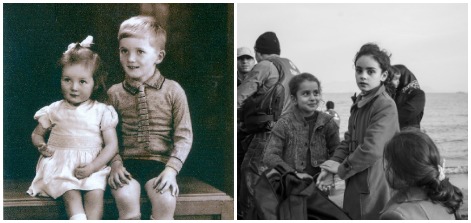
Are today's refugees really any different?
When I read a headline recently about the outrage of a 'picturesque' village to which 70 'child migrants' were to be sent, I was reminded of another time in our history when places in the countryside were obliged to welcome strangers into their midst.
Back in 1940 when she was six years old, my mother, Gwenda, and her older brother, Doug, were among the hundreds of thousands of children who left their inner-city homes and were evacuated to the countryside to escape the German bombs.
Gwenda's main memory of her journey from Newcastle to the Lake District centres round the banana she was given to eat by her mother – the last she was to see for several years. A teacher ordered the children to sit on their bags, and consequently, when Gwenda came to unpack later, she found squashed banana over all her belongings.
On arrival in the pretty village of Bampton they were lined up in the church hall while the villagers came to choose who they wanted. Yes, it does seem unbelievable that that was how the evacuees were billeted to their families! You might imagine that Gwenda and Doug – clean, nicely dressed children - would have been snapped up first (they would surely be the refugees that no one would protest about today!). But actually, that was not the case. Gwenda was the youngest child there as she was tagging along with Doug and his class of nine-year-olds - their mother had insisted that the pair should not be separated. Consequently, the locals were expecting older children, and someone of Gwenda's size probably didn't look very useful in this farming community.
Were these home-grown children that our rural communities welcomed back then really so different from the oft-maligned refugee children today?
Gwenda and Doug were the only children left when the wife of the village headmaster arrived. As the mother of two sons, she had to be persuaded to take a girl. However, she relented, and so the children went home with her. They would spend three happy years living in the schoolhouse and Gwenda would keep in touch with the couple she called 'Aunty' and 'Uncle' for the rest of their lives.
The following year, in more desperate circumstances, Bampton opened its doors to another influx of children, this time from the shipbuilding town of Barrow-in-Furness.
Undoubtedly thousands of lives were saved by this evacuation of the nation's children, and indeed, Gwenda and Doug's own street in Newcastle was bombed.
Britain also welcomed refugees from Europe, including thousands of Jewish children who might otherwise have perished.
Were these home-grown children that our rural communities welcomed back then really so different from the oft-maligned refugee children today? I would go so far as to say that the inner-city children who turned up in Bampton were often just as alien to their rural hosts as the foreign newcomers seem to be to the 'picturesque' village dwellers. But equally, both could teach something to the other.
Those harking back to 'when Britain was great' perhaps forget that it was also characterised by our opening our doors to those in need.
When the War Is Over by Barbara Fox, the story of Gwenda’s wartime evacuation, is published by Sphere and is available from Amazon.
By Barbara Fox
Twitter: @Gransnet
Many of the younger men are sent away by their families because if they remain they are forced to join ISIS, or whatever, or be killed.
Anya that really sums it up.
So what's your definition of a migrant compared to a refugee?
Anya said it all.
Yes indeed.
Figures in here to put it into perspective.
fullfact.org/immigration/asylum-seekers-uk-and-europe/
'In 2015, the UK accepted roughly 20,000 refugees. That’s counting people accepted through the normal, in-country asylum process, as well as those brought over from other countries under ‘resettlement’ schemes.
Asylum seekers make up around 4% of immigrants to the UK. People accepted as refugees make up around 20% of those given permission to settle here.'
Perhaps you should be more worried about these people than refugees.
politicalscrapbook.net/2016/11/far-right-extremists-now-a-majority-of-referrals-to-anti-terrorism-programme-in-some-parts-of-uk/
We worry about them too. 
Refugee Status is not awarded automatically to anyone who claims it. The trouble is, many have lost their papers, either through circumstances beyond their control or deliberately.
www.unhcr.org/uk/refugee-status-determination.html
A vital part of being recognized as a refugee is Refugee Status Determination, or RSD. This is the legal or administrative process by which governments or UNHCR determine whether a person seeking international protection is considered a refugee under international, regional or national law. States have the primary responsibility for determining the status of asylum-seekers, but UNHCR may do so where states are unable or unwilling. In recent years, due to changes in volumes and patterns of forced displacement, the refugee agency has been required to conduct RSD in more countries than before and for a greater number of people.
Yes, I do take your point Anya, as was proved in Germany.
Are the South Africans (white), Australians, New Zealanders etc that come to UK and work here (all legally I am sure) considered as a 'problem' cluttering up schools, doctors surgeries, taking 'our jobs'? Are they economic migrants? They tend to come for work and CV opportunities. I know of a few lovely people who had their babies here , as it is 'better than home' then after their kids have a few years in school go home for the benefits of sport/ outdoor lifestyle that UK climate does not support! It is part of their life plan. Not sure how /where this fits into the debate but it does seem that we focus on non English speaking migrants more but the impact on services will be the same ?
I think the important work is legally!!
Wherever they are from.
What I think posters mean (and I may be wrong) are the economic migrants mingling with refugees, thereby swelling the number of people fleeing conflict and needing help and trying to come to the UK illegally.
And - allowing economic migrants to work in jobs for which they are properly and fully qualified would help our hospitals and wherever we have job shortages. Making them take English exams when they are native English speakers is ridiculous too.
Except that those who tell foreigners that they voted for them to go home do not usually differentiate between different types of migrants.
Would these have been the right kind of refugees - if they aren't all dead yet?
'Today 45 civilians were killed in a horrific attack by the Syrian regime while trying to flee from the Jub al-Qubba district. The shelling killed families in the streets, their possessions left lying amongst the corpses. Most of them were children and women.
Up to 50,000 people have fled in the last few days. There is no home for them, and there are no guarantees they will not be harmed once they reach the other side.'
Dj its been said often enough on this thread that there is no problem with genuine refugees but we're not so keen on economic migrants!
Who decides?
How many refugees/immigrants are still waiting to find out if they can stay here, not allowed to work or claim benefits?
*Update: following public outcry, the home office bowed to pressure and reported that six allegations of sexual abuse had been investigated. But it refused to reveal the outcome of those investigations or whether women had been deported following making an allegation of sexual assault. Openness and transparency is still badly needed in order to put women's safety ahead of corporate interests*
Our new Prime Minister -- Theresa May -- has officially taken office and everyone’s talking up her feminist credentials. But she’s helped to cover up one of the most shocking abuses of women of our time.
The hundreds of women detained at the privately run immigration detention centre Yarl’s Wood have come to the UK seeking refuge. Many of them have fled war in their own countries -- and 70% of them are rape survivors.
Now many of them report being raped and sexually abused by the very people who should be protecting them: the staff at Yarl’s Wood. But we don’t know how many. The Home Office, under Theresa May, refused to release the information -- saying it could “prejudice the commercial interests” of the private companies running Yarl’s Wood, like Serco.
From www.sumofus.org
Michael Rosen on immigrants.
www.facebook.com/michael.rosen.5496/posts/10154692190742225
It is simple for some on GN. Anyone we like the look of is a genuine refugee.Any one we don't like the look of isn't. We don't like the look of young men who are traveling on their own and look older than their age. We don't like the look of any group of people who can't prove where they have come from and provide evidence of their country of origin. We don't like the look of anyone who has had the temerity to make their own way across Europe and wants to enter the UK (they should have stayed in a camp nearer home and waited their turn). We only like the look of people who can prove that they have been bombed, shot at, and come from a genuinely war torn area (civil wars do not necessarily meet this requirement).
Of course these people welcome refugees, providing they like the look of them!
some on GN ??
these people ??
I suppose I was brought up surrounded by men and boys who would always have put women and children first, not saved their own skins.
So, when I see a fit-looking young man I do tend to wonder 'where's your mother, your sister, your granny, your grandad?'.
Perhaps trying to survive and being bombed in bread queues in Syria, or trying to keep the little ones fed and warm in a tent in a refugee camp, helping their elderly grandma and grandad escape, the little boy of barely 5 or 6 carrying a baby brother or sister.
Yes, they are the ones my heart bleeds for and the ones I want to help.
I suppose I must be one of these people on GN
I never realised that when I have been trying to help.
and there are many, many young men who have not left their families, they are suffering hardship too, trying to do their best for their wives and families.
So you wanted them to stay and join the rest in the human graveyard, did you, Jalima? And if they don't I presume they are not real men?
www.theguardian.com/world/2016/nov/30/syria-aleppo-death-toll-united-nations-statistics
Don't twist what I said please djen you know perfectly well what I mean.
Not all the men fled, some stayed and cared for their families as best they could or helped to get them out.
And you know that many of them joined the White Helmets, bravely trying to rescue others. You told us about them, although many of us knew about them already.
So please don't make out I think they should join the rest in the human graveyard.
I will not be bullied off like others over the situation in Aleppo.
This discussion thread has reached a 1000 message limit, and so cannot accept new messages.
Start a new discussion
Get our top conversations, latest advice, fantastic competitions, and more, straight to your inbox. Sign up to our daily newsletter here.
