Are today's children lacking in empathy? Psychotherapist William Pullen thinks so - which is why he has invented the epathy walk. Should you take your grandchildren on one?
William Pullen
Empathy Walks and why they're important
Posted on: Thu 12-Jan-17 16:36:50
(31 comments )
We all know that getting out and getting moving is a tried and tested method to raise the spirit – as they say, 'movement is medicine'. But how about if you could go for a walk and learn an important skill too? As a psychotherapist I wanted to examine this further, and have now developed a form of psychotherapy, Dynamic Running Therapy. It blends walking or running, with psychotherapy and the outdoors and, drawing on the healing qualities of conversation, movement and nature, it includes exercises intended to help children learn the skills of talking and listening. These exercises are specifically designed to improve the levels of empathy in children.
Why is this important? Well, research from the University of Michigan shows a dramatic decline in empathy among the young over the last 30 years, with the steepest decline reported in the last 10 years. Psychologists, parents and teachers are reporting an 'empathy crisis'. No one is sure what is influencing this dramatic change - it could overuse of technology or gaming, superficial networks of friends, reduced participation in clubs and other social organisations or a dozen other possibilities. Everyone is too busy to really sit down and spend time with one another and when they do is brief and often involves electronic devices. Children don’t know any better and are learning this behaviour, in part, from their parents.
Psychologists, parents and teachers are reporting an 'empathy crisis'. No one is sure what is influencing this dramatic change - it could overuse of technology or gaming, superficial networks of friends, reduced participation in clubs and other social organisations or a dozen other possibilities.
The good news is that the researchers at the University of Michigan believe that empathy is highly fluid, meaning that it can potentially increase as easily as it decreases. Through a combination of question and answer sessions about everything from nature to friendships, concerns at school or home, 'empathy walks' (or runs) can create a bridge across the 'empathy gap'.
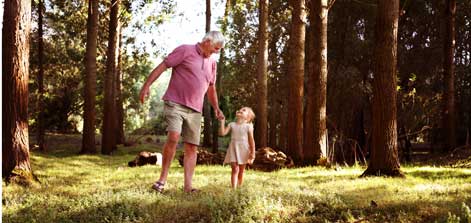
One of the greatest gifts you can give your grandchild is a sense of being seen and heard – and these walks give you one-on-one time together to make that happen, to get your grandchild talking, listening properly and asking questions.
How best to do this? Well, first of all listen. Listening is what empathy is all about.
Also have fun – be creative, use your imagination, teach your grandchildren about plants, tress, flowers and most of all, how the outdoors is a wonderful place in which to play and experiment.
Ask questions: about nature, schoolwork, friendships, emotions – happiness/unhappiness, kindness, courage, anger.
Don't worry about where, how far or the pace at which you walk. Just get outside and explore. It's about connecting with nature and your grandchild and helping them to talk, listen and above all, empathise.
Example Questions to ask on the walk
- Do you think you are a good friend? Why?
- How could you make a friend feel better without using any words?
- When you forgive someone, how does it feel afterwards?
- When you were last angry or sad, what made you feel better? Did someone help you?
- How could you help someone feel more confident?
- What is the kindest thing anyone has ever done for you?
- How would you make someone feel happier if they were sad?
William's book, Run For Your Life, is published by Penguin and is available from Amazon.


 which often encouraged them to talk about their own experience.