Now I'm getting adverts for home schooling appearing above, presumably to help me speed up my work! ?
Too late I'm afraid, could have done with that 60 years ago.
William and Catherine’s Anniversary Photo
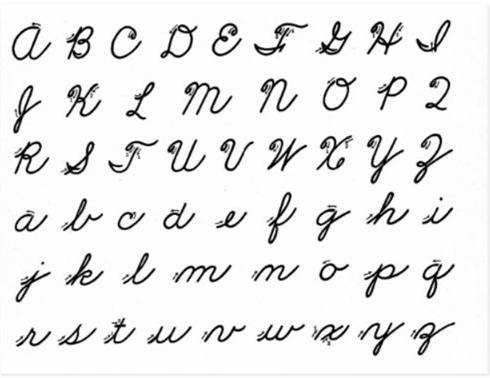
A while back I was horrified to see my grandson's handwriting which was illegible! Apparently instead of teaching them the letters of the alphabet separately they have tails on the front and back so they find it easier to do 'joined up' handwriting.
They say this helps them join up their handwriting more quickly and easily. I just hope so because it looks a flippin' mess to me. Anyone got any feedback on this?
Now I'm getting adverts for home schooling appearing above, presumably to help me speed up my work! ?
Too late I'm afraid, could have done with that 60 years ago.
I started school in 1957. We printed until about age 7, then were taught cursive writing. Still using it when I started grammar school in 1964, but gradually developed my own ‘style’, as different schools had used various types of writing.
My writing looked much neater when I was 11 than what it does now!
Using cursive to write improves blending/reading and spelling.
So what if its a bit messy at 5/6. It'll be messy before it gets neat
Ah, the good old days of Marion Richardson handwriting books
.
It looks no different to the style of writing I was taught when I was at primary school, but you didn't start on it until you were 7 and in the third year. I couldn't wait to get there because joined up writing looked so grown up. What actually happened is another story.
My DGC were taught to write with letters joined right from the start. I have seen their writing, it looks fine.
How often do you write? I find when I have to sign a card, it's a mess.
I definitely don't write as well as I used to, presumably because I mostly use a keyboard. It takes a lot of writing to get proficient so I hope children get enough practice with a pen. I remember scrawling away madly during my CGE exams and that was the culmination of 10 years practice with nothing but a pen.
Exactly the same as I was taught in the 50 s always told I have good handwriting
What’s wrong with it and how were you taught then Chestnut
My two DCs were at primary school in Australia and were taught the most beautiful cursive script - it was called Victorian as it came from the Australian state of Victoria and seemed to be the standard taught in schools there. Thirty years later DD's handwriting is still beautiful although I fear that DS takes after his father who only seemed able to write in capitals!
I remember being taught Marion Richardson script when I was at school in the 1950s. And then funnily enough my first teaching job was at a school in the East End of London named after her.
Well it seems I moved on from basic letters and did cursive handwriting by the age of 8 years! So it seems I did the two-tier system, learning one style first and then cursive writing. It's so long ago I can't remember any of this, and I don't know what the handwriting is called. Here is my 1958 writing. Is this Marion Richardson?
I went to three junior schools. At the first two we were taught to print letters. At the third school, we had to use a dip pen and ink and do cursive writing. I found it very difficult to adjust to at first and it held me up quite a bit.
I hadn't heard that cursive writing aids spelling, etc. If it does, then it seems sensible to get children to do it. If they're doing any sort of writing at all, though, that's probably OK, since much of the work seems to be done on computers now.
I'm not sure that it's right that if cursive writing isn't taught initially it has to be taught later. Surely the un-joined up style of writing gradually leads to a form of joined up writing without the twiddly bits?
There doesn't seem to be so much routine learning in schools now. I know it is frowned upon but I do think there is a place for it. In the mornings, we always did dictionary exercises - finding words to put in the blanks within sentences. And when we made spelling mistakes, we had to write them out four times underneath our work. I think this aids basic learning - and it still leaves room for less structured sessions. I think the vast majority of us had very good literacy skills, even the school was in a predominantly working class area in what was then in Greater London.

We used to recite the alphabet in the kindergarten class every morning a says ahh b says beh and there was a colourful frieze around the walls and we also recited out all the tables everyday I m still good with my tables
I think there is a lot to be said for repetition We also used to have to write spelling mistakes out like you eloethan my spelling has been pretty good for me
My notepad stands beside my computer. I am always making little notes; aide memoire, shopping lists, hand written notes of thanks and condolence.
Writing is part and parcel of my day. Ironically my handwriting is dreadful; messy and illegible. I was in my forties before the reason was realised, I am mildly dyspraxic and while the therapy I had then helped a bit, it still looks as if a drunken spider fell in an inkpot and then staggered across the page.
I was alright until they introduced italic, I could never get the hang of it. Then we had those dip pens which exploded when you pressed too hard and crossed the nib. By secondary school my writing was awful. My mum bought me a Parker pen and that helped.
Writing is harder for children than reading as they have to form the letters, think about spelling and most importantly write to make sense.I
(A friend of mine writes for BBC radio and he can neither write legible not spell.He has won many awards.)
My DGD2 (8) is left handed and considering the contortions he requires to do joined up writing, his writing is actually quite good.
There are a few “lefties” in the family but I had never realised how much harder it is if you are left handed.
On another tack, if I may, I have a theory that different generations have similar handwriting. This is based on (not very) extensive research, coming from reading some of my late MIL’s letters and some from her best friend who was also Paw’s godmother.
They are nearly identical! Both women went to Wellington School near Ayr, so perhaps that was what was taught there back in the 1020’s.
But DD1 and other young women of her year/generation also have a similar hand - very bold and confident and extremely legible. Is this down to their schooling or their age I wonder?
When my mother started teaching, she had to teach the Marion Richardson style of writing. It changed her handwriting as well. In the days when we kept in touch by letter, I went through a stage of not recognising her writing on the enevelope and wondering who the letter was from!
My father's handwriting was rather similar to that shown in the OP, with loops and slightly sloping. He would have started school at the beginning of the 1900s.
What exactly is the Marion Richardson style?
I have noticed that American all write the same so it is down to teaching
Nice writing Bluebelle and it looks very carefully done. I think we all tried very hard at that age as we wanted to get praised for our nice handwriting! I certainly didn't carry on writing like my previous example, as I think your writing evolves over time.
M0nica I confuse my daughter's and my sister's handwriting. They have no connection through their upbringing or the education system: different generations and lived in different parts of the country. Strange!
My writing has got worse over the years and I think it is lack of practice. Despite the fact that we do use computers, I think learning to write decently and legibly is vitally important.
I started school in ‘54 in Scotland using exactly the lettering you illustrated Chestnut so it is not new.
As a result I found it extremely difficult at uni to use simple italics when using Linnaeus nomenclature such as Homo sapiens.
My children were initially taught the clean lettering in your second illustration which corresponded with the print in their books. They moved onto joined up writing effortlessly.
Registering is free, easy, and means you can join the discussion, watch threads and lots more.
Register now »Already registered? Log in with:
Gransnet »Get our top conversations, latest advice, fantastic competitions, and more, straight to your inbox. Sign up to our daily newsletter here.