Exactly the same as I was taught in the 50 s always told I have good handwriting
What’s wrong with it and how were you taught then Chestnut
This sounds awful … Elderly lady euthanised against her will in Canada


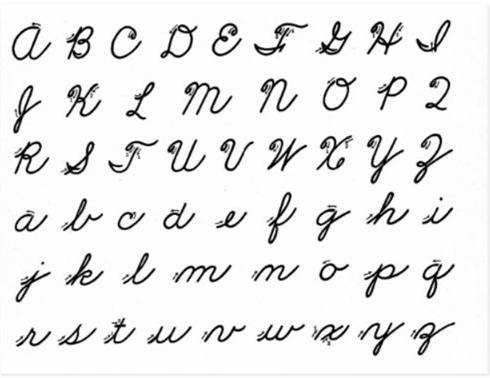
A while back I was horrified to see my grandson's handwriting which was illegible! Apparently instead of teaching them the letters of the alphabet separately they have tails on the front and back so they find it easier to do 'joined up' handwriting.
They say this helps them join up their handwriting more quickly and easily. I just hope so because it looks a flippin' mess to me. Anyone got any feedback on this?
Exactly the same as I was taught in the 50 s always told I have good handwriting
What’s wrong with it and how were you taught then Chestnut
I definitely don't write as well as I used to, presumably because I mostly use a keyboard. It takes a lot of writing to get proficient so I hope children get enough practice with a pen. I remember scrawling away madly during my CGE exams and that was the culmination of 10 years practice with nothing but a pen.
How often do you write? I find when I have to sign a card, it's a mess.
It looks no different to the style of writing I was taught when I was at primary school, but you didn't start on it until you were 7 and in the third year. I couldn't wait to get there because joined up writing looked so grown up. What actually happened is another story.
My DGC were taught to write with letters joined right from the start. I have seen their writing, it looks fine.
Ah, the good old days of Marion Richardson handwriting books  .
.
Using cursive to write improves blending/reading and spelling.
So what if its a bit messy at 5/6. It'll be messy before it gets neat
I started school in 1957. We printed until about age 7, then were taught cursive writing. Still using it when I started grammar school in 1964, but gradually developed my own ‘style’, as different schools had used various types of writing.
My writing looked much neater when I was 11 than what it does now!
Now I'm getting adverts for home schooling appearing above, presumably to help me speed up my work! ?
Too late I'm afraid, could have done with that 60 years ago.
Just to add that my handwriting was always praised for being very neat, as you can see from the example. This went on for years, always had beautiful handwriting. The downside was that I was very slow! I spent too long getting my work perfect. My handwriting and drawings were always so lovely but the teachers always said I needed to work faster. To be honest I didn't want to. I liked my work to look beautiful!
If not taught in cursive it has to be taught twice.
One DGS in Y2 has been taught the curly wurly way from the very start, his cousin of the same age at a different school was taught “proper” letters first, but is now joining them up. To me the second approach seems more logical.
We were taught to write in italics, which I still do, though I don’t use the italic nib these days!
You got a tick, well done Chestnut.
I think we were taught at about age 7, which is Y3 now.
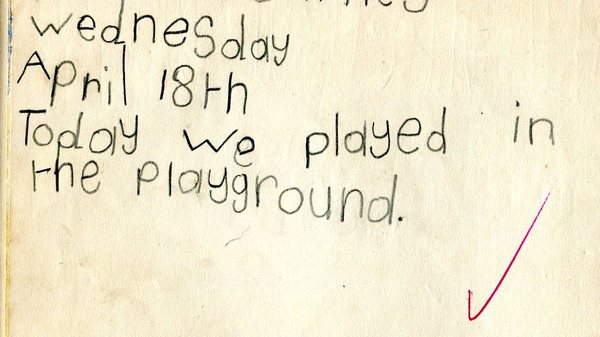
Just found a handwriting book of mine aged 6 years! It seems I wasn't taught cursive handwriting at my primary school in London in 1956.
trisher That's more like the way DGD was writing when we did some work together last week, rather than the very loopy example at the top of the thread.
The writing in the OP reminded me of my father's style of handwriting and he left school in the early 1900s.
We all develop our own style anyway. When I was taught in the 1950s we just called it joined-up writing.
I used to teach cursive writing just like this. It is true it makes it easier when they join the letters.
trisher - I'm not sure what style of cursive handwriting was being taught, I just saw some very messy handwriting at age 5 or 6 I think and felt rather concerned. I will have to check again to see how his handwriting is progressing. I suppose I just assumed the Ladybird style was the norm and it just seemed they were making it harder to learn the letters. But I'm no expert.
I was taught italics after I had learned cursive writing in my junior school in Edinburgh.
This is how I was taught in 1956, seems a logical way to learn.
Snap, easzybee 

Chestnut if the picture you have posted is the script being used in your GCs school I would question it. It is perfectly easy to teach leaders and joining strokes without all the curly wurly stuff. It is the script I was taught 60 years ago and it is particularly easy to mix F and T up.
Here's a better example.
It's sad to see the 'handwriting isn't necessary any more' statements.
Handwriting is extraordinarily helpful in learning to spell as it embeds the unique pattern and rhythm of each word in kinaesthetic memory and develops automaticity of writing and spelling. This just cannot be achieved through keyboarding, the processes needed for spelling on a keyboard are too complex, especially at an early stage in children's learning.
The other thing I have seen is that some research shows that students taking handwritten notes have a better recall of their content than those who have taken notes on a laptop.
Still a place for handwriting, I think. Especially in a power cut!
The theory is that cursive writing will imprint spelling patterns in the mind, and aid the flow of writing; the hooks and tails are there in preparation for fully joined up writing. Cursive handwriting was reintroduced in the nineties/ early 2000s (I think). The theory is sound but unfortunately it is not taught rigorously enough in the early years or reinforced sufficiently,(look at the handwriting on the white boards) at school so the handwriting is untidy, messy and frequently illegible.Pencil grip and correct posture have a great deal to do with the result.
That said, I much prefer the semi-italic style I was taught at my grammar school in the fifties; clear and specially chosen for speed writing in exams!
This is how my grandsons are taught.
Having taught in primary school for many years and in last few years as a supply teacher I can tell you cursive writing has always been taught. It is just when it is taught that is not always the same in every school. Some start from year R and some wait. Usually individual letters are introduced with lead ins and outs but again in some schools they leave that until a little later. Learning the correct formation of a letter is important as it is difficult to correct bad habits. Cursive makes the flow of words from ideas to sentences on a page easier as it is quicker than printing each individual letter and much less easy to lose track of the words you want to write when you are learning. It also helps understanding of the shape of a word which will help with reading.What surprises me is that the schools seem to be losing the opportunity of communicating what they are doing with children in the classroom as so many here seem not to know.
paddyanne The others say writing isn't a necessity now as they all use keyboards.
I get really upset to think that keyboards might take over. ?
Writing by hand is an essential part of human development, a skill that enables the brain to communicate with the hand without any equipment involved. If we lost that skill then the human race would be going backwards.
Registering is free, easy, and means you can join the discussion, watch threads and lots more.
Register now »Already registered? Log in with:
Gransnet »Get our top conversations, latest advice, fantastic competitions, and more, straight to your inbox. Sign up to our daily newsletter here.
