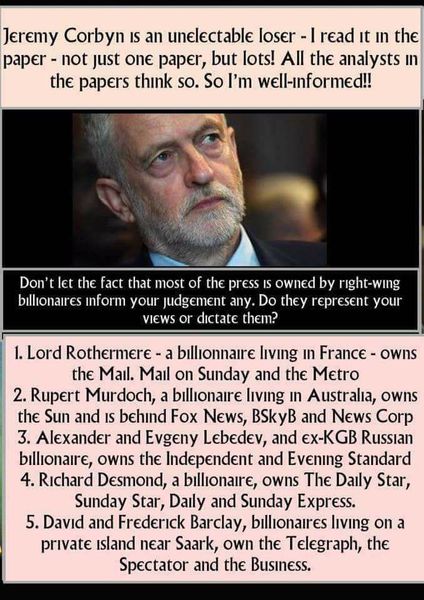
This shows how the far right has hijacked the media.


dd asked this question on another thread. I can't possibly answer it because I think it's a catch all term which means different things to different people. However, various labels have been mentioned, such as communism, socialism and Marxism, I presume as illustrating 'far left' thinking and it set me thinking.
Marxism is a term which interests me because Marx's ideas were at the basis of communism. Marx as a sociologist was briefly covered in my degree course and I thought his analysis of society was interesting. I still do. On the other hand, I think he spent too much time sitting in the Reading Room of the British Museum and failed to take the reality of human nature into account. His theory of 'communism' quite failed to recognise that no two people think alike and that 'man' is not inherently noble and disinterested. We know from history just what happens in Communist countries and it in no way resembled the workers' nirvana that he visualised. It produced a society that was as hierarchical, repressive and unfair as the contemporary societies he analysed.
However, I think his work offers food for thought as to how societies might be better organised.
These are extracts from a review of his work which I think are still relevant today.
So what was it that made Karl Marx so important? At the cornerstone of his thinking is the concept of the class struggle. He was not unique in discovering the existence of classes. Others had done this before him. What Marx did that was new was to recognize that the existence of classes was bound up with particular modes of production or economic structure and that the proletariat, the new working class that Capitalism had created, had a historical potential leading to the abolition of all classes and to the creation of a classless society. He maintained that “the history of all existing society is a history of class struggle”. Each society, whether it was tribal, feudal or capitalist was characterized by the way its individuals produced their means of subsistence, their material means of life, how they went about producing the goods and services they needed to live. Each society created a ruling class and a subordinate class as a result of their mode of production or economy. By their very nature the relationship between these two was antagonistic. Marx referred to this as the relations of production. Their interests were not the same. The feudal economy was characterized by the existence of a small group of lords and barons that later developed into a landed aristocracy and a large group of landless peasants. The capitalist economy that superseded it was characterized by a small group of property owners who owned the means of production i.e. the factories, the mines and the mills and all the machinery within them. This group was also referred to as the bourgeoisie or capitalist class. Alongside them was a large and growing working class. He saw the emergence of this new propertyless working class as the agent of its own self emancipation. It was precisely the working class, created and organized into industrial armies, that would destroy its creator and usher in a new society free from exploitation and oppression. “What the bourgeoisie, therefore, produces, above all, is its own grave-diggers”.
His analysis of 'class' was pretty sound, the bit in bold is what we know he was mistaken about.
^ With the evolution of modern industry, Marx pointed out that workmen became factory fodder, appendages to machines. Men were crowded into factories with army-like discipline, constantly watched by overseers and at the whim of individual manufacturers. Increasing competition and commercial crises led to fluctuating wages whilst technological improvement led to a livelihood that was increasingly precarious. The result was a growth in the number of battles between individual workmen and individual employers whilst collisions took on more and more “the character of collisions between two classes”.^
why is it that Marx felt that the existence of classes meant that the relationship between them was one of exploitation?
In the course of the working day, Marx reasoned, workers produce more than is actually needed by employers to repay the cost of hiring them. This surplus value, as he called it, is the source of profit, which capitalists were able to put to their own use. For instance, a group of workers in a widget factory might produce a hundred widgets a day. Selling half of them provides enough income for the manufacturer to pay the workers’ wages. income from the sale of the other half is then taken for profit. Marx was struck by the enormous inequalities this system of production created. With the development of modern industry, wealth was created on a scale never before imagined but the workers who produced that wealth had little access to it. They remained relatively poor while the wealth accumulated by the propertied class grew out of all proportion. In addition, the nature of the work became increasingly dull, monotonous and physically wearing to the workforce who became increasingly alienated from both the products they were creating, from their own individuality and from each other as human beings.
Sound familiar?
The political system, the legal system, the family, the press, the education system were all rooted, in the final analysis, to the class nature of society, which in turn was a reflection of the economic base.
*This did not mean that education and teaching was a sinister plot by the ruling class to ensure that it kept its privileges and its domination over the rest of the population. There were no conspirators hatching devious schemes. It simply meant that the institutions of society, like education, were reflections of the world created by human activity and that ideas arose from and reflected the material conditions and circumstances in which they were generated*
...the individuals who make up the ruling class of any age determine the agenda. They rule as thinkers, as producers of ideas that get noticed. They control what goes by the name “common sense”. Ideas that are taken as natural, as part of human nature, as universal concepts are given a veneer of neutrality when, in fact, they are part of the superstructure of a class-ridden society. Marx explained that “each new class which puts itself in the place of the one ruling before it, is compelled, simply in order to achieve its aims, to represent its interest as the common interest of all members of society i.e. ..to give its ideas the form of universality and to represent them as the only rational and universally valid ones”. Ideas become presented as if they are universal, neutral, common sense. However, more subtly, we find concepts such as freedom, democracy, liberty or phrases such as “a fair days work for a fair days pay” being banded around by opinion makers as if they were not contentious. They are, in Marxist terms, ideological constructs, in so far as they are ideas serving as weapons for social interests. They are put forward for people to accept in order to prop up the system.
I think this is fair analysis, too. It is also a very simplified version of a large body of work.
The questions in my mind are:
"How far are people willing to accept that the situation Marx analyses is inevitable and has to be lived with?"
And
"Is it reasonable to be influenced by Marx's analysis as a basis for altering the balance in society to ensure a more equable distribution of resources without actually wanting to overthrow the status quo?"
This shows how the far right has hijacked the media.
It appears that Keir Hardie was influenced by Marx.
This, written by Sylvia Pankhurst in 1921. Six years after Hardie's death.
Strange that Keir Hardie’s real opinions should be so little known by British socialists. We have before us a pamphlet containing reprints of three articles written by Keir Hardie in 1910, and entitled: Karl Marx: The Man and His Message. This pamphlet shows how absurd are the stories that Keir Hardie ignored or was opposed to the Marxian doctrine, or, as we have sometimes seen it said, he had never read a line of Marx...
www.marxists.org/archive/pankhurst-sylvia/1921/keir-hardie.htm
That's interesting, Maizie. Like you say, it seems to be forgotten about.
“Socialism will abolish the landlord class, the capitalist class, and the working-class. That is revolution; that the working-class, by its actions, will one day abolish class distinctions.”
“And it was the inspired version of Karl Marx which first formulated as a cold, scientific fact the inevitable coming of that glorious time. Little wonder that his memory is a consecrated treasure enshrined in the hearts of millions of the best men and women of all lands.”
If it wasn't for Marx, there would probably not be a working class Labour party, as the middle classes would have been quite happy to be at the top of the pile.
We seem to have gone backwards, in that case.
"The existence of a ruling class is only a proof of a successful revolutionary struggle waged by that class at some former period of its history. With each succeeding class struggle the bounds of human freedom have been enlarged until, with the advent of the capitalist system of wealth production, we have society, in the main, divided into two great antagonistic classes – the owners of property and the producers of property.”
Does that mean we've had too many class struggles, or too few?
We certainly haven't had the class struggles predicted (or should that be 'theorisedl?) by Marx. If you consider our 'ruling elite' over the centuries it ran in a pretty unbroken line for hundreds of years, with only a short break in the 17th century. And the post Civil War period was terminated with a return to the previous 'elite' without much trouble. The 20th century saw the most 'revolutionary' change in the 'elite' but, as dd pointed out, we preserved our state institutions and absorbed the changes. Would it qualify as a 'class struggle' in Marxist terms?
Do those who are identified as 'Marxist' at the present time actively want to destroy our Constitution or do they want to effect radical change within its framework?
At the moment the greatest threat to our constitution seems to be coming from the Right rather than the Left
Surely whoever is in charge is 'the elite'. Trump claimed to be overthrowing the elite and letting the people speak, but all he has done is replace one elite with another. The same in Cuba, Venezuela, the Soviet Bloc, China etc etc
The weasel words 'the elite' just mean a group of people you do not like being in charge.
I agree that that's how it's being used at present, but if you use that definition and look at our history the 'elite' was made up of pretty much the same people for hundreds of years.
But it's interesting how the composition of the 'elite' gradually changed. Very slowly after the 1832 Reform Act but much faster since universal suffrage achieved in the 1920s. Though still with a huge fear of any who want to change the economic balance/structure of our society. Even fear from those most likely to benefit...
The concept of class seems to have changed a good deal. Far more people define themselves now as middle class, as they do non-manual jobs and they (or their children) have been to university.
However we do live in an increasingly unequal society where there is a lot of injustice. The prospects of young people being able to buy a home, even in their thirties, is more and more to do with access to the "bank of Mum and Dad".
Some who still do define themselves as working class, and disadvantaged by their circumstances, become politically active and may even join a left wing or left of centre party. This is what happened when we were young. However disadvantaged people (especially the poorly educated can be manipulated by the forces of the right to target blame for their situation towards immigrants, the "elite", "Westminster", the EU, globalism, etc.
This way we have seen the rise of nationalist and populist parties, not just in the UK. I believe much of this is fired up by the right wing press, whose billionaire tax-exile proprietors have their own agenda. I know we are often told that young people don't read newspapers as we do, but the press can still mold attitudes and start a conversation which is amplified on social media. Those pulling the strings do not give a toss for the voters they fool and exploit.
Monica I agree completely ( the elite just means a group of people you do not like being in charge!) Succinctly put.
Imagine for a moment that Corbyn, Mc Donnell et all were in power ( sobering thought) then they would be the ruling elite.
Varian, I read last week that the bank of mum and dad has been blamed for putting up house prices.
It hasn't in my neck of the woods. Is there a different elite in the South compared to the North?
Varian class is a nonsense and rarely have I heard anyone in Scotland say they are anything other than working class...if you have to WORK to earn a living ...and thats ANY type of work then you are working class.There are millions of people who are one wage away from being homeless or in poverty ...thats WORKING people and whether they have university degrees or top jobs they are all in the same boat.Any one who says they are other than working class is deluded unless they have vast inherited wealth.Sying you're "middle class" is just you thinking you're superior to other folk .Ridiculous !
Varian I went to college with a woman who said she was "middle class" because she had a fridge feezer and a washing machine ! THATS how stupid the whole class thing is .
Apologies for often referring to the situation in France, but there are still some social groups here who behave in a way that Marx described ie the uprising of the working classes. Especially the farmers.
There's a case going on at the moment about maize farmers who are protesting the lack of action from the govt. on the water shortage. They've taken destructive action in rebellion.
They haven't got much sympathy from the general public though - even France seems to be drifting to the right.
You are right in some ways, Paddyann in that class has always been less of an issue in Scotland than England. Scotland has had many generations of educated people whose origins were very humble, going back to people like David Livingstone, walking to Glasgow University at the beginning of term with his sack of oats.
It was probably not until the nineteen fifties that working class English people began to get the opportunity of higher education. Until fairly recently English accents were strong class indicators, although less so now we hear a wider range of regional accents on TV. Did you notice the disparaging remarks made about Steph McGovern's Middlesborough accent on GN?
There are of course other divisions in Scottish society which are much worse than I've ever found in England - in particular sectarianism, fostered by religious segregation in schools, which is less of a factor in England, and of course, in recent years, the huge divide of separatism (which I know SNP supporters constantly deny, but is still very raw for so many after the 2014 referendum).
Class in Marxist terms means something different to other class analysis, and if a sociologist is using the term they really have to make it clear what they mean exactly.
Class in Marxist terms and in its basic meaning depends on your relationship to the means of production, I.e. If you own the means of production you were a capitalist and if you sold your Labour in order to access the means of production you were working class. Of course this theory was developed during the early industrial period and so the development and progress of capitalism meant that this relatively simple explanation no longer answered the needs of the sociologist or economist or historian.
The ideology of class had over the years changed and developed, and there are many explanation for class. However the OP talks about the far left and what it means.
So if we look around the world, we could argue that North Korea, China is rather left, as is Cuba and Russia all to varying degrees. These societies are characterised by a state controlled society in every institute, both social and economic. It is usually very authoritarian, often closing down any alternative offered to the population. There are no "far left" political parties in the UK except perhaps I think it's called "people before profit party" which I believe terms itself as a socialist party.
Just as an aside, the type of society we see in those "far left" countries bears no remote relationship to the type of society Marx described as a socialist society.
No roses, the elite just means the people who are in charge. You can be perfectly happy with them being in charge and they would still be an 'elite'. Using it as a pejorative term is really a bit of an abuse of language.
Left wing governments have 'elites' in just the same way that any other country has them. It's just that in a functioning democracy it's a great deal easier to change them than in it is in a one party dictatorship. We did do it through free and fair elections. As I noted earlier, the nature of the UK 'elite' has changed over the years. which demonstrates that it is possible to effect change without resorting to revolution.
I fear that we are getting to the state where elections are not 'free and fair'. They seem to be increasingly manipulated by the rich working behind the scenes to engineer a government which favours them and gives them the right conditions in which to increase their wealth. See all the worries over the harvesting of people's data from social media and using it to target individuals with messages that no-one else sees. Techniques were used by the Brexiteers and by the Trump campaign.
Tricia, do you really think that the situation with the French farmers really qualifies as an uprising of the working class in Marxist terms? Are they seeking to overthrow the 'elite' so as to take control? Or are they just doing what French farmers do when they feel unfairly treated? I don't recall their protests about British lamb leading to revolution. Or is it different now?
Frankly, I think all this talk about class is so much doggy doo doos.
Yes, there was a time, several generations ago, when it was simpler to divide people up: live in rented property, work with your hands, paid weekly = working class, work in an office, own your own home, be paid monthly = middle class, but that doesn't apply now. Jobs are so varied, most people are paid monthly, rent their home and the division between different types of work is very fluid.
OK, social demographers need divisions, but in real life the only hierarchy that has any meaning is money. The life style of a household with an income of £50,000 is different from one with an income of £25,000. But even then household size, aage -composition will mean different life styles.
Whenever you hear about middle-class lifestyles in the media they assume 4 bed detached house, big new car, children at private schools, several foreign holidays every year? Really? for all the people who would describe themselves as middle class? Teachers, various types of managers, ordinary accountants or bank managers (where branches still exist) junior doctors. The best thing is to laugh and refuse to get involved in a discussion that is the modern equivalent of the medieval argement about how many angels can balance on the head of a pin.
Now, that is an interesting argument. Anybody any idea how big an angel is and whether they can be compacted down? how big would the pin head have to be, could we get more on if we used a pin with a ball shaped glass pinhead?
Maizie No, we have not reached a stage where elections are not 'free and fair'
I disagree with your theory on that.Any manipulation behind the scenes works both ways, the media, social media etc.We still have our own vote which counts.
^ The best thing is to laugh and refuse to get involved in a discussion that is the modern equivalent of the medieval argement about how many angels can balance on the head of a pin.^
True. Class is irrelevant, though we Brits still seem quite obsessed with it.
monica you are right of course. As you go through life what matters to most people are life chances and opportunities.
But in order to plan policies in say education or health or social services as a couple of examples Government and others need to be able to measure the needs of groups of people, and to be able to do that in our society we are put into groups in this case called class. It is a necessary and sensible way of organising our society.
Another big difference now is that because of social media we can see how much we are manipulated and protest.
Elections not free and fair?
The millionnaire Brexiteer who spent over a million on the campaign and is now targeting MPs who voted to remain yet live where the majority voted to leave, spending another million on it, does not seem very free and fair to me.
And don't forget Mercer. Untold millions into the Brexit campaign.
Registering is free, easy, and means you can join the discussion, watch threads and lots more.
Register now »Already registered? Log in with:
Gransnet »Get our top conversations, latest advice, fantastic competitions, and more, straight to your inbox. Sign up to our daily newsletter here.
