Of course, the root of this debate can be found in the economy. Cutting services means cutting jobs and without jobs there isn't sufficient cash in the economy to drive it.
Although some areas of the UK may appear to be prosperous it could well be that is because many of the inhabitants are living on credit. There is a huge problem with personal debt in the UK. While national economies can run perfectly well while in debt, household economies can't because they truly have a limit to the amount of money available to them.
This is a very worrying article which explains a consequence of personal/household debt:
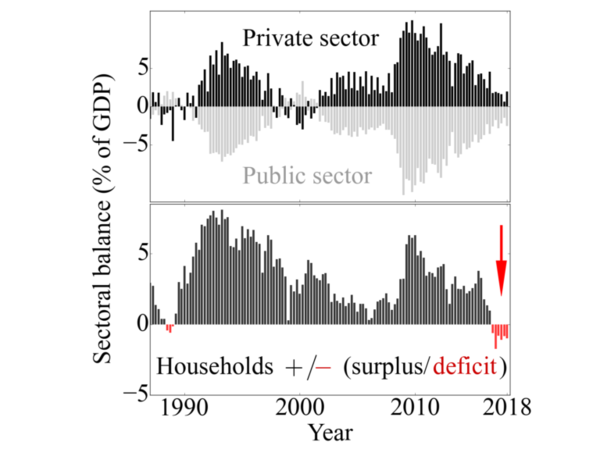
Now let’s come to the household sector (you and me) which as we know operates on different time scales. You and me are time limited. We cannot roll over a debt for decades or centuries. In the lower plot, I show the household sector on its own. This is really interesting. As you see households are mainly in surplus – they are saving rather than spending. Only very occassionally do they slip into deficit (red) – spend more than they save. This happened around 1988. If individuals spend more than they earn then eventually they have to stop, spending falls and the economy stalls. The result of the 1988 household deficit was the recession of the early 1990s. During a recession, households are, on average, repairing their balances sheets, i.e. saving rather than spending. Consequently, during and after a recession, we see a large private sector surplus and therefore necessarily a large public sector deficit – the mirror effect. This happened in the both the mid 90s and after the recession of 2008.
Given what I have described, the most shocking part of the household data is what happens after 2016 – follow the big red arrow. We have entered a period of household deficit of a magnitude and duration that is unprecedented in our history.
The lower of the two graphs is the one he is referring to. It shows a level of household debt greater than any in the last 20 years (at least). And note what he says
The result of the 1988 household deficit was the recession of the early 1990s
Yet household debt then was miniscule compared to now
www.progressivepulse.org/economics/the-single-most-important-piece-of-economics-that-everyone-should-know