

Pretty good you just need to include the n sound
cuskee n dah. The pronunciation of the Welsh language is the hardest bit.
Gransnet forums
News & politics
Cultural appropriation
(129 Posts)This has been in the news over the last couple of days.
I don't want to start a contentious thread. I really want to understand this. I think I might have unwittingly done this in the past and maybe still am.
Ive always worked in mukti-ethnic schools and mostly lived in multi-ethnic communities. If I saw something I liked I adopted it.
For instance learned how to use spices properly and my cooking definitely tends to Southern Asian rather than traditional British.
The music of Southern Africa appeals to me and it was played at my husbands funeral. He was white British like me.
When Im invited to Diwali celebrations I go in a sari. But now I'm wondering if I've been making a mistake.
I'm looking for guidance from someone who understands cultural appropriation more than I do.
SueDonim Wed 02-Sep-20 17:22:41, I see where you are coming from but do you think that wearing those hair styles now is a statement or a fashion? I think the latter.
I also don't think people are "taking other people’s culture" I think they are copying it and that is a compliment. It could be taken further to suggest that a black person straightening their hair is copying the hair of the oppressor for whatever reason. I think it is all about the reason we do these things and suggest it is simply fashion.
So if my black friend puts my hair into cornrows because she likes me with them, is that OK? Of course someone else may not like me wearing them, how do I know which is right?
There are so many things we all do which someone would object to, I am not going to stop eating meat because a vegan doesn't like it. I don't really think our lives should be determined by what someone we don't know thinks. Surely if we know that what we are doing is kind and not offensive that should be enough?
Chewbacca Wed 02-Sep-20 21:51:14 when we went to a Sikh wedding we didn't go quite that far but did ask what was appropriate - DH covering his head etc. We also learned that we mustn't have the soles of our feet forward as that was insulting. As the only white people there we were treated with great consideration and I don't think anyone thought about whether we were doing things right or not.
When I used to have to go to the Iranian consulate and Bank Meli I always covered my head, arms and legs and never objected to men taking my place in the queue because I wanted to fit into their culture, I didn't appropriate it.
I didn't know cornrows were originally about slaves so how could I be accused of CA? I believe that we should learn about history and use it to change the future. There is, imo, too much of this whinging and not enough looking at ways for society to be fairer for all.
Why do so many just assume people are “whiners” or “snowflakes” or “that isn’t a real problem”?
Why not learn to listen and say “ok, I’m sorry I didn’t know that was hurtful, I’ll do better”? Why the “this is out of control? People are ruining the cause” or “my black friends say this is stupid”?
People need to actually listen to what is being said as opposed to yelling out that what is being said is stupid
I wouldn't say that people are whiners, but I do sometimes think that if they chose their battles so as to win the big ones, the smaller ones would not have to fought at all.
But the big battles still aren’t seen as battles by many.
Many on this forum deny racism and the fact that many in the UK are in fact racist. So sometimes the small battles have to be fought so people can even see that the big battles exist.
Microagressions are put off as “not that bad/not an issue/others had it worse/but what about this”.
We don’t get to decide what a “silly/small” hill to stand on is. People feeling oppressed do.
I have a beautiful suit which was a gift from an African friend, she had it made for me in Africa and is of traditional fabric.
I have worn it on many occasions and have only ever received compliments from all nationalities.
I do not feel I have appropriated anything and surely if my friend had, she would not have given it to me, and not been proud when it is complimented on when we are out together.
felice but if you were to wear the suit, accept compliments but not tell where the fabric was from or explain about your friend it would then become cultural appropriation, as people would probably assume it was made locally.
Does that go for clothes made in all countries other than your own and your own culture, as has been mentioned earlier many cultures wear styles from others.
If I am complimented on the suit and other items of non Scottish clothing it would lead to a very boring conversation.
Anyway we have a large black population here and lots of great markets selling stuff from all cultures.
I have Morrocan sandals and foulards, Indian blouses, native American jewelry, my X is South African and DD wears SA rugby shirts.
Where does it end, oh and the "Kilt" is fancy dress and as tartan was banned by the English for many years why do they think they can appropriate it now.
Until anyone buys my clothes or pays my bills, then I don't think they can dictate what I wear or so my hair.
Cultural appropriation, to me, is the likes of the woman who pretended to be black, and was a loud voice on black issues (until her parents; both white, pointed out her "mistake')
I just wish I could remember her name.
I have just read the article from everyday feminism and am now sitting here spitting nails. I don't know if SueDonim is American or not, however, she is unaware of how Brits (and the French) reacted to black music. So a little potted history for her.
First Josephine Baker. She arrived in Paris aged 19 in 1925. She was an instant success and became a European star. Despite her fame when she returned to America to perform she was banned from certain hotels and restaurants.
Many blues artists came over to Europe in the 50s. They liked it here because the people were generally more friendly than in America. Perhaps I should say their audiences.
Black American GIs brought records over during the war and also merchant seamen visiting the various UK ports. From 1955 onwards Decca started to import not only American jazz records but also blues.
A DJ called Mike Raven broadcast regularly on one of the pirates back in the sixties and his programme comprised American blues music, including Sister Rosetta Tharpe. It was through listening to him that I started to like the blues and have several old records.
During the early sixties many American blues players toured in Europe. They influenced British musicians and there was a flowering of blues music during that decade. John Mayall, Eric Clapton, Jimmy Page to name but a few. As their popularity grew, so the people who bought their records searched for the originals.
Music is an area where there has been masses of cultural assimilation. There are many videos on You Tube of the venerable black American musicians playing with the (slightly) younger white ones.
Gwyneth
Pretty good you just need to include the n sound
cuskee n dah. The pronunciation of the Welsh language is the hardest bit.
Oh yes, I realised I'd missed the n!
Sister Rosetta Tharpe is fantastic! 
In the 1970s I bought a sari in India and wore it some years later in Sri Lanka, where we went on holiday with a Sri Lankan friend.
Was that wrong? Our friend complimented me on the sari and I felt less conspicuous than when I wore Western clothes as there were very few Western tourists in Sri Lanka at that time. I don't think "cultural appropriation was a thing then.
I just wish I could remember her name.
Rachel Dolezal MissA?
That's her, chewbacca.
Thank you!
Callistemon
Cuskee Dah?
Now you’re just showing off!?
SueDonim
Maybe you’d be happy to continue to act in a manner which someone had told you they find upsetting or offensive, Monica. I am not. If someone told me what I did was offensive or upsetting to them, I would apologise and stop doing it.
It’s nor for me to determine who can be permitted to be offended and who must suck it up.
If somebody told me that they were upset by seeing my blonde hair in cornrows ( wouldn’t happen....looks a painful hairstyle) then I’d say ‘too bad’.It’s high time everybody who posesses common sense to say the same.
They can carry on being offended if they like.What utter nonsense it all is.
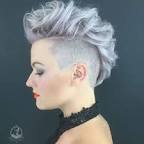
Is this cultural appropriation?
Tradition dictated that Mohawk warriors cut the sides of their heads leaving only a strip of hair over the top of the head, universally recognized today as a 'Mohawk. ' This style is also called the scalplock. ... We valued the length of hair for its strength, spirituality and power.”
I had my hair like that in the 80s, before appropriation was invented.
Me too MissA! And it was dyed different colours too! 
I get confused when it comes to fashion, as there are only so many ways that hair can be worn, and so many styles of clothing, and young people will always want to look unlike their parents, so are almost certain to look outside of the 'norm', whatever their culture. Traditional dress is, in most cultures, kept for festivals and so on - I don't even know what a traditional English outfit would look like, although the other UK countries have kept their national dress.
Fashion seems to me a bit like knitting stitches, where I am on safer ground . I think it is generally agreed that nobody can copyright a knitting stitch, as it is impossible to prove that it hasn't been knitted before, but when a number of stitches are put together in a particular way, and made into a pattern with shaping and so on, the pattern can be copyrighted.
Sometimes fashion trends follow films or TV series - I have seen a fashion for the hairstyles used in Vikings, for instance. I have no idea how accurate the costumes and hairstyles are, but they may well have been worn by people all over the world at one time or another, and some are not unlike the Native American ones. When you are looking at cultures that spanned hundreds of years there is sure to have been some overlap, by accident or design.
I'm not sure what point I'm making now - I was responding to the question about the Mohawk photo .
You were?
MissAdventure
You were?
Yes, however rambling, I was saying that whilst the Mohawk style could be cultural appropriation, it could equally possibly be copying a style from another culture (eg Viking), as there are only so many ways to wear hair.
Whether or not that matters, I don't know, to be honest, but I'll not waffle on any longer .
I’ve now (tried to) read the everyday feminism article posted by sue, but tbh found the article hard going. I think I get what Cultural appropriation means in terms of literature & film & drama, but the bit about eating in Mexican restaurants had me
I’m not sure in what circumstances one is culturally appropriating(not ok), or just exchanging(ok) or even trying to assimilate(ok)
I personally haven’t oppressed any Mexican people. I’ve eaten in many Mexican restaurants in different parts of the USA. I think the restaurant owners were pleased to have our business.
Similarly clothing. I still have an embroidered Chinese jacket that I bought in Hongkong 40 years ago and still wear it occasionally.
I suppose I could have been seen as a member of the colonial powers.
But guess who sold me the jacket - a Chinese woman in the China products emporium. And who is oppressing the people of Hongkong now?
(Joining you on your ramble Doodledog)
Join the conversation
Registering is free, easy, and means you can join the discussion, watch threads and lots more.
Register now »Already registered? Log in with:
Gransnet »