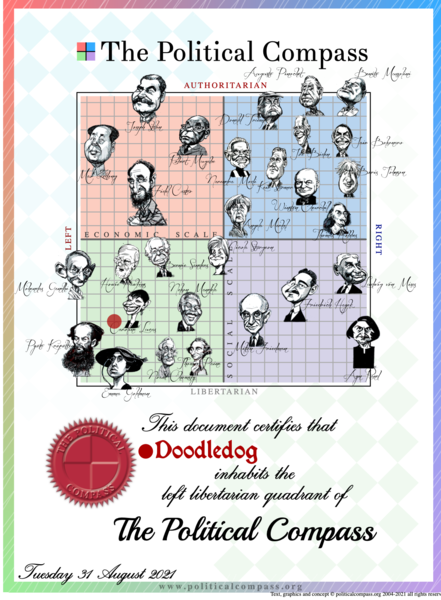
I think politics exists on two axes - libertarian and authoritarian on one, and large state/small state on the other. It is perfectly possible to sit at one extreme on one axis and the other extreme on the other, depending on where your core beliefs lie, so concepts like 'left and right wing' are often not very useful.
Nevertheless, on the whole, Labour would support large state and Conservative small - as broad brush examples Labour would support nationalisation, regulations on wages and public health and education systems, whilst Conservatives would support private profit-making services and no wage controls. The idea of a welfare state does not fit with small state ideals - people should provide for themselves and their families, and 'there is no such thing as society', and in a large state view everyone should pay to support one another by creating a safety net.
On the other axis is how far you think the state should interfere in 'personal freedoms', so Conservatives would be high on the libertarian scale - not wanting to impose lockdowns, few controls on things like how many holidays employers have to offer staff, whereas Labour would be less libertarian and more in favour of protections - so more support for health and safety legislation, laws prohibiting long working hours and so on. Support for things like freedom of expression, sexual freedoms, adherence to prescribed norms of behaviour sit on this axis, too.
As a result of both of these sets of ideas, Conservatives are a party of low taxation, feeling that people should fend for themselves, and Labour's philosophy of state protection of its citizens needs to charge everyone higher taxes to pay for it, whether they need protection or not.
As individuals, though, someone like Johnson (Libertarian, small state) and May (Authoritarian, small state) can share beliefs about how far the state should protect or leave us to our own devices, but otherwise be on different places on the political compass, as can Corbyn and Starmer. None of these people is being untrue to their principles or party, as what counts as being 'Labour' or 'Conservative' shifts all the time, largely depending on the leaders, and explains the factions and need for regular reshuffles of people who don't 'fit' any longer.
Manifestoes are just a set of policies to try to create a society that broadly aligns with the current set of leaders' place on the compass.
You can test your own place on the compass (based roughly on the axes I've outlined above) on this link. It's quite interesting to see which historical figures had views similar to yours.