Gransnet forums

News & politics

Increasing the interest rate to 5%, is this really the fairest way to slow inflation?

(416 Posts)
foxie48 Thu 22-Jun-23 18:35:32

I will not personally be affected as we paid off our mortgage years ago and don't have any debts but I am so worried about how this will affect so many families and young people who are already struggling. A divorced friend has been trying to sell her house as the children have moved out and she no longer gets maintenance. She is really struggling to pay her mortgage but despite reducing the price of her home, she still can't sell. She's been selling belongings to make ends meet. I'm sure she's representative of lots of people and they are not the people who should be targeted, it's people like me! Mortgage free, decent pension, savings, with the ability to soak up extra costs. What do others think?

Norah Fri 30-Jun-23 19:11:13

M0nica

But doodledog this is not that different to the situation many of us faced in the 1970s and 80s.

No one is suggesting the current situation is easy and for some it will be catatstrophic, but that was the same then as now. Houses were repossessed, families were left homeless.

In fact it is better now because lenders do go to great lengths to help those facing difficult times, and have a range of schemes, from going interest ponly for a short perios, to extending morgages.

In the 1970s and 80s, if you couldn't make your payment, the lenders just foreclosed. DD bought her first home in 1993 and one property she wanted to buy, was a repossession. Someone over reached themselves, couldn't cope with a rise ininterest rates, so the only option was repossession.

Agreed.

Nobody said it's easy right now for people who face re-sets. But accommodations are being made by lenders. This will work out for most, my guess.

Germanshepherdsmum Fri 30-Jun-23 19:07:37

My mention of student loans was simply noting that they had been to university, so not unintelligent. Better options for them if they stretched themselves so much to buy would surely have been a cheaper property or continuing to rent - rents may have risen or shortly do so, but they had managed to save a deposit, money to fall back on if necessary.

maddyone Fri 30-Jun-23 19:05:52

Monica you have said it all. I can add no more to what you have said. I agree with you, it is absolutely not worse for people with mortgages now than it was in the past. It was truly awful and many, many people lost their homes.

Doodledog Fri 30-Jun-23 19:01:22

I assume they bought because they needed somewhere to live, and had nobody to donate them a house?

I'm not sure about the link between student loans and intelligence, really. They are compulsory unless people have someone to donate the fees and maintenance costs of education - something else that we didn't have to consider.

We bought our first house in 1978/9. The repayments shot up immediately. Yes, we borrowed a smaller multiple of our income, but like everyone else we can't take credit for that as it wasn't our wisdom that stopped us from borrowing more - it was just the system. We weren't rushing in, either. A friend had bought an identical house (a tiny modern 'starter home' on boring estate three years earlier for half what we paid. How were we to know that three years later ours wouldn't cost twice as much again? It wasn't a case of over-reaching - there was nothing cheaper, really.

That was in the past, and I can't remember a lot of detail, but energy bills weren't huge then, and life was simpler - nobody had or needed computers or phones, or digital TV, so outgoings were lower too.

I was 22 when I married - a year after buying the house. My children are 10 years older now. Both have good jobs, but neither has a mortgage yet, as they pay hight rents and deposits are insanely high. They have done nothing wrong, any more than my generation did anything right. It is just harder for young people now, I think.

I also think that there is no virtue in suffering, and the fact that this has happened before doesn't make it easier for those going through it now. I don't think that the rates rises are 'unfair' - but I am starting to understand why some younger people resent older generations for smuggery and self-righteousness.

Norah Fri 30-Jun-23 18:46:57

Germanshepherdsmum

In which case Doodledog, given that nobody can have escaped the warnings that the long run of unprecedentedly low interest rates would end, why did your hypothetical couple with their two small children take out the mortgage? If they have student loans to repay one might hope they would display rather more intelligence. Any fool could work out the effect on their already tight budget of an even a small interest rate rise.

Indeed.

If both work, common currently, and have young children, and student loans, and the deposit was a "stretch" -- why purchase until all things improved for them financially? No need to rush into chaos!

Casdon Fri 30-Jun-23 18:44:00

M0nica

But doodledog this is not that different to the situation many of us faced in the 1970s and 80s.

No one is suggesting the current situation is easy and for some it will be catatstrophic, but that was the same then as now. Houses were repossessed, families were left homeless.

In fact it is better now because lenders do go to great lengths to help those facing difficult times, and have a range of schemes, from going interest ponly for a short perios, to extending morgages.

In the 1970s and 80s, if you couldn't make your payment, the lenders just foreclosed. DD bought her first home in 1993 and one property she wanted to buy, was a repossession. Someone over reached themselves, couldn't cope with a rise ininterest rates, so the only option was repossession.

Here’s the evidence. It needs the further inflation rises since 2022 factored in to make a true comparison.
www.ons.gov.uk/economy/inflationandpriceindices/articles/consumerpriceinflationhistoricalestimatesandrecenttrendsuk/1950to2022/pdf

M0nica Fri 30-Jun-23 18:25:21

But doodledog this is not that different to the situation many of us faced in the 1970s and 80s.

No one is suggesting the current situation is easy and for some it will be catatstrophic, but that was the same then as now. Houses were repossessed, families were left homeless.

In fact it is better now because lenders do go to great lengths to help those facing difficult times, and have a range of schemes, from going interest ponly for a short perios, to extending morgages.

In the 1970s and 80s, if you couldn't make your payment, the lenders just foreclosed. DD bought her first home in 1993 and one property she wanted to buy, was a repossession. Someone over reached themselves, couldn't cope with a rise ininterest rates, so the only option was repossession.

Germanshepherdsmum Fri 30-Jun-23 18:17:28

In which case Doodledog, given that nobody can have escaped the warnings that the long run of unprecedentedly low interest rates would end, why did your hypothetical couple with their two small children take out the mortgage? If they have student loans to repay one might hope they would display rather more intelligence. Any fool could work out the effect on their already tight budget of an even a small interest rate rise.

Casdon Fri 30-Jun-23 17:06:30

Doodledog

I don't think it is easy to ride out large increases in housing though, however savvy (or 'opted in' to awareness) you are.

I've done a quick Google of costs, and found some figures for Mr and Ms Average buying an average house, with and without average childcare costs:

The average house price in the UK is £285,000 (YouGov) with huge regional variations.

With a 10% deposit (which would be difficult to save on that salary), a mortgage of £256,500 would cost £1425 per month at 4.2% (moneysavingexpert calculator) assuming that no fees have been added to cover arrangement costs, solicitor, estate agent and removals.

The median salary is £31,000 (Indeed.com) across all age ranges, and this will, of course, be lower in younger groups who are likely to have newer mortgages.

A salary of £31k would give Mr/Ms Average, assuming a pension contribution of 6% and a student loan repayment of £27 a month, a take-home of £1965.82 (thesalarycalculator.co.uk).

This would leave about £540 a month for food, transport, council tax, energy, water, phone, TV etc for a single person.

It would take a rise of only 4% on the £256,500 mortgage to take the repayments to £1980, which is more than the take-home pay before any other expenses.

Even if we assume that most houses are bought by couples with two salaries, and that both partners earn the average of £31k with the same offtakes, we are looking at a disposable household income of £2505 a month ((£1965x2=£3930, minus £1425), and childcare may well have to be paid out of that £2505. According to day nurseries.co.uk the average cost of a full time nursery place per child is £14836 pa for an under-two, and £14539 for a two year old, which comes to £2448 per month for a family with one of each. This would more than wipe out one of the salaries, and even on the 4.2% mortgage there would be little or nothing left for expenses. State help for childcare doesn't kick in until over 3, and even then will not cover full-time places.

£2448 (childcare) + £1425 (mortgage) =£3873, leaving the princely sum of £57 a month for everything else, and if the mortgage went up even a tiny bit even that would be wiped out.

I don't think that either common sense or a knowledge of brain surgery could make that work.

Thank you Doodledog, that’s really helpful.

Doodledog Fri 30-Jun-23 17:04:22

I don't think it is easy to ride out large increases in housing though, however savvy (or 'opted in' to awareness) you are.

I've done a quick Google of costs, and found some figures for Mr and Ms Average buying an average house, with and without average childcare costs:

The average house price in the UK is £285,000 (YouGov) with huge regional variations.

With a 10% deposit (which would be difficult to save on that salary), a mortgage of £256,500 would cost £1425 per month at 4.2% (moneysavingexpert calculator) assuming that no fees have been added to cover arrangement costs, solicitor, estate agent and removals.

The median salary is £31,000 (Indeed.com) across all age ranges, and this will, of course, be lower in younger groups who are likely to have newer mortgages.

A salary of £31k would give Mr/Ms Average, assuming a pension contribution of 6% and a student loan repayment of £27 a month, a take-home of £1965.82 (thesalarycalculator.co.uk).

This would leave about £540 a month for food, transport, council tax, energy, water, phone, TV etc for a single person.

It would take a rise of only 4% on the £256,500 mortgage to take the repayments to £1980, which is more than the take-home pay before any other expenses.

Even if we assume that most houses are bought by couples with two salaries, and that both partners earn the average of £31k with the same offtakes, we are looking at a disposable household income of £2505 a month ((£1965x2=£3930, minus £1425), and childcare may well have to be paid out of that £2505. According to day nurseries.co.uk the average cost of a full time nursery place per child is £14836 pa for an under-two, and £14539 for a two year old, which comes to £2448 per month for a family with one of each. This would more than wipe out one of the salaries, and even on the 4.2% mortgage there would be little or nothing left for expenses. State help for childcare doesn't kick in until over 3, and even then will not cover full-time places.

£2448 (childcare) + £1425 (mortgage) =£3873, leaving the princely sum of £57 a month for everything else, and if the mortgage went up even a tiny bit even that would be wiped out.

I don't think that either common sense or a knowledge of brain surgery could make that work.

M0nica Fri 30-Jun-23 15:56:55

No one is saying young people today are less savvy than in the past. But at every level you can not opt out of making sure you stay in touch with what is going on round you in the world you live in.

What is happening now is happening, but it is not uniquely dreadful. It has happened before, several times within living memory, and it will happen again. And at times like this people draw down on their savings to meet bills. Again it is what people did in the 1970s and 1980s and at any other time when prices were going up faster than incomes.

We took a mortgage out in 2021. We fixed it for 5 years, we made length of fix, more important than lowest interest rate because we had heard the news, listened to the radio programmes like Briefing Room, seen news items and other commentary online and in newspapers and magazines, and we realised that interest rates were more likely to go up than down.

OK we do not know what will happen in 2026, but in the meanwhile we will watch what interest rates do, we will read everything we come across and we will plan ahead on the basis, that in three year's time our mortgage payment could double, or more. It is common sense, not rocket science or brain surgery.

Casdon Fri 30-Jun-23 14:46:54

foxie48

Interestingly, the reason the BofE didn't put the rate up was because their modelling told them not to. Apparently, this period of very low inflation had not been experienced before. The experts got it wrong. Do listen to The Briefing Room, Norah, there are proper experts on there discussing it.

You’re whistling in the wind, as I was foxie48. The fact that money being taken out of individual savings accounts has hit an all time high as reported yesterday (because people can’t pay their bills any more) is also probably totally irrelevant and down to the young people of today being less financially savvy than their elders.

foxie48 Fri 30-Jun-23 14:33:25

Interestingly, the reason the BofE didn't put the rate up was because their modelling told them not to. Apparently, this period of very low inflation had not been experienced before. The experts got it wrong. Do listen to The Briefing Room, Norah, there are proper experts on there discussing it.

Norah Fri 30-Jun-23 14:23:55

M0nica Casdon there have been so many articles in newspapers on line, everywhere for about 4 years aor more saying interest rates are due tp rise and cannot stay so low.

Again back in the 1970s, we had no expereience of mortgage rates going as high as they did and certainly no experience of interest rates nearly double and sometimes treble what they are now.

Agreed, for several years the news was replete with stories that interest was too low and should be soon to go up.

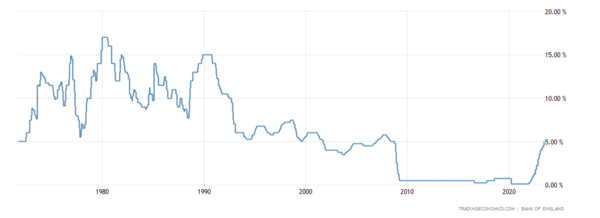
Certainly anyone knew for a fact interest rates fluctuate - from a 7% in 1971 to a high of 17% in 1979 to lows beginning in 2008. The rates after 1980 were, quite obviously, volatile and changing.

No excuse for ignorance. Two of our children purchased in the early 80s and two in the early 2000s - they surely grasped the concepts of rate changes.

Bank of England base rate 1979-2017
Bank rate at year end (%)*
1979--17
1980--14
1981 --14.375
1982--10
1983--9.0625
1984--9.5
1985--11.375
1986--10.875
1987--8.375
1988--12.875
1989--14.875
1990--13.875
1991--10.375
1992--6.875
1993--5.375
1994--6.125
1995--6.375
1996--5.9375
1997--7.25
1998--6.25
1999--5.5
2000--6
2001--4
2002--4
2003--3.75
2004--4.75
2005--4.5
2006--5
2007--5.5
2008--2
2009--0.5
2010--0.5
2011--0.5
2012--0.5
2013--0.5
2014--0.5
2015--0.5
2016--0.25
2017--0.5
2018--0.75
2020--0.25
2020--0.10
2021--0.25
2022--0.5
2022--0.75

foxie48 Fri 30-Jun-23 11:57:49

The Briefing Room, BBC radio 4 at 11.00 had a very interesting and informative programme on inflation. I learned a great deal, it's worth a listen.

Germanshepherdsmum Thu 29-Jun-23 20:43:49

Exactly.

M0nica Thu 29-Jun-23 19:24:12

Casdon there have been so many articles in newspapers on line, everywhere for about 4 years aor more saying interest rates are due tp rise and cannot stay so low.

Again back in the 1970s, we had no expereience of mortgage rates going as high as they did and certainly no experience of interest rates nearly double and sometimes treble what they are now.

As I said I do not lack sympathy, but just believe that the whole thing is being over egged saying that people today are suffering far more than we did in the past. They aren't and we got through it. Perhaps a bit of hardship would be good for some of them. Let them know that they need to learn to take the rough with the smooth.

Dinahmo Thu 29-Jun-23 14:21:59

As I wrote on Sunday, the B of E interest rate between 2009 and 2022 was less than 1%. As far as I can see there has never been such a long period of flat lining before. It's not surprising that newer borrowers did not anticipate such an increase.

I'm wondering how many lenders and mortgage advisers pointed out the frequent changes in rates in earlier years so that more recent borrowers were made aware.

Last year the daughter of a friend bought a house. During the period that she was looking at mortgages she changed jobs with a large salary increase. Her broker telephoned her to say that she could borrow a further £60k if she wished. She didn't wish to since she was quite happy with the house she was buying.

Casdon Thu 29-Jun-23 14:11:07

www.mortgageable.co.uk/wp-content/uploads/2022/12/History-of-Mortgage-Interest-Rates.png

This is why people are struggling Monica. Interest rates have been low for 15 years. Most people with newer mortgages have not known or expected them to change more than perhaps a couple of percent. They don’t have the memory of tougher times that age and experience brings. The inflation on everything else is also impacting people hugely. You can be unsympathetic, I believe I’m being realistic.

PS It’s not a sob story from me, I haven’t had a mortgage since my husband died over 15 years ago and it was paid off, my daughter is overpaying on hers, so I’ve got no personal axe to grind.

Norah Thu 29-Jun-23 13:58:33

M0nica these interest rates did not come as a surprise.

That interest rates would not stay at their historic low much longer has been discussed in the press and on the media for 3 or 4 years now.

Of course nobody thought ridiculously low interest rates could last forever. No surprise whatsoever as to the new rates.

Proper prior planning would have ameliorated some people's problems. Lenders offering temporary switches to interest only and lengthening mortgage terms - should hopefully help most people.

M0nica Thu 29-Jun-23 13:53:25

Casdon we took our first mortgage out in June 1969. Look at the graph for 1970s mortgage rates in this link www.telegraph.co.uk/property/news/people-complaining-interest-rates-mortgage-1970/. It is no different to the pattern we have had recently.

In the 1970s, inflation, over the whole decade averaged 12% on a calendar-year basis, peaking at almost 23% in 1975. As well as hitting levels not seen in any other post-war decade'

Back in the 1970s we faced the same problem of rocketing interest rates, galloping inflation, far higher than now and Bulding Societies, then were entirely unsympathetic to those having problems and simply foreclosed, end of. None of the current attempts to find ways round to help etc etc.

Unemployment rates were also rising steadily through the 1970s reaching nearly 7% at the end of the decade and the labour market was much less flexible. Most jobs were full time and there were very few part time jobs. There was also no maternity leave, maternity pay. It was very difficult to work 'extra hours or find part time work.

Does no one remember the housing slump from, roughly 1988 -1995, when there were wholesale repossesssions, mainly of small first time homes, and in many areas the price of starter homes halved. DD entered the housing market in 1993. She made offers on 2 flats in South London, one fell through because it had an absent freeholder so she could not get a mortgage, but both were selling for half the price the owners had bought them for 4 years previously.

I am not without sympathy for those early in their mortgage caught by high interest rates, but there is nothing unique about the situation and many of us faced exactly the same problems but worse 50 years ago and there were similar problems in the 1980s going into 1990s.

So please, no special pleading. it will not wash.

foxie48 Thu 29-Jun-23 09:31:24

I don't find it hard to sympathise with borrowers and find suggesting they didn't think of the consequences of an interest hike a bit patronising. What they couldn't foresee and therefore plan for (neither could the lenders) was that they would be hit with huge increases on fuel and food because of events which were completely out of their control. I'm one of the fortunate ones, I've got savings but I know of many families who live from one pay day to another and they are no doubt, sick with worry. They are not indolent, stupid people who lack financial knowledge because they managed to scrape together a deposit for a small home and stretched themselves to pay a mortgage. These are people who would still be caught because they lived in rented property, paying ever increasingly high rents, had no security of tenure and wanted to give themselves and their children a better life or even worse, were living with their parents in their 30's. Do have a look at the cost of renting, it's frighteningly expensive and difficult to find. Honestly people, a bit of compassion is at least free.

Germanshepherdsmum Thu 29-Jun-23 08:59:50

It has been agreed that there will be an embargo on repossessions for twelve months and that lenders will offer temporary switches to interest only and lengthening of mortgage terms. Lenders now build in an interest rate rise of I believe 3%when considering affordability and as MOnica has pointed out, interest rates were never going to remain at the historic lows of the last few years - it’s hard to sympathise with borrowers who didn’t think about that when deciding how much to borrow.

Casdon Thu 29-Jun-23 06:11:36

I think what has changed is peoples options to dig themselves out of a mortgage black hole now Monica. Everything you have no choice but to spend money on has increased, and both partners in most couples work already, their mortgages were taken out on the basis of them doing so, so there are less options to make ends meet by taking on more hours. I think you’re right, help should be targeted. Even then I can see there being a significant rise in the number of repossessions.

M0nica Thu 29-Jun-23 05:47:35

Casdon but it has always been like that, and when lenders are working out how much someone can afford to borrow, they factor in, I think, the lender's ability to meet payments if the interest rate goes up by several %.

Do not misunderstand me, I have every sympathy for those in the early years of a mortgage and facing these huge jumps in interest, but these interest rates did not come as a surprise.

That interest rates would not stay at their historic low much longer has been discussed in the press and on the media for 3 or 4 years now. We took out a Retirement Interest Only mortgage a couple of years ago to fund an extension to our house and we consciously put length of fix ahead of getting the lowest interest rate for just that reason.

When we bought our first house, we had a whole set of contingency plans to deal with different scenarios, that might cause us problems.

I do think there ought to be some help for those in the early years of their mortgage who are having to refix while interest rates are so high, but there are about 11 million mortgage holders in the UK and the majority of those will not be facing the huge increases in mortgage payments. Help is needed for some, but it should be targetted.