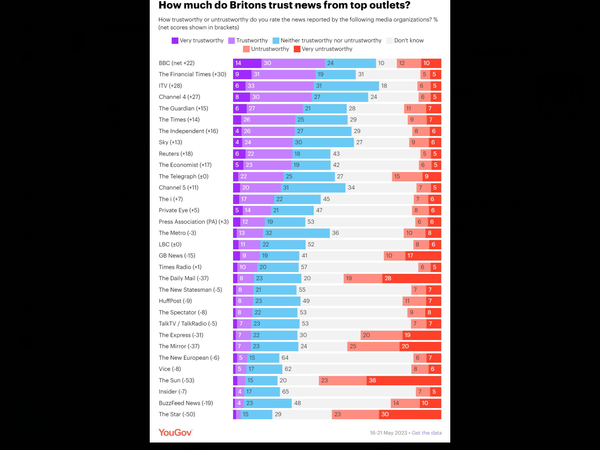
I just saw these results from UGOV, from what I have observed on GN, many do not trust the BBC, whereas it appeared top in this survey.


I just saw these results from UGOV, from what I have observed on GN, many do not trust the BBC, whereas it appeared top in this survey.
I agree with almost all the positions in that chart.
If anyone doesn't trust the BBC then who do they trust more? I'm interested to know.
I do find they sometimes ignore an item of news if they don't want to report on it, and that annoys me. But on the whole they can be trusted. I believe they take care to verify their facts.
I agree with you Chestnut. The BBC is my first "go to" site to check out the headlines.
Interesting comparing the number of untrustworthy counts for each as well. The FT and ITX substantially less untrustworthy than the BBC and only slightly less trustworthy. What it does clearly demonstrate is that only approximately a third find any organisation to be trustworthy. So basically there is no real confidence in anyone which is rather damning of our media as a whole.
I think that most of the so-called 'mainstream media' are trustworthy in that the basic facts they give are accurate. The difference is in how they are presented, so 'trustworthy' often means 'is in line with my own beliefs'.
Doodledog
I think that most of the so-called 'mainstream media' are trustworthy in that the basic facts they give are accurate. The difference is in how they are presented, so 'trustworthy' often means 'is in line with my own beliefs'.
The more trustworthy media give sources for their news items.
I use BBC and SKY as my newsfeed, nine times out of ten their stories corroborate each other.
Overall I agree with the survey results.
I use a number of media outlets including the BBC, Sky but also CNN, European news etc as I like to read an alternative perspective.
GrannyGravy13
I just saw these results from UGOV, from what I have observed on GN, many do not trust the BBC, whereas it appeared top in this survey.
I think most under 35y don't rely on any of the tv channels or newspapers any more.
So I wonder what the demographic was?
Also, it really is a piece to reassure the public that all is well with the media.
If you read, let's say a journalists perspective of the industry, you will get a different answer.
Namsnanny
GrannyGravy13
I just saw these results from UGOV, from what I have observed on GN, many do not trust the BBC, whereas it appeared top in this survey.
I think most under 35y don't rely on any of the tv channels or newspapers any more.
So I wonder what the demographic was?
Also, it really is a piece to reassure the public that all is well with the media.
If you read, let's say a journalists perspective of the industry, you will get a different answer.
That is right - I agree with you
Wwmk2👍
I am not really sure those within mainstream media have completely realised what is happening to the way people access news, media etc.
It would be interesting to know something of the demographic surveyed - age, political leaning …
growstuff
Doodledog
I think that most of the so-called 'mainstream media' are trustworthy in that the basic facts they give are accurate. The difference is in how they are presented, so 'trustworthy' often means 'is in line with my own beliefs'.
The more trustworthy media give sources for their news items.
True, but all 'mainstream' media is regulated, and whilst the system is far from perfect they can be forced to retract inaccuracies.
My view that there is a link between which media people trust and how far they agree with their views remains though.
I am also broadly in alignment with the majority as depicted in the infogram.
Whitewavemark2
Namsnanny
GrannyGravy13
I just saw these results from UGOV, from what I have observed on GN, many do not trust the BBC, whereas it appeared top in this survey.
I think most under 35y don't rely on any of the tv channels or newspapers any more.
So I wonder what the demographic was?
Also, it really is a piece to reassure the public that all is well with the media.
If you read, let's say a journalists perspective of the industry, you will get a different answer.That is right - I agree with you
YouGov always uses a cross section of age, sex, political belief etc. for surveys, none of them would be worth paying attention to if they didn’t, so I don’t think the results are likely to be skewed.
One of my favourite sources of news is Reuters.
The BBC is my news and info of choice. I trust them.
Actually, the intersesting question is now whether any site is trustworthy, but how people would define 'trustworthy'.
As Doodledog rightly pointed out, for many people 'trustworthy' means 'does this site confirm all my prejudices?'
We have seen in recent years the growth of conspiracy theorists, who base everything they believe on the hairier end of social media and the posts of bloggers and other influencers who have no knowledge or capacity to offer authoratative information, just ignorance and stupidity.
So before I take any notice of a table like this. I would want to see a detailed analysis of who the respondents are and how the survey was carried out.
Interesting to see and to speculate upon. Why, for example, does ITV score as more trustworthy than Channel 4: Sky feature above Reuters? For news I prefer Radio 4, in the morning and pm early evening ( which is BBC in a different format, I suppose)
It's topical now with the revelations about media being subjected to attempts to thwart publication around the Post Office postmaster scandal.
For Monica, and anybody else who’s interested.
yougov.co.uk/about/panel-methodology
The problem is Casdon that your link gives the statistical base for the sample, but what is needed in a survey like this is a survey of what people in the sample understand and mean as 'trustworthy' and also how they use media to gain news.
M0nica
The problem is Casdon that your link gives the statistical base for the sample, but what is needed in a survey like this is a survey of what people in the sample understand and mean as 'trustworthy' and also how they use media to gain news.
How would you get that information for a large scale survey of this kind though Monica? The devil is in the detail of the wording of the questions they answer, but boring into the grasp people have of what is trustworthy is surely beyond the remit of a survey unless you do a whole other survey about that specifically?
That is exactly what you should do. Randomised studies are nott he be-all and and-all of opinuon researching. Pre classfication of structured samples is quite common and needs to be used in cases like this.
I do know that Monica, I’ve got a Sociology degree. However there are a huge number of surveys carried out, and it’s neither feasible nor desirable for them all to be rigorous academic studies. The YouGov methodology is as robust as you are likely to find for snapshot surveys, which is what we are talking about here.
The devil is in the details ....
Not just applied to a survey, but how I feel about the media too.
For example, what is left out, is just as necessary for the reader/viewer to know, to enable a more nuanced understanding.
It's also about the phrasing of the article or question.
Much can be said to be 'truthful' and still not give an honest non partisan answer.
Registering is free, easy, and means you can join the discussion, watch threads and lots more.
Register now »Already registered? Log in with:
Gransnet »Get our top conversations, latest advice, fantastic competitions, and more, straight to your inbox. Sign up to our daily newsletter here.
