A lay-in sounds like a flock of chickens planing a coup
The Daily Mail - the great divide
Reform given huge donations by crypto currency billionaires
Andy Burnham illustrates how much he cares about Homelessness


….because I’ve just had an email ad from Joules re nightwear.
‘Enjoy a rare lay-in….’
A lay-in sounds like a flock of chickens planing a coup
If someone uses ‘lay’ when it should be ‘lie’ I always want to say “Eggs or bricks?”. I think I saw that first in a Miss Read book.
I used to teach the Literacy Hour in primary in the early 2000s which brought in some grammar. Not sure if it still taught but I just loved doing Haydn Richards with my children and even the naughtiest boys loved writing out the exercises and getting them right. Those were the days.
My daughter is head of English in a secondary school and her degree was in linguistics (which to my untrained eye seems to be grammar with some other interesting stuff thrown in - she’d kill me for saying that).. She’s passionate about grammar and tells me there is a return to it in the curriculum. I’m going to ask her whether they teach the difference between transitive and intransitive verbs in her school.
My brother-in-law used to tell his dog to Lay down!
My mother left school at 14, and had no further formal education, but she never made grammatical errors or malapropisms. She must have been well taught at school, first in Scotland then in Surrey, from 1914-23.
I learnt grammar from her, then at school, both junior and secondary, especially from my Head teacher and my Latin teacher.
As a teacher of French, my pupils used to say that they only learnt grammar through Modern Languages.
I must admit though, that my grandson at Key Stage 2 was taught English using all sorts of terminology I had never encountered.
Greta
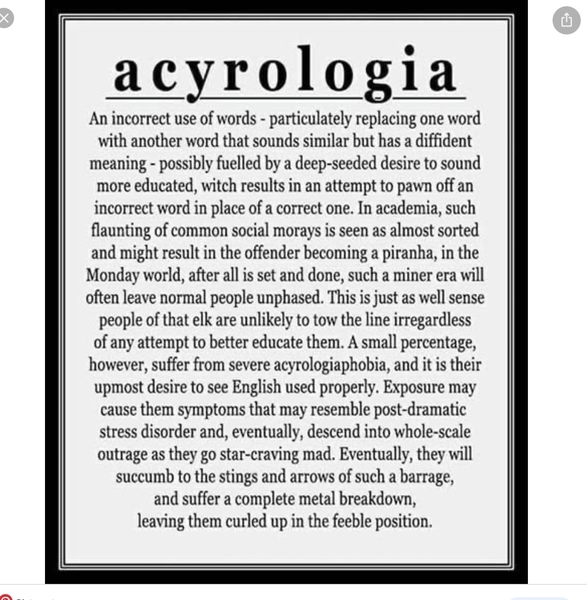
Thank you for the acyrologia, maw. Hilarious. I taught German and French at a secondary school in Hampshire. In our MFL department we often had visits from other subject teachers who wanted to check grammar points with us. When I started to learn English at the age of 10 the first book we were given was a book of English Grammar. I still have it. My English husband said he never had a grammar book. And he was in a grammar school...
I never had a grammar book as such, until I started teaching EFL - and that was a whole new world of things you don’t think about as a native speaker, or even as a learner of MFLs. Question tags, first, second and third conditionals….
But grammar was perfectly well taught - or absorbed, anyway, inc. via the learning of foreign languages, inc. Latin, which we all did for 2 years at my school. After that it was Classics, German, or extra English,
I still think a lot of correct usage may be absorbed by reading - and the books don’t need to be ‘literature’ - or by hearing it around you. It was my mother who told me how to tell when ‘I’ should be ‘me’ as in e.g. ‘between you and I’ and she was someone who often regretted that she hadn’t been better educated.
Some time ago a neighbour visited me. I offered her a cup of tea
Neighbour: I don't drink normal tea now. I prefer erotic tea.
Me: Umm...I've never tried that.
Neighbour: You should. It's very relaxing.
I still haven't tried it.
JackyB
Just what I was going to say, Maw.
I don't have any problem confusing them because the German differentiates and there is no way you can mix them up there.
"Legen" is pronounced "Lay-gen" and can only be used in conjunction with an object (including, of course, a reflexive pronoun). It describes a movement.
"Liegen" is the same sort of word as "stehen", to stand, sitzen, "to sit". They are intransitive and do not require an object. In fact, they just can't have an object, and stand alone.
Ich liege (I am lying (down)) is a complete sentence.
Ich lege (I am laying) requires something to finish the sentence.
What about 'ich lege mich hin' and 'ich setze mich hin'? I suppose the reflexive pronoun becomes the object or accusative case thus the transitive verb then has an object although you are performing the action on yourself. Fascinating language.
nightowl
No Maw it’s not, but I don’t know whether grammar is taught in schools now (though my daughter assures me it is)
As a former German teacher, I know the difference between transitive and intransitive verbs isn't taught in English. Pupils find "ich liege" and "ich lege mich" a struggle.
Chestnut
I love the acyrologia! But exactly how many errors does it contain.....? I can't be sure I have found them all, so is there an answer sheet?
*
I would like to see that, too. I am grinning from ear to ear after reading it but I bet I missed some. When you "hear" it in your head, some may seem right only because they sound right and the flow of the text lulls you into accepting the malapropisms.
I love the acyrologia! But exactly how many errors does it contain.....? I can't be sure I have found them all, so is there an answer sheet?
I forgave Bob Dylan more than fifty years ago…
Lay lady lay
Lay across my big brass bed
Message withdrawn at poster's request.
Thank you for the acyrologia, maw. Hilarious. I taught German and French at a secondary school in Hampshire. In our MFL department we often had visits from other subject teachers who wanted to check grammar points with us. When I started to learn English at the age of 10 the first book we were given was a book of English Grammar. I still have it. My English husband said he never had a grammar book. And he was in a grammar school...
I hate this too maw 🙄
I think one of the problems is that for some years both primary and secondary teachers have been the product of a system which was, shall we say, relaxed about grammar.
As a HoD and Head of House in my teaching career, one of my “jobs” was checking the termly or annual reports teachers had written. It was often an eye opener!
And in my MFL department I can remember inspired and gifted teachers among my colleagues who nevertheless sometimes floundered teaching French and German grammar because they lacked that foundation in their own language-English.
Finally, while firmly astride my high horse  my particular hate is people who speak in public- from politicians to local “dignitaries” or pundits, who try to sound more erudite by using “fancy” words - and all too often the wrong one.
Time to revisit “Acyrologia” ?
Baggs
American usage from 18th Century (so presumably British usage before that?):
Now I lay me down to sleep,
I pray the Lord my Soul to keep[;]
If I should die before I 'wake,
I pray the Lord my Soul to take.
Correct British usage as "lay" is used with an object, which should always be the case.
Here I (subject) lay (verb) me (object).
Gramatically the same as" I lay the book on the table." Or for that matter as "Hens lay eggs."
"Lie" does not take an object, so "I lie down for a nap in the afternoon" is correct where "I lie me down" would most definitely be wrong.
Me too, Maw.
I can lay myself down on the sofa for a nice little zizz any time.
No Maw it’s not, but I don’t know whether grammar is taught in schools now (though my daughter assures me it is) 
And the past tense of “lay” is “laid” as in “my hens laid three eggs last week while my cat lay in the sun.”
It’s hardly rocket science is it?
I think some of the confusion comes because ‘lay’ is also the past tense of ‘lie’ so you could say ‘I lay down last night’ and it would be correct.
My favourite to help differentiate the two verbs (only in the present tense though) is ‘even ducks don’t lay down’.
The humble apostrophe has a whole new life in the modern world Maw
Thank you JackyB in that respect French and German are more straightforward with clear reflexive verbs.
However the transitive/intransitive distinction should be enough. Sadly I fear it's too often a lost cause.
I hadn't appreciated how many people have little grasp of grammar or spelling (apart from tomato's potato's etc at the greengrocer's) until I started using social media like Facebook!
Perhaps I didn't emphasise the idea of "movement". If you are laying something somewhere, it - and you - are moving.
If you are lying, sitting or standing, you are static, not moving.
Just what I was going to say, Maw.
I don't have any problem confusing them because the German differentiates and there is no way you can mix them up there.
"Legen" is pronounced "Lay-gen" and can only be used in conjunction with an object (including, of course, a reflexive pronoun). It describes a movement.
"Liegen" is the same sort of word as "stehen", to stand, sitzen, "to sit". They are intransitive and do not require an object. In fact, they just can't have an object, and stand alone.
Ich liege (I am lying (down)) is a complete sentence.
Ich lege (I am laying) requires something to finish the sentence.
Registering is free, easy, and means you can join the discussion, watch threads and lots more.
Register now »Already registered? Log in with:
Gransnet »Get our top conversations, latest advice, fantastic competitions, and more, straight to your inbox. Sign up to our daily newsletter here.
