These kinds of threads keep coming up.
I checked the Daily Express article. It describes the state pension as a handout which rather sets the tone.
But it does clearly say:
For older state pensioners, the increase would be the same 4.1% rise, but on a smaller starting amount, as the older state pension pays a smaller total, currently £184.90 per week. *However, older state pensioners can also get now-defunct schemes such as the Second State Pension or SERPs, which younger state pensioners can't access.*
Sloppy reporting from a young journalist, Alex Evans whose background is in local news for regional papers and who is clearly not a pensions expert
For someone whose NIC record covers years before and after April 2016, their SERPS/SSP is taken into account in the pension calculation and part of it paid as a “protected payment” so they are no worse off under the new state pension system.
I and others have explained many times in great detail how the the old and new state pension systems work.
As DD said upthread, everyone’s pension will differ depending on how many years NIC they paid, how much they paid in graduation contributions, how much they paid into SERPS/SSP, whether they were in a works pension scheme that was contracted out, whether they inherited pension from a late spouse or civil partner and whether they deferred receipt of their pension.
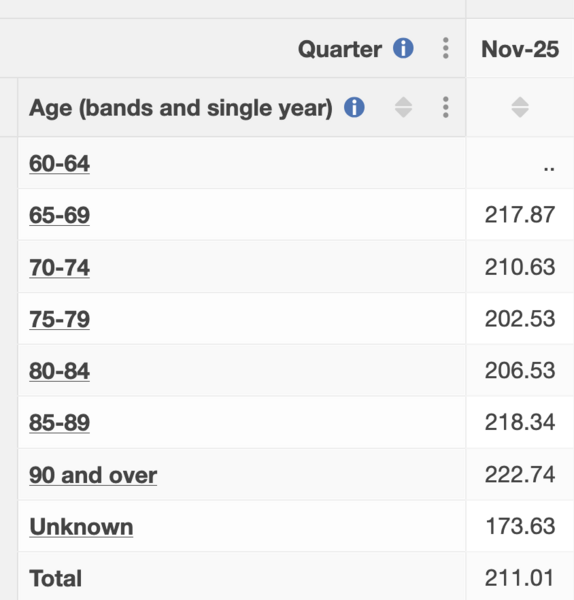
The government provides statistical data through Statxplore.
This is the latest based on November 2025 published in May 2026. The next update is due next month.
As you can see from the chart there is not much difference overall in the average pension paid to different age groups. The average pension paid last year to someone age 89 was £218.34 so about the same as the average pension paid to someone 69 which was £217.87.
In May 2025, 758,363 people on old state pension and 64,603 on new state pension had weekly pension above £300. By contrast, 636,311 old and 173,164 new got only £100 or less. 9030 people had a state pension more than £400 and 160 over £500. (Statxplore).
Percentage increases will always mean those with a lower staarting point receive a proportionately smaller increase. It's exactly the same for wages. If you only earned a pension (or wage) of £100 pw you are going to receive a smaller increase than someone who earned a pension (or wage) of £180 pw even if you are paid under the same system.