Gransnet forums

Ask a gran

No fun being old under Andy Burnham .

(80 Posts)
Sarnia Thu 20-Aug-26 01:29:21

Why has Andy Burnham said that older pensioners, those born before April 1950, will get a lower triple lock deal than those born after that date?

Older pensioners pay the same for a supermarket shop as younger pensioners so why the reduction?

I'm beginning to go right off him!

NotSpaghetti Fri 21-Aug-26 10:06:53

I'd like him to give more credit to his predecessor when policies have positive outcomes - such as the French agreement with small boats.

Burnham enjoyed quite a bit of praise regarding the smaller legislative body after reform of the House of Lords even though the legislative work wasn't his.

I wish he would just say - yes, the Labour Party under KS was working hard for this and that - and now we are starting to see the benefits.

I suppose it's the lack of humility that bothers me.
Very "Blair".

Doodledog Fri 21-Aug-26 10:54:03

I have high hopes for AB, too.

I would like to see papers like the Express and everyone who has circulated articles like the one under discussion be made to print a clear and obvious retraction. All they do is sow division and discontent - many people really believe that everyone on the OSP is worse off than anyone on the NSP, and resent it, yet this is just untrue.

(From Google) - Anyone reaching State Pension age on or after 6 April 2016 falls under the new State Pension system, which is far stricter regarding individual contribution records. The rules have changed in three major ways for women who didn't work:

1. No More Relying on a Spouse's Record
*The Old Rule*: Women born before 6 April 1953 could claim a basic pension increase or a partial pension purely based on their husband’s National Insurance (NI) record.

*The New Rule*: For younger women, the State Pension is based entirely on your own individual NI record. You can no longer claim or inherit a pension rate based on a living spouse's or civil partner's record. (Exception: The rare exception is if a woman specifically opted into the historic "Married Woman’s Stamp" reduced-rate election decades ago).

2. A Hard 10-Year Minimum Threshold
*The Old Rule*: Women under the old system could sometimes get a small pro-rata pension with fewer than 10 years of personal contributions.

*The New Rule*: Under the new system, you must have at least 10 qualifying years on your NI record to receive any pension at all. If you have 9 years or less, you get nothing.

3. More Years Needed for a Full Pension
Under the old system, women needed 30 to 39 qualifying years to get the full basic State Pension.Younger women under the new system need 35 qualifying years to receive the maximum full rate (which is £241.30 per week for the 2026/27 tax year).

The rules on inherited pensions and the State Earnings-Related Pension Scheme (SERPS) treat the two generations of women entirely differently.

Women born before 1950 (the Old State Pension group) enjoy generous, sweeping rights to inherit their deceased husband's state pension wealth. In stark contrast, younger women (the New State Pension group) face a heavily restricted system that has mostly eradicated direct state pension inheritance.

The basic pension inheritance rules differ completely between the two generations, with older women born before April 1950 able to inherit up to 100% of their late husband's basic State Pension to top up their own weekly rate, whereas younger women born after April 1953 receive 0% direct inheritance because the basic pension is completely individualised under the new system.

When it comes to SERPS and Additional Pension inheritance, older women receive a generous amount ranging from 50% to 100% of their husband's SERPS depending on his date of birth, while younger women face extremely limited rules where SERPS has been replaced, allowing them to inherit only 50% of a specific transitional "Protected Payment".

The Old System deliberately ran two parallel tracks. A person built up a foundational Basic Pension through NI years and added a completely separate, uncapped SERPS tier based on their career earnings.

This meant an older worker with high earnings could retire with a combined state payout far higher than the standard rate.

The New System completely abolished SERPS. It merged both elements into a single, flat-rate cash payment. No matter how much money a younger worker earns today, they cannot build up any extra state pension above the standard flat rate.

____________________________________

So yes - someone on the OSP who paid lower rate NI for fewer years will get less than her NSP equivalent who paid full NI for much longer. But when you take all of the other variables into account, the system does not discriminate against the older group - quite the reverse!

Casdon Fri 21-Aug-26 11:02:03

Why not open up the option for people on the old system to opt to pay back the six years national insurance contributions they missed by retiring at sixty, and then claim the pension at the rate for those who didn’t receive it until 66? Otherwise, whatever the government does isn’t fair to some.

BlueBelle Fri 21-Aug-26 11:17:39

Well I m very happy under Andy Burnham I like him and so far I think his ideas show a good start
I m old, 1945 and I m happy to get any pension, I worked till I was nearly 70 well 69 and a half to be more accurate and I m still working just not getting paid any more
My pension is what it is and as long as I can keep myself fed and clothed I m happy, life’s way too short to be mithering
(good old Suffolk word) about money

Graphite Fri 21-Aug-26 12:18:12

One of the fundamental issues of disparity in pension uprating is that only the basic pension is triple locked and earnings linked. The additional state pension (aSP) and other add ons are uprated by the Consumer Price Index (CPI).

You can read a history of pension uprating in this House of Commons Library briefing paper:

researchbriefings.files.parliament.uk/documents/CBP-7812/CBP-7812.pdf

In a Lords debate in 2020, Baroness Altmann question the fairness of not applying the earnings link to the additional state pension.

The then Tory Minister for Work and Pensions Baroness Stedman Scott replied, …

it is not possible to make direct comparisons between the two systems in this way … care has been taken to ensure fairness to both groups … some people may get a larger amount uprated by the triple lock but they will not have access to other elements of the previous system, for example a lower state pension age and the ability to build a higher state pension through the additional state pension.

... which is effectively what Doodledog has, quite rightly, said in her posts.

There was only 1% difference last year between CPI of 3.8% and wages growth of 4.8%, the latter used for this year’s basic pension increase and the former for the aSP. But in other years there has been a more marked difference between the two and that is what can cause a gap to open when comparing the newer single tier pension and the old two tier pension.

However, when you bear in mind that the additional state pension can be as much as £230.54 per week and that around 825,000 pensioners, around 760,000 of them on old state pension, receive more than £300 a week and some more than £400 you can see how expensive it would be to triple lock it.

It’s important to understand that when earnings related contributions were abolished from 6 April 2016 the rate of NIC remained the same at 12%. In other words the NIC that once paid for two tiers of pension, now pays for just a single tier pension but based only on the number of years of contributions. There is no longer an earnings-related component no matter what you earn.

In arriving at the rate for the new single tier pension from 2016, the government set it at a rate just above the basic level of means-tested support for single pensioners with no option to contract out of any part of it.

It was equivalent to 130% of the old state pension and still is.

2016 Old £119.30 v New £155.65 a difference of £36.35
2026 Old £184.90 v New £241.30 a difference of £56.40

In theory then, the difference for someone receiving old state pension is made up of additional state pension.

That £36.35 indexed it by the CPI for each year since 2016 comes to £50.60 so it isn’t far off the current difference, especially after tax - £4.40 to be precise.

The most problematic recent years have been 2023, when the CPI was 6.7% and wage growth 8.5%, and 2024 when CPI was 1.7% and wage growth 4.1%. The difference in 2024 was only 1%, CPI 3.8% wage growth 4.8%.

The government's aim in introducing new state pension was both to simplify it and to make it cheaper per capita to pay in the longer term once everyone with aSP or protected payments had died.

However, we know the number of pensioners is rising because baby boomers are reaching pension age. Around 750,000 new pensioners each year compared to around 600,000 dying, hence all the debate about the sustainability of the triple lock.

Which brings us back to to the argument about percentages because when you look at it per capita we are taking about peanuts. The triple lock this year gave an extra 1% above CPI. For the full new state pension,(which many do not receive anyway due to contracted our deductions or not having enough contribution years), that extra 1% equates to a post tax rise of at most £1.85 per week. Are politicians really arguing over a sum that wouldn’t even buy a decent loaf of bread?

Moreover, by the time some received that £1.85 in May 2026, and many less than that, it's a year after the wage growth that it's based on and the inflation that wage growth will have contributed too. Always playing catch up.


Cossy Fri 21-Aug-26 13:20:56

NotSpaghetti

I'd like him to give more credit to his predecessor when policies have positive outcomes - such as the French agreement with small boats.

Burnham enjoyed quite a bit of praise regarding the smaller legislative body after reform of the House of Lords even though the legislative work wasn't his.

I wish he would just say - yes, the Labour Party under KS was working hard for this and that - and now we are starting to see the benefits.

I suppose it's the lack of humility that bothers me.
Very "Blair".

I see that too, though I do like what I’ve seen of him thus far

NotSpaghetti Sat 22-Aug-26 10:29:42

I do accept him Cossy - just not sure I like him.
...but I don't actually have to - and do hope he's successful.

Emeraldforest Sat 22-Aug-26 15:07:13

I think AB is very promising as a PM.He's very ambitious, almost worryingly so,but I think he's committed to doing as good a job as possible.

jomo Sun 23-Aug-26 13:47:30

Wow how hetup do oaps get 😒 🙄 it's been less for older oldies for ages I got a Sil who's pension is about £400.00 more a year then either my hubby or me .
That's the way it goes kill off the older ones first I think 🤔 then they get more in the kitty 😺 wrote with tongue in cheek before I upset anyone !!!

.

Cossy Sun 23-Aug-26 13:51:03

jomo

Wow how hetup do oaps get 😒 🙄 it's been less for older oldies for ages I got a Sil who's pension is about £400.00 more a year then either my hubby or me .
That's the way it goes kill off the older ones first I think 🤔 then they get more in the kitty 😺 wrote with tongue in cheek before I upset anyone !!!

.

👍👍🤣🤣🤣🤣

Sewingpruso Sun 23-Aug-26 14:31:09

I'm 81 and paid all my working life (30 years+) but my pension is still less than my husband...Grrrr!

ordinarygirl Sun 23-Aug-26 14:41:31

it is nothing to do with Andy Burnham - the "new pension" scheme was in place before he became PM

StoneofDestiny Sun 23-Aug-26 15:30:08

A true Marxist

😂😂😂😂😂😂😂😂

Nurseundercover Sun 23-Aug-26 15:47:12

Why is it that the politicians review pensions as a hand out? I certainly don’t when I have paid into the system since the age of 15 and worked hard.
With regard to our current self appointed prime minister, the thing that irritates me is when he’s speaking he keeps say “I will” but there’s no I in the party, surely the political parties are teams. Wouldn’t it be wonderful if all political parties would work together for the greater good of the country and most importantly its people.
Would that be too hard to do?

Milest0ne Sun 23-Aug-26 16:09:58

I think I am going to ask AGE UK to help me query my pension which isn't even a basic state pension. Every thing is very confusing

greyfur16 Sun 23-Aug-26 16:18:25

BlueBelle

Well I m very happy under Andy Burnham I like him and so far I think his ideas show a good start
I m old, 1945 and I m happy to get any pension, I worked till I was nearly 70 well 69 and a half to be more accurate and I m still working just not getting paid any more
My pension is what it is and as long as I can keep myself fed and clothed I m happy, life’s way too short to be mithering
(good old Suffolk word) about money

Always thought "mithering" was Yorkshire. Anyway it's fir for purpose!

Alison333 Sun 23-Aug-26 16:41:37

Whitewavemark2

eazybee

I'm beginning to go right off him! ??

I have been off him since he forced his way into being Prime Minister.
His aims are deliberately divisive: North against South, old against young, working against middle class, feckless against responsible.
A true Marxist.

😄😄😄

Hilarious! Where is this coming from?

WithNobsOnIt Sun 23-Aug-26 18:19:49

I was never really on him tbh.
The new Emperor who tries to gain influence and curry favour. With silly half arsed offers and policies that nibble around the edges.

And do not address the real serious problems that our country is facing.

Also likes to spend half the week lording it in Manchester like the Ancients Greeks and Romans.

Which has become the new Athens of the North.

petra Sun 23-Aug-26 18:30:51

Alison333

Whitewavemark2

eazybee

I'm beginning to go right off him! ??

I have been off him since he forced his way into being Prime Minister.
His aims are deliberately divisive: North against South, old against young, working against middle class, feckless against responsible.
A true Marxist.

😄😄😄

Hilarious! Where is this coming from?

You’ve seen so much in a short space of time.
Have you thought about fortune telling as a side hustle.

Browncow1 Sun 23-Aug-26 18:56:50

Casdon

Why not open up the option for people on the old system to opt to pay back the six years national insurance contributions they missed by retiring at sixty, and then claim the pension at the rate for those who didn’t receive it until 66? Otherwise, whatever the government does isn’t fair to some.

Casdon. If you receive the old pension, you will have received six years of pension more than me. I retired at 66, and therefore missed out on tens of thousands of pension money, maybe up to £60,000 in total including some SERPS. It is women like me who are paying indirectly towards the new state pension. Want to give back your six years pension? No, I thought not.

Casdon Sun 23-Aug-26 19:44:17

I am on the new pension Browncow1, I don’t think you understood what I was meaning?

To compensate us for the six extra years of work we did is impossible, but I think if people on the old scheme want to be on the new scheme, they should be allowed to pay the national insurance contribution for the six years of work they didn’t do. I know that wouldn’t take into account tax those of us who worked longer paid, so it’s not an exact science, but there is no way of achieving a completely fair system.

Doodledog Sun 23-Aug-26 19:45:12

Casdon will correct me if I am wrong, but I think she is suggesting that if those complaining that their old pension is automatically less than the new one (which is patently untrue) could rectify that if they paid back the six extra years, relinquished any SERPs or inheritance and instead got the percentage of the new pension based on the full contributions they personally made (pro rata if they paid the married woman's stamp), there would be few takers.

I am inclined to agree with her.

I also think that there would be an outcry from those who have had a significantly higher pension than the NSP for decades if they were expected to give it up or pay it back. My mother didn't work until all her children had left school, but she gets a lot more than I do (and I worked from 16 to retirement with two 6 month maternity leaves, and had to repay contracted-out contributions to get a full NSP) because she paid as much as possible into SERPS and inherited my father's SP as well as claiming her own. I paid higher rate tax, but didn't have the opportunity to get a higher rate pension as a result. Mum also gets my father's occupational pension, which is entirely separates (as it should be).

There is a huge discrepancy between our respective incomes, and I am the one who worked - I don't begrudge her, but only because she is my mother, and there is no way that it is a fair system. It irritates me to keep hearing how unfair to older pensioners the system is - the reverse is true, IMO.

Casdon Sun 23-Aug-26 19:46:18

Thanks Doodledog, that’s a much better explanation than mine!

Browncow1 Sun 23-Aug-26 20:31:09

Sorry Casdon. I misunderstood what you were trying to say in your post, and assumed that you were on the old state pension and having a moan at the higher rate of the NSP for newer retirees.
Yes, some older pensioners can get much higher amounts on the old state pension as Doodledog has stated in her posts.
Thanks to both of you 😀

Graphite Sun 23-Aug-26 20:39:48

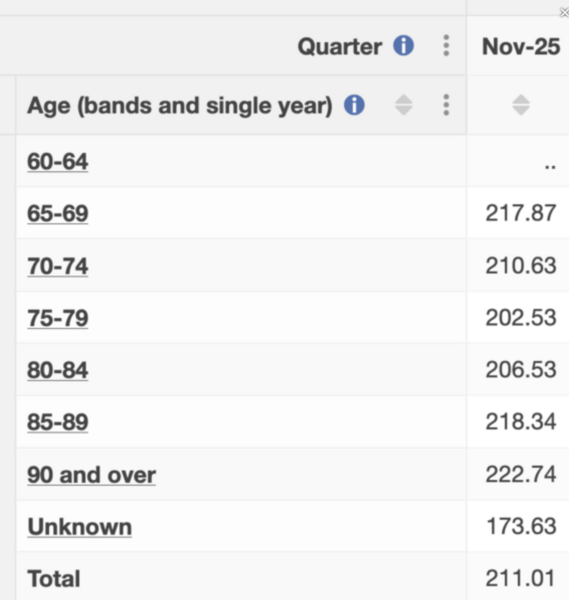
It’s worth reposting the DWP’s statxplore chart I posted upthread to show there’s little difference in the average weekly pension across the age ranges. That’s from last year so all of these numbers will have increased a little. (The next analysis is due next month.)

You could say broadly that the oldest pensioners are more likely to have had years when they were less likely to be in a works pension scheme (so no contracted out deductions for SERPS/SSP) and/or they have inherited pension.

The younger ones may have some post April 2016, post SERPS/SSP NIC contributions which can “burn off” contracted out deductions for pre April 2016 years if they have more than 35 years of contributions.

The oldest women in the new scheme are now or approaching 73 and men 75. They were receiving on average £210.63 per week compared to the then full rate of £230.25

Compare the then full rate of £176.45 of the old scheme. All older age groups were on average receiving more.

What does that tell us?