'Cause typos, I expect you get the drift.
Would you make the deal? Let’s talk about Dorian Gray.


Has anyone been following the investigation by The Times into the full scale of Coca-Cola’s funding of scientists?
It would appear that this funding has been used to influence research, and the extent of this has come to light after the government rejected a tax on sugar sweetened drinks, despite support from Chief Medical Officer Dame Sally Davies, the British Medical Association and TV chef Jamie Oliver.
The drinks firm is said to have links to more than a dozen British scientists, including government health advisers, who counter claims that its drinks contribute to obesity
Coca-Cola is said to have provided support, sponsorship or research funding to a variety of British organizations including UKActive, the British Nutrition Foundation, the University of Hull, Homerton University Hospital, the National Obesity Forum, the British Dietetic Association, Obesity Week 2013 and the UK Association for the Study of Obesity.
Through its trade organizations, Coca-Cola representatives have met government officials and ministers more than 100 times between 2011 and 2014, according to The Times. Coca-Cola is also said to host a parliamentary dinner.
Faculty of Public Health board member Simon Capewell accused Coca-Cola of trying to mold public opinion.
“Coca-Cola is trying to manipulate not just public opinion but policy and political decisions. Its tactics echo those used by the tobacco and alcohol industries, which have also tried to influence the scientific process by funding apparently independent groups. It’s a conflict of interest that flies in the face of good practice,” he said.
New York-based nutrition researcher Marion Nestle warned scientists should not take money from Coca-Cola.
“In my opinion, no scientist should accept funding from Coca-Cola. It’s totally compromising. Period. End of discussion,” said Nestle, a professor of nutrition, food studies and public health.
Quotes taken from The Times
'Cause typos, I expect you get the drift.
Excuse typos b****y iPad
Of course not Mamie. I agree we shouldn't just focus on children either but you have to start early so it becomes a lifestyle choice. How many chubby/overweight children do you see with thin parents? Very few or none I would guess. If however we could teach the children then we could break the cycle.
I understand that some things are in place to help with the problem, but not only is it not enough, there is not a cohesive approach. It's all just a drop in the ocean, a token gesture. The obesity problem needs to be near the top of the government's agenda simply because of how many ways it impacts on every day living in this country. It's costing millions now and will only cost more the longer it goes on. And there's the nub. The government would have to take on the food industry and the food chain - and it has no intention of doing this because there's too many vested interests.
We need the government to appoint someone like Gerry Robinson to head up an initiative to put in place a strategy to tackle the obesity problem. Or even to spearhead a campaign for change.
I know local authorities are strapped for cash. I know we're supposed to be under austerity measures. But on this thread we are talking about big companies being involved in scientific research and the negative impact of the food industry on the daily lives of people in this country. At the moment this government has no appetite for change because it would be biting the hand that feeds them. All puns intended.
The prevalence of obesity among health workers doesn’t appear to be significantly different to the general population, so I don’t think that education is going to make any difference at all. If working with diabetic amputees doesn’t motivate people, nothing will. People know full well what they need to do, they just don’t want to do it.
Politicians with the power to address the issue are also no less overweight than the general population either, and turkeys don’t vote for xmas. There might be some action if there were enough thin voters fed up of taxes subsidising obesity, but as the number of obese patients grows the number of thin voters diminishes.
The main problem is the lack of exercise, we already eat far less than in the past. Manual workers didn’t live off 2500 calories a day, navvies were eating about 8000 calories. I don’t buy the supposed equivalence between exercising more and eating less either, they are from the point of view of energy balance, but viewed in terms of the stimuli to the body they’re complete opposites. It’s far easier to lose weight by exercising, and for good reasons I think.
Wilma there are loads of people who get appointed to investigate all sorts of issues, but if the conclusion isn't what the government wants to hear the report just gets stuffed down the back of the filing cabinet.
Mamie if obesity is the point at issue, then only calories are relevant. Fat is a store for energy contained in excess food, and the calorie is a unit used for measuring the amount of energy in food.
Crun, there is a wealth of evidence to support the sustained and significant weight loss of people on low-carb diets without increased exercise. You won't read much about it because it doesn't suit the food industry. Exercise to keep fit is obviously still very important.
I don't want to derail this interesting thread though.
I think your point about overweight and obese health workers is very pertinent and exemplifies the difficulty of the task.
crunyou are making my point - the government has no appetite for seriously tackling the problem.
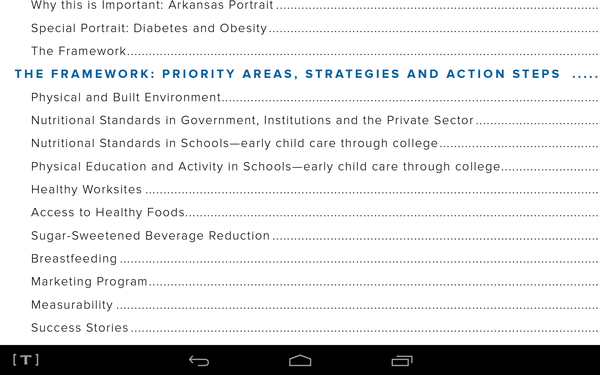
By coincidence I just read an article about Arkansas in the USA. It has just launched a 10 year plan called Healthy Active Arkansas to tackle obesity. It has the highest obesity rate in the USA. After just skimming the plan, it looks like the sort of framework we need in the UK. I have taken a screen shot of the framework outline so posters can see it covers everything mentioned here and more.
This is the link in case anyone wants to see the plan.
www.nwaonline.com/documents/2015/oct/14/healthy-active-arkansas-plan/
If you research information about losing weight, there's a wealth of evidence now that shows exercise is good for our health, but not essential for weight loss. Even at somewhere like a Slimming World class you are told whether or not you increase your activity, you will lose weight by following the plan, but you will lose weight more quickly if you do.
Wilma I'm not arguing that you can't lose weight by eating less, I'm suggesting that eat less and exercising more are not equivalent because the body has evolved to adapt to it's environment, and the two stimuli are opposites.
If you exercise more, that's a stimulus for your body to increase it's metabolic rate in order to provide the extra energy to fuel the exercise. If there's no extra food forthcoming, then your body will be forced to burn fat to make up the shortfall.
However, if you eat less, that's signalling to your body that there's an impending famine, and you will survive longer if your body can reduce it's metabolic rate as much as possible before it starts burning fat reserves. There's plenty of scope for your body to reduce your metabolism if you do no exercise, and so I think you will become less fit before you lose any weight. If you react to this by becoming less active, then you just descend into a downward spiral.
I have a record of my daily exercise and calorie intake for the last 13 years, and I think I can see this happening. During periods when I have been unable to exercise for health reasons, I have found that eating less just makes me weak, cold, and fatigued, but most of all my leg muscles get so painful I become even less active. Hence the downward spiral, and I lose no weight.
By contrast, when I have been able to return to exercising I have found that the weight falls off easily even though I'm eating hundreds of calories more. In 2008/2009 I was losing weight at 1.1kg/month on a calorie intake of 3100kcal/day, after a period when I had previously been gaining weight on 2600kcal/day.
Clearly people do lose weight by eating less, I just think that's the hardest way to go about it. People who take up exercise always comment on how much better they feel, and how the weight seemed to drop off without them even noticing. On the other hand, people who are endlessly dieting are always complaining how hard it is, and how they can't keep it up for very long. I've seen research quoted that those who do succeed in losing weight have all put it back on again within 5 years.
I haven't changed my exercise regime Crun (gardening, walking, swimming, keep fit, adult ballet) but have lost over three stone (now down to under 9 stone) by low-carbing over eighteen months.Weight has been stable for six months, cholesterol down, BP down, blood sugar down. Not a diet, just a way of eating that doesn't include refined sugar, potatoes, bread, rice or pasta. No calorie counting ever. Plenty of good fat, butter, olive oil, cheese, milk, meat, fish, masses of veg and some fruit. Real food cooked at home. Not hard at all and no problem sustaining it. OH has lost four stone, got out of pre-diabetes, off statins and is much fitter all round.
Sincere apologies to those who have heard all this before, but this is the diet that the processed food industry and the sugar lobby don't want to talk about. I think it is relevant to the thread.
mamie I agree with your post and crun I understand how dieting works, I just don't agree with your statement -
It’s far easier to lose weight by exercising, and for good reasons I think.
No one is saying exercise is not good for you or that it doesn't makes you feel better (through endorphins). I'm glad you found a way to keep your weight steady.
Yes, both eating less and exercising more can have an effect on how much energy your body needs, but the source of that energy is crucial. If you exercise a lot without eating a healthy diet you can still lose weight, but it doesn't necessarily mean you have a healthy body.
Please excuse the length of this post, but it does fit in with the OP
A recent report in the British Journal of Sports Medicine stated evidence now suggests that up to 40% of those within a normal weight (BMI) range will still have harmful metabolic abnormalities typically associated with obesity.
The authors of the report (including a British Cardiologist) describe the public relations tactics of the food industry as chillingly similar to those of Big Tobacco, which deployed denial, doubt, confusion and 'bent scientists' to convince the public that smoking was not linked to lung cancer.
Fittingly given the OP of this thread the report's authors also say
Celebrity endorsements of sugary drinks and the association of junk food and sport must end...
...health clubs and gyms need to set an example by removing the sale of these products from their premises. The health halo legitimisation of nutritionally deficient products is misleading and unscientific...
...Public health messaging has unhelpfully focused on maintaining a healthy weight through calorie counting, but it’s the source of the calories that matters...
...Sugar calories promote fat storage and hunger. Fat calories induce fullness or satiation. The prevalence of diabetes increases 11-fold for every 150 additional sugar calories consumed daily, compared with the equivalent amount of calories consumed as fat...
...And the evidence now suggests that carbs are no better. Recent research indicates that cutting down on dietary carbohydrate is the single most effective approach for reducing all of the features of the metabolic syndrome and should be the primary strategy for treating diabetes, with benefits occurring even in the absence of weight loss...
...The food environment needs to be changed so that people automatically make healthy choices. This will have far greater impact on population health than counselling or education. Healthy choice must become the easy choice...
...It’s time to wind back the harms caused by the junk food industry’s public relations machinery. Let’s bust the myth of physical inactivity and obesity. You can’t outrun a bad diet.
In 1975 John Yudkin wrote a book called Pure White and Deadly. I read it then but unfortunately forgot it. It has been republished and it certainly makes clear that sugar is not just harmless empty calories.
It causes far more illness than alcohol and we dont give alcohol to children after all.
Still catching up with this thread as I've been travelling all day but I came across the call for a clear message about healthy eating. Erm... I have felt harangued with very clear messages about healthy eating (some of which I disagree with) for years and I don't even have a telly, nor do I listen to the radio much, so I'm a bit puzzled that other people feel they haven't received these clear messages. How have they missed them?
elizabethb John Yudkin's book was mentioned earlier and I was thinking about buying a copy. But although it gets good reviews, lots of reviewers say it's not easy to read because of its academic style. Can you remember what it was like to read?
thatbags what makes you think people missed the messages?
Because, wilmak, I'm wondering why would anyone still be asking for clear messages about healthy eating if they hadn't missed the last few years' couple of decades worth of clear messages?
There's a difference between hearing the message and knowing what to do about it. Why do you think there's an obesity epidemic?
I think there's an obesity epidemic because, on average, we eat too much.
Food is, relatively speaking, cheaper and more easily available (in developed countries at any rate) than ever before and we have access to far more all the time than ever before. As a species we have not learned yet how to adapt to this.
Irresponsible people who overeat cost you and I millions of pound a year
and responsible sick people face long delays on hospital waiting lists
because of them.
Oh dear susan2014 I really don't like that way of thinking at all. Who is it that determines what is responsible or irresponsible?
Smokers and drinkers cost the NHS a lot of money, as do people who have a lot of children, people who live too long, people who are born with illnesses, disabilities, people who have inherited conditions, people who have been in car accidents.......... Where do you draw the line?
The problem is partly, Bags that people have been hearing the wrong message for years. The research of Ancel Keys on the effect of fats in the body seems now to be accepted as having been seriously flawed. That led to the "low-fat" commercial response (loved by the food industry because lots of money could be made from it) that added hidden sugars to many everyday foods.
This is what happened to Yudkin....
www.telegraph.co.uk/lifestyle/wellbeing/diet/10634081/John-Yudkin-the-man-who-tried-to-warn-us-about-sugar.html
I draw a line between people who are born with a disability or acquire and illness or are involved in an accident, and those who have brought on conditions such as lung cancer or obesity through a lifestyle they chose.
As others have said people need to accept responsibility for themselves.
The relationship between lung cancer and smoking is well established now. So I think is the relationship between serious overeating and obesity surely?
Registering is free, easy, and means you can join the discussion, watch threads and lots more.
Register now »Already registered? Log in with:
Gransnet »Get our top conversations, latest advice, fantastic competitions, and more, straight to your inbox. Sign up to our daily newsletter here.
