

It doesnt matter to me at all. I find the words be kind as meaningless as stay safe. I think 'kindness' often does untold damage.
Gransnet forums
News & politics
the law as it stands on sex
(1001 Posts)I think we should look at the law and stop fuffing about.
A transwoman can rape a woman a transman cant. In law rape is only about penises not gender.
However presently in law gender trumps sex, as a person with a penis is legally a woman if they say they are a woman with some checks. That is the law now. That is why the NHS has changed rules, the police the courts and lavatories and sport and girl guides, everything follows from a law change.
All political parties now wish to push this further and declare that checks are hurtful to people with penises who feel they are women and they should be legally declared women if they say so (self-ID) and be able to access all safeguarding previously, since time immemorial, has protected people without penises from those that do. For obvious reasons.
This is incredibly important and must be discussed openly and fully without fear or favour.
No trisher it is wrong to say that woman has meant in practice the people who present as women and has always encompassed some women who aren't female.
There's no such thing as a woman who isn't female, they don't exist. Women does not encompass TW, it never has and it never will, which is why we have the definition TW.
I suggest you get over it.
I agree with Galaxy. I think it is lazy speech that is used to keep women 'in their place'.
It means nothing apart from 'don't have an opinion, or if you must have one don't express it if it is anything other than affirming. Nobody ever says it to men.
Actions speak louder than words so when it comes to being 'kind' there are very few if any examples of trans activists and their allies being kind to women, as those women in the public eye who have been abused can attest too.
VS your post at 10.54 is one of the most patronising I've seen in a while. I'm sure Doodledog isn't in need of your advice regarding kindness.
Maybe it would help you to think about how you could be more kind, or where this feeling is coming from.
Not everyone cares about being kind, especially if they are angry but it obviously does matter to you. Or at least, it appears that way.
Also definitions of words do change
The origins of the word "woman" means something like "wife-man" if I remember rightly
So we took the word woman and we claimed it for ourselves by changing its meaning as we are far more than wives or servants if unmarried or just a bunch of wife-men washing their underwear for them in a river aren't we?
So if we can change the definition once it may be done again if we so choose to include tran women and, wait, we are all already doing so.
In actuality almost everyone on these threads does use "trans woman" when the meaning there is to cross over into a woman and acknowledges they are becoming or have become women.
So the meaning has changed and everyone here has knowingly or unknowingly allowed that already...
But what alternative is there that wouldn't be directly harmful to trans women, that wouldn't be hurtful or insulting or rude?
Maybe it's best to keep that neutral because science hasn't discovered everything there is to know about biology, there is already evidence that suggests the brain may develop in a different way to the body and it is still entirely possible where you see a man, there is a woman on the inside trying to force her way out of a prison that is everything a woman doesn't want to be.
Rosie51
I wasn't being patronising at all...
I was being genuine, you do not get to tell other people who they are.
When one person or a group of people get together and decide who someone else is, they create a monster only they can see.
You are wrong and I am not patronising anyone.
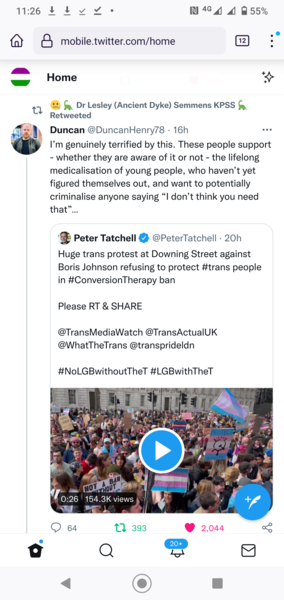
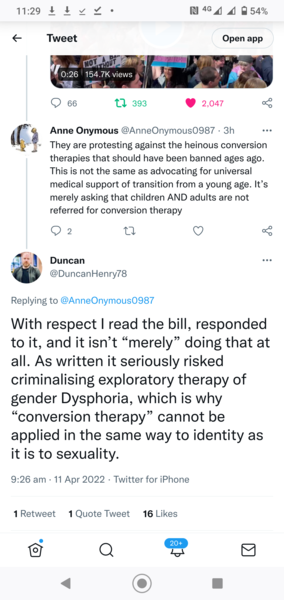
"I read the bill, responded to it, and it isn’t “merely” doing that at all. As written it seriously risked criminalising exploratory therapy of gender Dysphoria, which is why “conversion therapy” cannot be applied in the same way to identity as it is to sexuality."
mobile.twitter.com/DuncanHenry78/status/1513218699347566593
I talk about transwomen I suppose, I do not for one moment think they are any type of women. Maybe I should stop.
Thanks, Rosie.
I don't think I am unkind - I just disagree with VS.
I'm not too bad at rising above passive aggressive sniping though - I look on it as unkindness thinly disguised as caring.
Also definitions of words do change but trisher was insisting that the definition of woman has always included transwomen because it signified gender identity not sex which is patently untrue. As mentioned upthread it seems a tactic of trans issues, self confessed by a transwoman, that 'in some special contexts, we can lie' The meaning of the word woman would appear to fill that criteria to some.
VioletSky
Rosie51
I wasn't being patronising at all...
I was being genuine, you do not get to tell other people who they are.
When one person or a group of people get together and decide who someone else is, they create a monster only they can see.
You are wrong and I am not patronising anyone.
I'm not passive aggressive either or sniping
Words come from many origins, particularly in a language like English, which has linguistic contributions from wave after wave on inhabitants. The French for woman is "femme" -which looks and sounds far closer to female than does the English "woman". Do posters living in France find there is less or more confusion between the definitions of biological and trans "femmes" that exists here?
' . . . it is still entirely possible where you see a man, there is a woman on the inside trying to force her way out of a prison that is everything a woman doesn't want to be.'
Err, what?
Realistically if the origin of woman is wife man, then we eventually refused to be categorised by sex and we stopped letting others define our gender role... So it really doesn't matter
Did a woman rewrite that definition?
The language aspect interest me too. I always thought that in our language a woman is a man with a womb. wo=man.
In hebrew man' is an 'ish', woman is an 'isha'. The postfix 'a' converts male to female.
So it seems humans are all the same creation, with variations, according to our purpose. But distinguished from other animals by our power of speech.
Fennel
The language aspect interest me too. I always thought that in our language a woman is a man with a womb. wo=man.
In hebrew man' is an 'ish', woman is an 'isha'. The postfix 'a' converts male to female.
So it seems humans are all the same creation, with variations, according to our purpose. But distinguished from other animals by our power of speech.
I like that, we are all so very different and we don't stop being a woman if our wombs don't function or they are removed.
"adult human female" is far too constricting to those of us who don't want that role in carrying babies or following what we are told biology dictates for our future.
We aren't animals we don't have biological needs we cannot control
No thanks I dont want to be seen as a default man.
VioletSky
VioletSky
Rosie51
I wasn't being patronising at all...
I was being genuine, you do not get to tell other people who they are.
When one person or a group of people get together and decide who someone else is, they create a monster only they can see.
You are wrong and I am not patronising anyone.I'm not passive aggressive either or sniping
And I didn't say that. Bit angry are we, has the kindness gone away?
Just be Galaxy then, how often does anyone call you a woman anyway?
You don't have to define or label yourself or let anyone else do it.
I'm all over not letting people tell me who I am these days.
I can 'be' and argue the point VS. I am afraid that labels in certain cases are vital for the functioning of society, its why we can say an adult isnt allowed in the under 8 football team etc etc.
In actuality almost everyone on these threads does use "trans woman" when the meaning there is to cross over into a woman and acknowledges they are becoming or have become women.
No I do not acknowledge they are women, they are transwomen, who should live their lives in safety just like every other human being, while acknowledging they have not changed sex so those restrictions remain. That was probably the cleverest thing the trans ideology people did, the choice of nomenclature. Earlier so many people thought a transwoman was a woman who transitioned to a man. There are countless posts on social media where people got it the wrong way round. Perhaps the more accurate trans-identified male should be used instead? Seems a bit harsh but if it's needed for honesty?
"Wyfe" - the first half of your"wyf-man" - meant "female" on its own, and that was any woman, whether she was married or single. Chaucer's "Wife of Bath" was a woman of Bath (though she had had five husbands since the tender age of twelve - and buried them all) A "wife" in Scots still means any woman as well as a female spouse.
"Just as “history” is not derived from his + story (or as some pun, her + story), as folk etymology would have it, neither is “woman” from womb/woe/wee + man.
The early Old English (OE) wif – from the Proto-Germanic wibam, “woman” – originally denoted a female, and later became the Middle English (ME) wif, wiif, wyf.
By 1175 it was starting to be used to mean a married female, with the two meanings coexisting until the late 16th century. Another meaning of market trader or saleswoman emerged in the late 14th century, which survives in such sayings as “to swear like a fishwife”. "
www.scmp.com/magazines/post-magazine/short-reads/article/3052639/where-word-woman-comes-and-how-it-has-evolved
I know you didn't say that Rosie
But it was more of a general truth announcement
Also I'm not angry at all.
Do you think it is ok to tell others who they are and how they feel?
If someone was doing that to you, what might happen if you believed them?
If someone was doing that to you, would that be a relationship you are safe in?
Think about it...
Anyway. Definitely not angry, just a bit sad really and that's a sign to go be happy elsewhere
Is it Ok for transactivists to tell abused women who have sought sanctuary in a women's refuge that they are not allowed to feel that they are not safe if men (even ones who say they are women) are allowed to live there? Are the feelings of women less important that the feelings of trans women?
This discussion thread has reached a 1000 message limit, and so cannot accept new messages.
Start a new discussion
