Gransnet forums

News & politics

Junior doctors strike

(407 Posts)
Daisymae Mon 10-Apr-23 08:17:49

4 days from tomorrow. Trusts are getting GPs in to cover A&E for up to £200 per hour. Seems that the government are hoping that this action will see support for the doctors to dwindle. I feel conflicted but I don't see the government pulling out all the stops to prevent this and the inevitable suffering and loss of life. A lot of people are unaware of the action and probably won't care until they are personally affected.

Siope Fri 14-Apr-23 11:28:36

The Greek healthcare system (about which I could bore for England, but won’t) means that, provided someone is registered with the state healthcare system, EOPYY, they can see an EOPYY doctor for free or at a reduced cost and with a referral can get free hospital care. And health insurance is regulated and managed to support, not undermine, state healthcare.

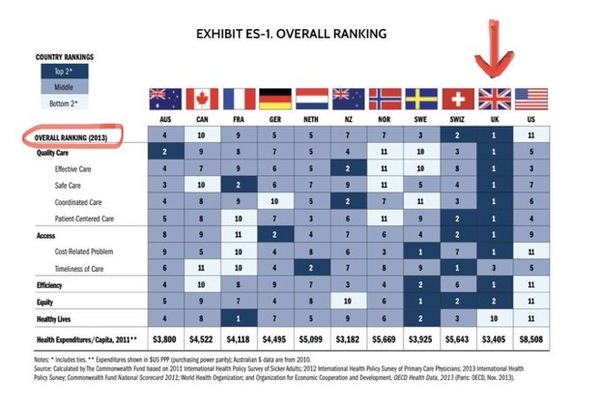
Reminder that, 10 years ago, the NHS was independently ranked the No 1 healthcare system in the world. Political ideology is what has changed this, not affordability.

Siope Fri 14-Apr-23 11:39:11

growstuff

Maybe those patients who consistently miss appointments and/or cancel without adequate notice could be fined or "struck off", but why should everybody else pay for them?

Because universal healthcare has to be universal. Excluding one behaviour that costs the NHS money for no ‘good’ reason is the wedge to excluding all sorts of behaviour that someone could deem unnecessary or inappropriate.

I know hospitals do remove no-show, no-explanation patients from treatment plans and/or bump them back down waiting lists where clinically feasible, but doing so can cause bigger, more expensive to treat problems.

DaisyAnne Fri 14-Apr-23 11:40:20

ronib

Callistemon21

^There is enough money in the economy to pay for a decently run NHS^

This
I have said that several times.

There is no will to do so.

King’s Fund points out that we spend more than the EU average on health apart from Germany, France, The Netherlands and one other country. Bit puzzling.

Amanda Pritchard insists that the Nhs delivers value for money spent - Nhs is wonderful talk to conference members for ‘we are the Nhs’ available on YouTube.

Something like 3.8 per cent uplift each year in spending? Or thereabouts…up from 1.5 per cent.

It’s beginning to feel that the Nhs needs double the amount spent on it ? Time to rethink the whole concept?

These are also from the Kings Fund report.

Our analysis of health care spending in 21 countries shows that the UK has fewer doctors and nurses per head of population than almost all the other countries we looked at. Only Poland has fewer of both.

Of the countries we looked at, only Denmark and Sweden have fewer hospital beds per head of population than the UK, while the UK also has fewer beds in residential care settings than comparator countries. While lower numbers of hospital beds can be a sign of efficiency, the growing shortage of beds in UK hospitals indicates that bed reductions in the NHS may have gone too far.

Although costs are rising, the UK spends less on medicines than most of the countries we analysed. A key reason for this is the success of initiatives to improve the value of expenditure on medicines, such as encouraging the use of generic drugs.

Under the Organisation for Economic Co-operation and Development (OECD)’s new definition of health spending, the UK spends 9.7 per cent of gross domestic product (GDP) on health care. This in line with the average among the countries we looked at but is significantly less than countries such as Germany, France and Sweden, which spend at least 11 per cent of their GDP on health care.

Your "fact" drawn from the King Fund report is simply not what they are saying. Quotes would be more acceptable then we can make up our own minds rather than being fed very biased comment.

DaisyAnne Fri 14-Apr-23 11:42:11

Reminder that, 10 years ago, the NHS was independently ranked the No 1 healthcare system in the world. Political ideology is what has changed this, not affordability. Siope Fri 14-Apr-23 11:28:36

I don't think we can say this too often.

growstuff Fri 14-Apr-23 11:58:22

Siope

growstuff

Maybe those patients who consistently miss appointments and/or cancel without adequate notice could be fined or "struck off", but why should everybody else pay for them?

Because universal healthcare has to be universal. Excluding one behaviour that costs the NHS money for no ‘good’ reason is the wedge to excluding all sorts of behaviour that someone could deem unnecessary or inappropriate.

I know hospitals do remove no-show, no-explanation patients from treatment plans and/or bump them back down waiting lists where clinically feasible, but doing so can cause bigger, more expensive to treat problems.

I agree. I wasn't being entirely serious. If a patient does consistently miss appointments, maybe he/she could be contacted and asked why and maybe given a bit of a telling off if there wasn't a good reason. I wonder what percent of total NHS expenditure is accounted for by DNAs.

DaisyAnne Fri 14-Apr-23 12:00:29

Doodledog

This is nothing to do with the doctors' strikes. A plumber's charges are not his 'pay'. He will be charging for offtakes, NI, tax, wear and tear of equipment, transport, maybe premises, an accountant, insurance and goodness knows what else before he or she gets anything for him or herself. Doctors, in common with most other employees, are paid after their employers have factored all of that in.

The 'who is more valuable?' debate is massively complicated, and like pretty much everything is political. IMO (as a believer in a large but liberal state) we, collectively, should pay for all training and education for anyone who can benefit from it, and in the case of those whose careers are (or can be) in the public sector this should be in return for a pro-rata contract with the trainee that they will work for a pre-arranged period of time in the role for which they've been trained at a pre-agreed and index linked rate which is clear to both parties at the time of starting the training.

Those going into private sector careers could have additional taxes until their training is paid for. I would have no differential between expensive and cheaper courses - training would be at a flat rate to the trainee, so an engineer who needs expensive equipment to learn on would be paying back no more than someone whose course is book-based and cheaper to teach. I would make it prohibitively expensive, or even impossible for someone trained on a 'public sector' free course to switch to a private sector role before their payback time has elapsed.

That way, if we need more doctors/teachers/town planners, we can pay for them in the knowledge that they will be there for x years, and nobody need be put off going into any profession, trade or whatever because of the cost of training. That would restrict the field to the most talented, not those most able to absorb prohibitive costs. A sensible government (I know, but this is never going to happen anyway grin) could plan for things like surges in the birthrate, an ageing population, or whatever, and ensure that there are enough relevant people to fill the roles that are needed.

I wouldn't exclude poets, musicians and artists from any of this. They would still get free education in the Arts, and would pay taxes on their work washing dishes and waiting tables which is how most make their living, but would stop us from becoming a nation of barbarians. I see them as worthy too. As are hairdressers and other groups who earn little but work hard and improve our lives in different ways.

Differentials in pay are, IMO, necessary, but there shouldn't be as much of a gap as there is now. We all need one another - yes, we can't do without some things (eg ambulance drivers, doctors, care workers), but life would be pretty inconvenient without sewage workers, plumbers and shop assistants and miserable without TV producers, actors, artists and authors.

It's a long quote but worth repeating in case anyone missed it.

I do like the fact that you put in a description of your political stance as a believer in a large but liberal state. The differences in parties and political beliefs are both economic and cultural and it helps to know where people's opinions are based.

I may not be coming from exactly your political stance but knowing what it is makes it much easier to agree.


Glorianny Fri 14-Apr-23 12:22:15

ronib

The Nhs has costed out missed appointments and appointments cancelled without sufficient notice. It’s a significant figure. A payment system might stop this?

I know that an impoverished country like Greece has a fee to see a gp in place. Also the Greeks I know seem very well informed on basic health care, nutrition, exercise etc plus use of pharmacy as first port of call. My feeling is that somehow the Nhs continues to struggle and some reform will become necessary in the future. It feels as if the two options here are very expensive private health insurance or an increasingly stretched public health sector.

Are you unaware of the huge and growing obesity problem in Greece? www.dianeosis.org/en/2022/04/obesity-and-its-consequences/#:~:text=As%20we%20mentioned%20in,overweight%20and%2024.9%25%20are%20obese.
It's largely put down to changes in diet.

Siope Fri 14-Apr-23 12:23:13

growstuff It’s tricky to calculate. NHS England assign a flat unit cost, and say the cost to the NHS is c£200m per year for missed GP appointments and about £1bn (Covid skewed here) for missed hospital appointments.

But: that assumes there are no sunk costs, such as utilities; that doctors/HPCs don’t do something else with the time (catching up with paperwork, spending longer with other patients, studying); and that there would not be further costs relating to a patient turning up (prescription, referral, tests etc).

I find it slightly amusing that one of the ways the NHS compensated pre-Covid for no-shows was one of the things many of us complained most about; having, eg, 6 appointment slots per doctor in an hour, and inviting 8 people to attend, all at the top of the hour, thus causing the majority of us to have longer waits.

ronib Fri 14-Apr-23 12:49:28

Glorianny effect of overweight/obesity on GDP averages 2020-50 so according to the information provided obesity is worse in
Uk, Sweden, Slovenia, Ireland, Poland,Lithuania, Latvia

growstuff Fri 14-Apr-23 14:47:56

Siope Wow! That's inflation for you! I lost count of the number of hospital appointments I had last year and I received a text before each one telling me that missed appointments cost the NHS £160 each. I didn't miss any.

I can't see how a 10 minute GP appointment costs £160, although I agree they're frustrating.

I get a regular update of the number of DNAs at my GP practice. I once worked out that that a maximum of 1-2% of appointments are DNAs - charging people £25 an appointment to stop those seems like overkill.

PS. I was once warned about a DNA I had allegedly caused. It turned out that the GP had tried to ring me when I wasn't expecting a call. I hadn't been able to answer the phone quickly enough, but it was a private number and I couldn't call back.

Farzanah Fri 14-Apr-23 16:00:37

These silly little teetering around the edges to save NHS money ideas would plainly not be necessary if we paid more for our universal service, which of course isn’t cheap, but not unaffordable.

A short time ago our NHS was the envy of the world, and it’s decline is no accident but mirrors the Tory party being the primary governing power since 2010.

The ideological aim is clearly for a free market system, which has ruined other previously run state services.

Farzanah Fri 14-Apr-23 16:07:58

tinkering…….not teetering!

Dickens Fri 14-Apr-23 17:04:17

Farzanah Fri 14-Apr-23 16:07:58
tinkering…….not teetering!

... it works equally well! grin

MaizieD Fri 14-Apr-23 17:19:20

These silly little teetering around the edges to save NHS money ideas would plainly not be necessary if we paid more for our universal service, which of course isn’t cheap, but not unaffordable.

It's not only not unaffordable, but it would be beneficial to our economy; as I have pointed out several times in the past.

Glorianny Sat 15-Apr-23 09:24:54

ronib

Glorianny effect of overweight/obesity on GDP averages 2020-50 so according to the information provided obesity is worse in
Uk, Sweden, Slovenia, Ireland, Poland,Lithuania, Latvia

Yes but nobody has stated people from those countries are well informed about diet and exercise, have they?
And others understand that a change in diet is largely responsible greekreporter.com/2022/03/19/childhood-obesity-rate-greece-europe/

ronib Sat 15-Apr-23 09:57:54

Glorianny I agree with you that obesity is an important aspect of self help and I am making an effort to improve both diet and exercise.
However from my perspective, the mixed Greek health system of affordable private healthcare has been very good in diagnosing issues that the Nhs has not. Greek doctors are very available for a fraction of the price here.

Siope Sat 15-Apr-23 12:12:54

Short, plain English (but with stats and graphs for those who like to see data presented that way) analysis of whether public sector pay rises drive up inflation, as Hunt and Sunak are claiming.

blogs.lse.ac.uk/politicsandpolicy/does-public-sector-pay-drive-inflation/

tldr: no, because service is free + sector is too small, and doesn’t push up private sector pay to compete.

MaizieD Sat 15-Apr-23 13:41:28

Siope

Short, plain English (but with stats and graphs for those who like to see data presented that way) analysis of whether public sector pay rises drive up inflation, as Hunt and Sunak are claiming.

blogs.lse.ac.uk/politicsandpolicy/does-public-sector-pay-drive-inflation/

tldr: no, because service is free + sector is too small, and doesn’t push up private sector pay to compete.

And the same conclusion from Richard Murphy

www.taxresearch.org.uk/Blog/2023/04/14/can-public-sector-pay-rises-cause-inflation/

Also connected and relevant:

Do pay rises cause a wage - price spiral? This has frequently been claimed by posters on here.

A more complex working paper from the IMF which examines 31advanced economies from the 1960s on. The conclusion is that pay rises very rarely cause a wages - prices spiral.

Their conclusion:

Wage-price spirals, at least defined as a sustained acceleration of prices and wages, are hard to find in the recent historical record. Of the 79 episodes identified with accelerating prices and wages going back to the 1960s, only a minority of them saw further acceleration after eight quarters. Moreover, sustained wage-price acceleration is even harder to find when looking at episodes similar to today, where real wages have significantly fallen. In those cases, nominal wages tended to catch-up to inflation to partially recover real wage losses, and growth rates tended to stabilize at a higher level than before the initial acceleration happened.
Wage growth rates were eventually consistent with inflation and labor market tightness observed. This mechanism did not appear to lead to persistent acceleration dynamics that can be characterized as a wage-price spiral.

www.imf.org/en/Publications/WP/Issues/2022/11/11/Wage-Price-Spirals-What-is-the-Historical-Evidence-525073

DaisyAnne Sat 15-Apr-23 15:34:19

MaizieD

^These silly little teetering around the edges to save NHS money ideas would plainly not be necessary if we paid more for our universal service, which of course isn’t cheap, but not unaffordable.^

It's not only not unaffordable, but it would be beneficial to our economy; as I have pointed out several times in the past.

It doesn't have to be more expensive either, although we may choose it to be so that we can do more.

I have just been listening to Any Answers. Ian Bainbridge, who describes his background (around 30:56), was talking about an "integrated whole system". What caught my attention most was that "we need a shift to prevention". So fewer people are going to hospital.

That means joined-up integrated community teams. Using both health and social care flying squads, offering support in the community. Then there need to be integrated rehab teams which take people out of hospital and back into the community. He went on to say that "we" have proven, with pilot schemes, that you can divert "huge numbers" of older people who are in hospital, needing long-term care, who can, in fact, go home.

He added that quite a big percentage of those don't need long-term support if they have joined-up health and care and intensive rehab. He pointed out that they had discovered that 70% of those in hospital, deemed to need long-term care, didn't need it when they had one joined-up scheme.

As Anita Anand then said, "And they want to go home". And she is right.

Quite uplifting to listen to someone with a cogent and tested answer. But are any politicians listening? I keep saying we can afford the NHS, and I am sure that is true. But we not only can afford it, but we also must. It may mean a completely different integrated system that is all in the community except for advanced surgery, etc., but times change and we need to change with them.

Grantanow Sun 16-Apr-23 09:26:46

It may not be all about pay but do the strikers think their overwork situation can be improved any time soon? It takes years to train a hospital doctor so in the absence of more immigrant doctors how can the workload be reduced? Barefoot doctors? Nurse substitution?

DaisyAnne Sun 16-Apr-23 09:38:51

Just watching a guest on LK give a great explanation why pay rises in the private sector could increase inflation while pay rises in state run areas do not.

If you want to see it it will be about 9:30/9:35

foxie48 Sun 16-Apr-23 09:58:20

First step would be to stop the drain by paying them properly, second would be by making the training more user friendly. Currently Junior doctors are on the move every six months or so, it makes it difficult for them to maintain relationships and finding affordable accommodation can be a real problem. Increasingly, Junior doctors are deciding not to continue with training but become career locums, it's very lucrative, gives them a very flexible life style and once established within a group of hospitals the work is generally as much as they want (such are the shortages in most hospitals). The NHS can't afford the costs of locums but currently they have to employ them to try to keep within safe limits. The answer is to have well paid Junior doctors on training programmes not well paid locums supporting poorly paid and demotivated junior doctors. We can't expand any services without the necessary staffing.

Shropshirelass Sun 16-Apr-23 10:04:36

Doctors take the hypocratic oath, in my mind strike action goes against this. They chose this profession with everything it brings with it. I cannot support any strike action by any health care workers whatsoever. Regardless of what they say, they are putting lives at risk going against the very heart of their work to look after people and save lives. Yes, the should be paid a lot more and working conditions improved but strikes are destructive and help no-one. Their workload will be much higher when they do return and then they will be moaning about that I suppose!.

DaisyAnne Sun 16-Apr-23 10:23:57

Shropshirelass

Doctors take the hypocratic oath, in my mind strike action goes against this. They chose this profession with everything it brings with it. I cannot support any strike action by any health care workers whatsoever. Regardless of what they say, they are putting lives at risk going against the very heart of their work to look after people and save lives. Yes, the should be paid a lot more and working conditions improved but strikes are destructive and help no-one. Their workload will be much higher when they do return and then they will be moaning about that I suppose!.

That is so illogical.

The Hippocratic Oath:

I shall never intentionally cause harm to my patients, and will have the utmost respect for human life. I will practice medicine with integrity, humility, honesty and compassion. I recognise that the practice of medicine is a privilege with which comes considerable responsibility and I will not abuse my position.

Where does that say, "I will do all this without pay"? In all countries I can think of, you don't count as a patient until they know where the money is coming from to pay for your treatment. Do you think all UK doctors should should for free?

Siope Sun 16-Apr-23 10:44:21

There’s no legal requirement for doctors in the UK to take any oath, let alone the Hippocratic one. Some graduation ceremonies have oaths, some do not. Some doctors attend graduation ceremonies, some do not.

And no doctor pledges ‘first do no harm’ as that would seriously restrict the treatment they could offer, from steroids to surgery.

Nonetheless, if we assume healthcare staff are focused on helping patients to access good healthcare, then they have to strike. If they do not achieve change (including better pay), waiting lists will grow, patients will continue to suffer and die unnecessarily, and eventually the poor will have limited or no access to treatment - just look at NHS dentistry for the model.