Gransnet forums

News & politics

Nearly 1 million children faced destitution in the UK in 2022..

(430 Posts)
CvD66 Wed 25-Oct-23 11:10:37

..so this is the day the Prime Minister celebrates one year in office by scrapping the cap on bankers' bonuses!
The Joseph Rowntree foundation has found 3.8 m people in the UK are facing destitution. This figure is up 61% in one year and has doubled in the last five years. Destitution is defined as having very low income or having to go without basic supplies.
When is this government going to turn away from their banker friends and face the tragedy their constituents are facing?

Galaxy Fri 27-Oct-23 10:43:41

And in addition to funding shortfall nurseries/ early years settings are having serious problems with recruitment which is impacting on support for children with disabilities.

Oreo Fri 27-Oct-23 12:27:38

Luckygirl13 just wanted to say I agree 100% with your posts.

JaneJudge Fri 27-Oct-23 12:32:46

Galaxy

And in addition to funding shortfall nurseries/ early years settings are having serious problems with recruitment which is impacting on support for children with disabilities.

and adults with disabilities!

I agree with lucky girl too

MaizieD Fri 27-Oct-23 12:48:15

There seems to be some confusion between destitution and deprivation on this thread.

Destitution = Extreme want of resources or the means of subsistence; complete poverty. (that's what the report is about, poverty)

Deprivation in the sense that it is used sociologically, comparing one group to other groups:

Relative deprivation is the lack of resources to sustain the diet, lifestyle, activities and amenities that an individual or group are accustomed to or that are widely encouraged or approved in the society to which they belong.

People who are in deprived areas aren't necessarily destitute. The two words are not synonymous.

MaizieD Fri 27-Oct-23 13:20:08

Just to be clear, this is what the Joseph Rowntree Report defines as 'destitution'

Start

Box 1: Definition of destitution
People are destitute if
EITHER:
(a) they have lacked two or more of the following six essentials over the past month, because they
cannot afford them:
• shelter (they have slept rough for one or more nights)
• food (they have had fewer than two meals a day for two or more days)
• heating their home (they have been unable to heat their home for five or more days)
• lighting their home (they have been unable to light their home for five or more days)
• clothing and footwear (appropriate for weather)
• basic toiletries (such as soap, shampoo, toothpaste and a toothbrush).
To check that the reason for going without these essential items was that they could not afford them,
we: asked respondents if this was the reason; checked that their income was below the standard
relative poverty line (that is, 60% of median income ‘after housing costs’ [AHC] for the relevant
household size); and checked that they had no or negligible savings.

OR:
(b) their income is so extremely low that they are unable to purchase these essentials for themselves.
We set the relevant weekly ‘extremely low income’ thresholds by averaging: the actual spend on these
essentials of the poorest 10% of the population; 80% of the JRF ‘Minimum Income Standard’ costs for
equivalent items; and the amount that the general public thought was required for a relevant-sized
household to avoid destitution. The resulting weekly amounts (AHC) were £95 for a single adult living
alone, £125 for a lone parent with one child, £145 for a couple with no children and £205 for a couple
with two children. We also checked that households had insufficient savings to make up for the income
shortfall.

End

MaizieD Fri 27-Oct-23 13:21:28

Report is here:

www.jrf.org.uk/report/destitution-uk-2023

growstuff Fri 27-Oct-23 15:14:01

I read it. Interesting that just over 60% of destitute people have health and/or disability issues. Most of them receive benefits, which just aren't enough for their basic needs.

Joseann Fri 27-Oct-23 15:28:53

Thanks for the link, MaizieD which I found interesting. The terminology might have changed over the years, but it still brings me right back to the findings of the 1958 survey which I was involved in, and the three main reasons I mentioned earlier. We have made few advances in improving life for disadvantaged children, and as a society we are still grappling with the same problems highlighted half a century ago.

growstuff Fri 27-Oct-23 15:53:12

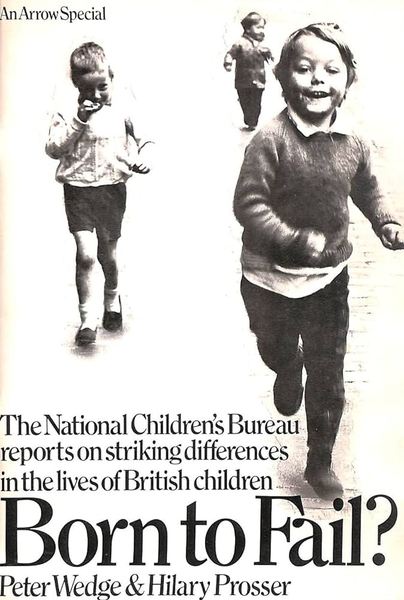
In 1969, shortly after the National Children’s Bureau was founded, it conducted a major study looking at the experiences of children from poor, disadvantaged
backgrounds. Born to Fail? revealed how growing up in these circumstances damaged children’s lives resulting in poor health, underachievement at school and lack of opportunities to fulfil their potential.
Nearly 50 years on, this report examines 12 key indicators to determine whether children in this country are still experiencing inequality and disadvantage.
It shows that far from improving over time, the situation today appears to be no better than it was nearly five decades ago.
• The number of children in poverty has increased by 1.5 million since Born to
Fail? was published.
• A child from a disadvantaged background is still far less likely do well in their GCSEs at 16.
• Children living in deprived areas are much more likely to be obese than those living in affluent areas.
• Children from disadvantaged backgrounds are more likely to suffer accidental injuries at home.
• Children living in the most deprived areas are much less likely to have access to green space and places to play.

Overall the inequality that existed 50 years ago still persists today, and in some respects has become worse. Clearly we could be doing much better.
International comparisons show that if the UK were doing as well for our children as the best industrialised nations:

• almost 1 million children in the UK would not be living in poverty
• 172 fewer children would die each year due to unintentional injury – 14 fewer deaths each month
• at least 300,000 more 15–19-year-olds would be in education and training
• 770,400 fewer children under 5 would be living in poor environmental conditions.
The fact that the poverty and inequality experienced by our children remains just as prevalent today as it did nearly 50 years ago must not be ignored. Unless a new course of action is taken there is a real risk of sleepwalking into a world
where inequality and disadvantage are so deeply entrenched that our children grow up in a state of social apartheid.

(Written in 2013)

Luckygirl3 Fri 27-Oct-23 22:36:25

Germanshepherdsmum

The government’s policy is that work should pay more than benefits - if you are able to work then you should. Do you consider that’s wrong Lucky?

The government, and your post GSM (sorry), demonstrate ta total misunderstanding about deprivation, both financial and cultural.

Of course it would be great if people were out at work and not on benefits, but the factors that keep people out of work are not to do with idleness. There will of course be a minority who just can't be arsed to work and play the system to get the maximum in benefits that they can, but they are not the norm.

The factors that cause people to be out of work are many and varied, but here are some:
- poor aspirations, caused by growing up in poverty or with generations of unemployed.
- poor education that is not being addressed - the government has based its educational policy on the public school model of many of their peers, with the result that schools are deluged with micro-management and inappropriate curricula that turn disadvantaged children off education. (and incidentally wear teachers out and diminish the value of their professional expertise).
- poor health that cannot be turned around without access to solid health services backed up by a government committed to keeping health care free and available when needed. There are many people out of work and on benefits because they have been waiting years for surgery.

The policies of this government in relation to poverty are based on a gung-ho out of touch attitude that says that people should jolly well pull up their socks and get on their bikes and get to work. It has no understanding of the lives that those brought up in disadvantaged homes so ploughs on with policies that will never work. They need to start listening to those working on the ground who know what is going on.

I saw all this first hand as a social worker - decent people trying to do their best for their families but simply never having had the life advantages of our legislators whose policies aimed at them bear no relation to life as it is lived by so many.

It is bloody tough being at the bottom of the pile and until our legislators get a grip on that fact they will continue to bark up the wrong tree.

Germanshepherdsmum Fri 27-Oct-23 22:44:30

I’m one of the pulling socks up brigade. It’s also bloody tough working to pay the benefits of those who have ‘poor aspirations’. I didn’t have the life advantages of our legislators either.

Glorianny Fri 27-Oct-23 23:08:28

Germanshepherdsmum

I’m one of the pulling socks up brigade. It’s also bloody tough working to pay the benefits of those who have ‘poor aspirations’. I didn’t have the life advantages of our legislators either.

The trouble is some children have no socks to pull up!
It used to be known as "I'm all right, Jack." The ability of some to ignore the plight of others.
I wonder why the work of a solicitor is so much harder that the low paid mother who works as a care assistant but is on minimum wage and sees costs spiraling , her rent increasing, energy costs going up and who has to choose between eating and heating and feeds her children from a food bank?

When I was growing up a lot of people had very little but most of them willingly paid to support those who had even less. It was called a social conscience. It seems that the more people have the less of a social conscience they possess.

growstuff Sat 28-Oct-23 00:07:47

Germanshepherdsmum

I’m one of the pulling socks up brigade. It’s also bloody tough working to pay the benefits of those who have ‘poor aspirations’. I didn’t have the life advantages of our legislators either.

This must be one of the smuggest posts I've seen written on GN.

ronib Sat 28-Oct-23 06:35:06

I see some good points here - so how is it that legislators have imposed policies out of kilter with so many? Legislators as enforcers of social structures/hierarchies and not enablers?
In a working democracy how are inappropriate legislators/mps not voted out? How do progressive views take hold? Given that social inequalities are not loosening in the UK, are we stuck with this model for another 50 years?
No answers just questions.

growstuff Sat 28-Oct-23 06:51:49

Oh my goodness ronib! Some big questions there! Before they can be answered, there needs to be recognition of the issues and a will to address them rather than always blaming those affected for their own situation.

ronib Sat 28-Oct-23 07:15:33

Growstuff Well the people at the bottom of the pile know what the issues are for example, poor health, poor educational outcomes, inadequate, insecure and completely unaffordable housing,
excessive energy and food prices, lack of work training and lack of good well paid employment. Probably also inherited health conditions. And more.
The blame bit lies with the way this society arranges its resources?

Joseann Sat 28-Oct-23 07:32:15

We're very good at commissioning surveys, doing research and talking about it theoretically, but little ever gets done.

HelterSkelter1 Sat 28-Oct-23 08:19:49

Back to bankers' bonuses... they often raise little tax as they are often paid directly into a pension and there they stay. No trickle down.

growstuff Sat 28-Oct-23 08:30:23

ronib

Growstuff Well the people at the bottom of the pile know what the issues are for example, poor health, poor educational outcomes, inadequate, insecure and completely unaffordable housing,
excessive energy and food prices, lack of work training and lack of good well paid employment. Probably also inherited health conditions. And more.
The blame bit lies with the way this society arranges its resources?

I'm sure those at the bottom of the pile know very well what the issues are, but do those at the top know?

Germanshepherdsmum Sat 28-Oct-23 09:00:16

I’m not smug growstuff. Despite ill health (physical and mental) I often worked 70 hour weeks (working while my child slept). That’s what’s hard about being a solicitor at the level I was Glorianny, no such thing as regular hours and ‘eating what you kill’, no work dished out by an employer. Given that I came from a working class family and that my father was blind, but worked all his life at what he could do, and that I qualified as a solicitor by studying at home in the evenings and weekends whilst working full time before I had a child, pardon me if I have no time for those with ‘poor aspirations’.

ronib Sat 28-Oct-23 09:00:43

Growstuff the top must have some tiny little inkling by now. It’s been like this for ages. I guess the problem is that the people at the bottom have no voice? The people at the top have no policies for the very poor.
Does the elite/government ignore all reports from Joseph Rowntree and similar? Is it all crying in the wind?

Joseann Sat 28-Oct-23 10:59:10

I don't totally subscribe to the pull your socks up theory, but I do understand Germanshepherdsmum's comment that effort and application are required to succeed, or to at least to move upwards. The die is not always cast from birth or childhood. Inspite of the odds, (and I never knew my father, I lived in East London in a house full of random tenants, went to a comprehensive school - all very unusual in 1960/70s), children who have had a disadvantaged upbringing can and do overcome this, and do go on to have happy, successful lives (as I did).

Callistemon21 Sat 28-Oct-23 11:07:30

Joseann

I don't totally subscribe to the pull your socks up theory, but I do understand Germanshepherdsmum's comment that effort and application are required to succeed, or to at least to move upwards. The die is not always cast from birth or childhood. Inspite of the odds, (and I never knew my father, I lived in East London in a house full of random tenants, went to a comprehensive school - all very unusual in 1960/70s), children who have had a disadvantaged upbringing can and do overcome this, and do go on to have happy, successful lives (as I did).

It helps to have a good brain and intelligence, though.

Not everyone is blessed with this and we can see from many posts on GN that the only way to succeed is to go to university and anything less is considered to be failure.
Apprenticeships and other training schemes are considered to be second best.

Some children will struggle to pass their GCSEs, not through lack of trying and many will be suffering from Long Covid at the moment too.
The 11+ was criticised, rightly, as divisive, because children were thought of as 'failures' at 11 but attitudes haven't really changed at all.

The education system still fails a lot of children.

Germanshepherdsmum Sat 28-Oct-23 11:18:07

I didn’t go to university. I got married instead.
Apprenticeship schemes are an excellent idea, by no means second best as a lot of people are not suited to academic learning.

Joseann Sat 28-Oct-23 11:30:50

we can see from many posts on GN that the only way to succeed is to go to university and anything less is considered to be failure
Well that is nonsense.