
I think this is why I prefer mixed forums ( as in men and women) as GN gets so over emotional at times.
I prefer to allow the authorities to sort out who should be living here and who shouldn’t.Other views are available.
Gransnet forums
News & politics
Meanwhile, in Scotland....
(222 Posts)We had a by-election. SNP won, Labour second, Tory third.
The new MSPs were sworn in and they used 13 different languages in their oaths.
People in Glasgow stood in the street surrounding a Home Office van trying to deport so called "illegals". And they did stop them. One man lay down under the van.
And we've been surge testing and giving vaccines to all adults in Moray, where the hotspot looks like stabilising.
Another day in paradise....?
????
Sorry, I laughed.
????
I don't think you're posturing but neither do I think lemongrove is expressing faux rage. I sometimes think people on here are arguing for the sake of it.
Meanwhile laws are laws and all countries have immigration policies.
I'd personally be more impressed if Police Scotland had done something about the large Asian gang in Glasgow who had been involved in the sexual abuse of so many local girls.
I laugh too Aleg ( frequently) at the nonsense put out at regular intervals on threads here.
An all women forum does have an air of the schoolroom about it unfortunately, either a bossy lecture or emotional and personal stuff at times.
You may feel pride that a bunch of people out celebrating in the street stopped a home office official and police from detaining two men, but you can’t expect everyone to agree with you.
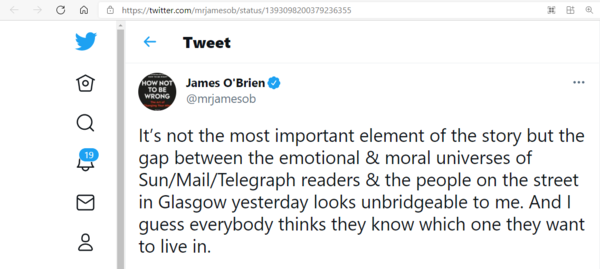
I wonder when we decided as a country that the Windrush Scandal was only a scandal if the right number of people were affected.
What we do know is that Wendy Williams report on this was never published in full and there are still criticisms from her of the lack of adequate progress in reviewing its hostile environment policies.
Check out Operation Cerrar
Aveline
I don't think you're posturing but neither do I think lemongrove is expressing faux rage. I sometimes think people on here are arguing for the sake of it.
Meanwhile laws are laws and all countries have immigration policies.
I'd personally be more impressed if Police Scotland had done something about the large Asian gang in Glasgow who had been involved in the sexual abuse of so many local girls.
Lemongrove is saying that others are showing faux outrage, not the other way round.
Women are bossy, emotional and too personal, apparently.
???? I laughed again.
It’s good to laugh, there should be more of it. Actually it’s some women Aleg 
OP I agree - the scenes were so moving!
I am a non-British person living in the UK and for those on here who have said that such things should be left to the authorities, or that bad things don't happen to immigrants in Britain, clearly have very little experience with with the British immigration system. It is an incredibly cruel, money-making machine and I'm so glad the community took a stand on this occasion.
Cruel money making machine?!!! Now I have heard it all.
Alegrias1, thanks for your post of 1231. Still laughing at it. The Lord loves a trier!
Re Moray.... I have family living in Elgin who tell me the whole thing has been blow out of proportion. Well.... that may be in their small quarter but statistics seem to be saying otherwise. Sure hope it all calms down. Again thanks for 1231. Terrific.
Herbie15 ?
Kim19 too ? I just saw that they are staying in Level 3 for another week - I hope that does the trick.
The two men have been released on bail by Police Scotland.
I'm afraid, in my ignorance, I have never heard Aamer Anwar speak before. Brilliant on PM about the clash between the Home Office and Police Scotland.
Anwar is a bit marmite but he does seem to specialise in "unfair" cases, and in getting things done.
In this instance I thought he came over very well Alegrais1.
lemongrove
Cruel money making machine?!!! Now I have heard it all.
Apparently they make 103% profit on visas...
I can't see you bothering to read this, lemon, but it's a bit of an eyeopener.
www.theguardian.com/politics/2021/may/13/cruel-paranoid-failing-priti-patel-inside-the-home-office
Some of the MSPs making statements before their oaths. Just when you think it couldn't get any better.
m.youtube.com/watch?v=1FUCaX41cOc&feature=youtu.be
Alegrias1
Some of the MSPs making statements before their oaths. Just when you think it couldn't get any better.
m.youtube.com/watch?v=1FUCaX41cOc&feature=youtu.be
Thank you for that Alegrias1. I don't want Scotland to leave the UK but while England thinks it is the UK I'm not sure what else they can do.
A bit more information coming out now about the two men
"Please note
Both men lived here for years and never claimed a penny.
They both have jobs."
So not scroungers. Indeed contributing to the UK via their work and taxes.
Sadly Granny23, if there is someone to throw (verbal) stones at, stones will be thrown.
lemongrove
So, the men were not even Muslim! I did wonder about this since most Indians are either Hindu or Christian.
Which makes all the fuss about religious festivals even more crackers.
there are ten times as many muslims in india as christians.
i believe the men in question were sikhs;
about one per cent of indians are sikh.
might be nearer two per cent, sikhs in india, but are declining.
Whatever your views on immigration surely noone can approve of a force which so misuses power sometimes with no legal backing whatsoever. Immigration Enforcement have been found to have:
Racial bias. Workplace raids are massively skewed towards certain ethnic groups; people from India, Pakistan and Bangladesh account for 75% of all those arrested.
"Low grade" intelligence. While claiming to be "intelligence led", the majority of operations are based on "low grade" tip-offs from "members of the public", classified as "uncorroborated" information from "untested sources" in the official intelligence rating system.
Entry without warrants. In the majority of raids, Immigration Enforcement teams do not in fact have court-issued warrants. A sample carried out by the Independent Chief Inspector of Borders and Immigration in December 2015 found that teams had warrants in only 43% of cases. In many other raids, Immigration Officers claimed they had "informed consent" to enter premises. But the Inspector noted numerous irregularities in Immigration Officers' understanding of "consent", and that there was no record keeping to actually demonstrate whether or how consent had been given.
Independent Chief Inspector's criticisms. An earlier 2014 report by the Independent Chief Inspector of Borders and Immigration strongly criticised Immigration Enforcement for entering premises without warrants, including doing so unlawfully, and widely abusing the system of "Assistant Directors' Letters" to enter without due legal process.
Abuse of "consensual questioning". The Independent Chief Inspector found that, contrary to legal guidance, raid teams routinely round up and interrogate everyone in a premises, whether or not they are a named suspect. They are only supposed to ask "consensual questions" of people who are not named suspects. However, according to the Inspector, “In the 184 files we sampled there was no record of anyone being ‘invited’ to answer ‘consensual questions’. The files showed that officers typically gathered everyone on the premises together, regardless of the information known or people's actions.”
Not exactly a great record of fair treatment.
I agree with you trisher; it's an appalling record. What I don't understand is why so many are happy to be associated with it. It's all incredibly sad.
Join the conversation
Registering is free, easy, and means you can join the discussion, watch threads and lots more.
Register now »Already registered? Log in with:
Gransnet »